When Winning Becomes the Setup
I've blown close to 800 prop firm accounts across Apex, Topstep, MyFunded Futures, Tradeify, and others. The worst stretches came after winning ones, not after losing ones.
The pattern repeated for years. Stretches of clean trading. Real payouts pulled. Rules tight every morning, position size capped, stops where I said they'd be, walked away at the daily limit. Did that for weeks at a time. The math was working. Then a setup would come in early, ES holding the overnight low or NQ rejecting a key level, something that lined up clean. And the voice that's gotten me back to even on every blowup said the same thing it's said every time: "I'm on a roll. I should press this." So I'd size up. The trade would go my way for a minute, then reverse. I'd hold it. I'd add. I'd move the stop. Inside a couple of sessions the week's profits were gone and a string of accounts were in violation. Same setup I'd taken clean a hundred times. Different trader sitting at the desk.
Ask me how I know this is about misplaced confidence, not greed.
What Winning Does to Your Brain
Biology drives this, not willpower.
In 2008, Cambridge researchers Coates and Herbert tracked hormones in traders on a London trading floor. Morning testosterone predicted that day's P&L, and winning streaks drove testosterone higher, which drove more confidence and bigger risk. Biologists call this the "winner effect." Winning rewires you toward the next bet.
Stanford neuroscientists Camelia Kuhnen and Brian Knutson ran fMRI scans on people making financial decisions. Activation in the nucleus accumbens, a dopamine-rich reward region, preceded risk-seeking choices and predicted risk-seeking mistakes. The neural signal fires before the conscious decision. By the time you're consciously thinking "should I press this?" your brain has already biased the answer. The dopamine surge after a win turns the volume up on that signal. Your risk filter weakens at the exact moment you should hold it tighter.
The wrong model sounds like this: "I'm trading better when I'm hot." It feels right because you're winning. But the reverse is happening. You're winning, then your brain rewards you with chemistry that degrades the decision-making that produced the wins. Same screen. Same setups. Different driver.
Earned vs. Streak Confidence
We treat all confidence the same. That's the mistake.
The math doesn't care about your streak. A profitable system over 100 trades is a profitable system. It will produce green and red sessions in some sequence. Three greens in a row don't make the next one safer. The probabilities reset at every trade. Streak confidence is your brain confusing "I won lately" with "I'm reading the market better than I was last week."
In "What Your Journal Is Actually Telling You" (Lesson 2), you sorted by execution score to find your bottom 10. Now do the inverse. Find your top 10 days by P&L, then check their execution scores. Most traders see something uncomfortable: their top P&L days don't have the highest execution scores. They got paid for taking on more risk than the plan allowed, and variance went their way. That isn't a green light. That's a warning.
The Prop Firm Amplifier
Funded account profits feel like free money. That's the illusion.
When you pull a $5,000 payout from an Apex account, your brain files it as "found money" because it didn't come out of your personal bank account. It came from a firm you've never met in person, evaluating against rules you don't fully control. The detachment makes the gain feel less real. The house money effect runs at higher volume on funded accounts than on personal capital, because the original balance was never "yours" to begin with.
That's why the press happens more violently in prop. The Drawdown Protocol exists for this exact moment. 50% of daily limit used, cut size in half. 100%, done for the day. The protocol doesn't switch off after a winning week.
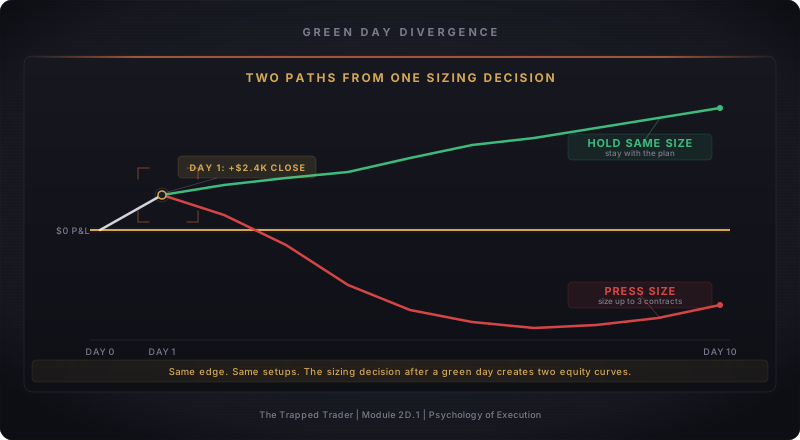
Apex 100K account. Daily loss limit: $2,500. Per-trade plan: 1 ES contract with a 4-point stop. Risk per stop-out: 4 x $50 = $200. You're up $4,200 across the week. Friday morning feels like a milestone.
Risk per stop-out: 3 x 4 x $50 = $600. One stop-out = 24% of daily limit. Two stop-outs = $1,200 = 48% of daily limit. The Drawdown Protocol's first trigger is right there. A third stop-out hits $1,800 of $2,500 used. You're now trading scared on what's left.
Risk per stop-out: $200. Three stop-outs in a row = $600 = 24% of daily limit. Still well within tolerance. You have room to wait for A+ setups instead of forcing trades to "make Friday count."
Holding size after a winning week keeps you in business. Pressing converts a great week into evaluation pressure for the rest of the month. The $4,200 you made is the same $4,200 either way. The difference is whether you keep it.
The Post-Green-Day Protocol
The fix is structural, not motivational.
Tape one rule above your screen: after any green day or green week, the next session uses the same position size, the same stops, the same rules. No reward sizing. No "I've earned it" press. Same as if yesterday hadn't happened. If your edge is real, it doesn't need a confidence boost. If your edge isn't real, sizing up just makes the drawdown worse.
We want to celebrate by risking more. That impulse is the trap activating. The celebration is staying disciplined the day after, not increasing size on the day after. Disciplined Friday after green Thursday is the trade. Pressing Friday is the blowup setup.
Key Rules
- After any green day, trade the next session at the same size, same stops, same rules. No reward sizing. No exceptions.
- Define earned confidence as 100 trades minimum. Three good days is not enough data to change your sizing plan.
- The Drawdown Protocol applies after green weeks too. Hit 50% of daily limit, cut size in half. Hit 100%, walk away. The protocol does not switch off after profits.
- Pull your top 10 P&L days from journal data and check execution scores. If top P&L beats top execution, the wins came from risk, not skill.
- When you feel "I'm reading the market right now," size DOWN 25% for that session. That feeling is reward chemistry, not edge.
- Track post-green-day execution as a metric. If average execution drops more than 1 point after green days, the trap is active in your trading.
The green-day trap activates when your brain feels safest. The next lesson covers the opposite condition: when your brain is depleted, decisions degrade, and stopping becomes the highest-skill move you can make.