Two Reviews of the Same Trade
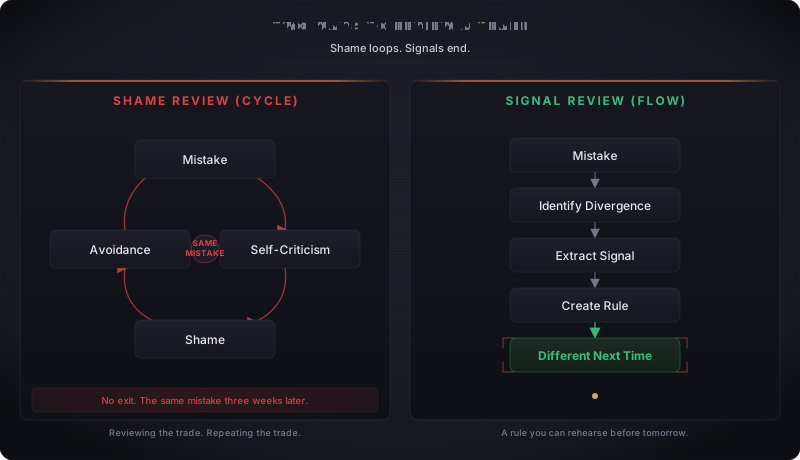
For years my post-trade reviews were variations of the same paragraph. Different dates, same content. "I'm so stupid for holding that. I knew the level was failing. I have to stop doing this." Two pages of self-flagellation, sometimes more. I'd close the journal feeling worse than when I opened it. Three days later, same setup, same mistake.
Ask me how I know. The journal entries are still there. Ten of them, weeks apart, describing the same error in slightly different language.
One Tuesday I reviewed a trade differently. The setup was the same kind I always blew up on. ES, holding past my exit signal, watching the level fail in slow motion. Instead of writing how I felt about myself, I wrote what happened.
Price tested my level mid-morning and rejected on the next bar. I saw the rejection. I held anyway because I was already in profit and didn't want to give it back. Three minutes later it stopped me out.
Then I wrote one sentence. "Next time, if price rejects my level within two minutes of entry, exit. No second chance."
That mistake stopped repeating. Not in week one. By month two, the pattern was gone.
Why Shame Doesn't Teach You
There's a body of research on shame and guilt directly applicable to trading. The two emotions look similar from outside, and we use the words interchangeably, but they produce opposite behaviors.
Shame is global. Guilt is specific. Shame says "I'm a bad trader." Guilt says "that entry violated my rule." Tangney and her colleagues at George Mason ran studies through the 2000s and 2010s and the pattern was consistent: guilt-proneness predicted behavior change, while shame-proneness predicted repeat offenses (Tangney, Stuewig, and Mashek, 2007, Annual Review of Psychology). The shamed brain wants to hide. The guilty brain wants to fix what it did.
When you write "I'm so stupid for holding that" over and over, you're activating shame. You feel worse. The brain notices, and starts protecting itself from looking at the trade too closely next time. You gloss over the bad days. You skim past the entries where the loss was real. The pattern keeps repeating because you've made yourself emotionally unable to study it.
Self-compassion research from Kristin Neff found the same effect from a different angle. Students who treated their failures with self-compassion adopted mastery goals (focused on learning); students who shamed themselves adopted performance goals (focused on looking good) and avoided situations where they might fail again (Neff, Hsieh, and Dejitterat, 2005, Self and Identity).
Most traders think the harder they're on themselves after a bad trade, the faster they'll fix it. The research says the opposite. The harder you are on yourself, the less you study the trade. The less you study it, the more it repeats. Shame triggers avoidance.
The Four-Question Signal Review
The replacement for the shame review is a structured one that extracts a signal instead of a self-judgment. Four questions, in order.
Question one is descriptive. State the plan as it was before the trade, not as you wish it had been. Question two finds the divergence moment. Question three identifies the earliest observable signal you saw or could have seen. Question four converts that signal into a behavioral rule.
The output is a sentence like the one from earlier: "If price rejects my level within two minutes of entry, exit." That's a tool. You can apply it tomorrow. You can test whether it works over the next ten trades. Compare that to "I'm so stupid for holding that." One sentence creates work for next session. The other creates shame that prevents work.
When the Review Happens Matters
There's a window where the review is useless. The window is whenever you're still hot.
Loewenstein's work on the hot-cold empathy gap (Loewenstein, 2005, Health Psychology) showed that when you're in a heated state, you systematically misjudge what you'd do in a cold state, and vice versa. A trader reviewing his blown trade five minutes after the stop-out is hot. What he writes is what hot-Jon thinks of cold-Jon's decisions, which is mostly contempt. The review is biased by the state.
Give it time. Hours, not minutes. End your session, close the platform, do something that has nothing to do with markets. When you come back to the journal, the trade is data. You can describe it the way a doctor describes symptoms: clinical, not critical.
If you're still angry when you start writing, you'll write angry sentences. Those sentences become your record. Next time you read the entry, the anger comes back. You learn nothing new.
The clinical tone isn't optional.
The Weekly Signal Extraction
Daily reviews surface signals. Weekly reviews compound them into a tool.
Every Sunday I open the past week's signal-based reviews and pull out the three best signals into a running document I call the signal list. Not every signal makes it. Some are duplicates of rules already on the list. Some are too narrow to apply outside that specific setup. The ones that make it are the ones I'll forget about by Wednesday if I don't write them somewhere I'll see them.
Over a year the signal list becomes its own trading manual. Built from your own mistakes, in your own language, calibrated to the setups you actually trade. The rules don't come from a course or a book. They come from trades you took and trades you blew, processed clinically instead of emotionally.
In "What Your Journal Is Actually Telling You" (Module 2D.1, Lesson 2) you learned how to sort journal entries to find patterns across trades. The signal list is the natural next step. The patterns are the diagnosis. The signals are the treatment.
The reviews build the signals. The signal list builds the rulebook. The rulebook builds the trader.
Key Rules
- Write every post-trade review using the four signal questions: plan, divergence, earliest signal, rule for next time.
- End every review with a single sentence stating the behavioral rule. No rule, no signal, no value.
- Wait a minimum of 2 hours after the session before writing reviews. Wait longer if you're still hot.
- Use clinical language: describe what happened, not how you feel about yourself.
- Banned vocabulary in trade reviews: "I'm so stupid," "I always do this," "I'll never learn." Those are shame statements, not signals.
- Every Sunday, pull the 3 best signals from the week's reviews into a running signal list document.
- If a review doesn't produce a usable rule, the review isn't finished. Keep working until you have one.
The next lesson, "Trading Someone Else's Signals," covers a related trap: even when your own signal list is clean, trades you take based on someone else's call activate different psychology and produce different mistakes than the trades you generate yourself.