Why Their Distribution Looks Better Than Yours
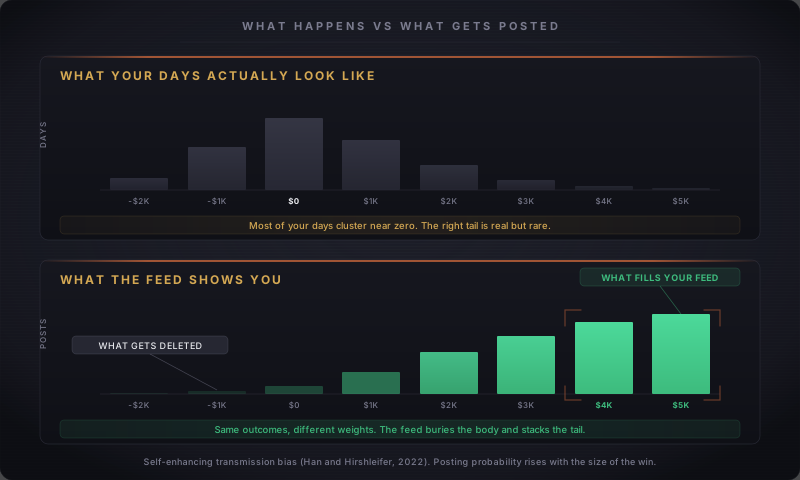
Academic finance has a name for what your feed is doing to you: self-enhancing transmission bias. Han and Hirshleifer modeled it in 2022 and found that traders broadcast their winners far more than their losers. The bigger the win, the higher the probability of posting. Their math word for it is "increasing and convex." The plain English version is harsher.
Strip the math down and the picture is obvious. The trader who blew up at 9:47 AM CT doesn't take a screenshot. The trader who caught the move does. Your timeline is a curated highlight reel of every account you follow. Losing days deleted, flat days skipped, top days posted with fire emojis.
So when you scroll fintwit, you are not comparing yourself to other traders. You are comparing your full distribution to their right tail. Two completely different samples. The math doesn't care that you know it's curated. The feeling shows up anyway.
Think of it like a casino at 8 PM. Walk in and ask people on the floor how they're doing. The guy who hit a jackpot twenty minutes ago is still there, telling everyone.
The two hundred people who left broke an hour ago are gone. Your sample is contaminated before you ever asked the question.
Fintwit is the same room, except the broke players unfollowed each other a long time ago.
How Comparison Shifts Your Baseline
Most traders treat comparison as a confidence problem. The fix, they assume, is more discipline or thicker skin. That misreads the mechanism.
The damage doesn't happen because you choose to feel inadequate. It happens because your reference point quietly migrates. Yesterday your goal was "execute the plan." Today, after an hour scrolling P&L posts, your unconscious goal has shifted to "beat the timeline." Your plan didn't change. Your benchmark did.
I've sat at my desk and watched a $200 day feel like garbage because someone I follow posted five figures an hour earlier. The session was clean. The numbers in my journal said so. The benchmark in my head was reading numbers that weren't in my journal at all. Ask me how I know.
In "Process Over P&L" (Module 1.4, Lesson 7), you learned that the only honest measure of a session is whether you followed your process. That's an internal metric. Nobody else's P&L touches it. But a feed full of external metrics doesn't get filtered out just because you know it's curated. Your brain treats them as data points whether you give it permission to or not.
This is why willpower doesn't fix it. Willpower is a tax on the next decision. The feed pre-shifts your decision before willpower gets involved. By the time you sit down to evaluate the session, the benchmark has already moved without your permission.
The Mute Protocol
You can't outdiscipline an input you keep feeding yourself. The fix is structural: change what you see.
The specific move is mute, not unfollow. Three reasons.
First, mute is reversible. You can flip it off in two taps if you decide a poster's content shifts back to useful. Unfollowing has more friction and signals a permanence you may not want yet.
Second, mute is silent. The other person doesn't know. No conversation, no awkwardness, no debate about whether their content is healthy for you. It isn't their job to manage your feed.
Third, mute is surgical. On platforms with topic-level muting, you can filter their P&L posts and keep their market analysis. Even on platforms without that, muting one account while leaving the rest of the feed alone lets you isolate the variable. You'll know in seven days whether the change moved your pre-session state.
Unfollowing gives you none of those properties. It's permanent enough to feel risky, visible enough to invite questions, and broad enough that you can't tell which input was doing the damage when the state changes.
Your Information Diet
Mute is the trigger move. The longer practice is information diet design.
You already audit your trade plan. You're going to audit your feed the same way. Measure how much time you spend on trading social media in a typical week. Then ask what each input is producing for you: learning, signal, comparison damage, or just noise.
Phone screen-time report shows 23 minutes per day on X plus trading Discord. Not journaling, not chart review, just consumption.
23 min x 7 days = 161 minutes per week, roughly 2 hours 41 minutes.
That's about one full trading session's worth of attention spent consuming other people's framed outcomes. None of it touched your plan, your charts, or your journal.
161 minutes is a usage signal, not a moral failure. The question for next week is what kind of minutes those were. Track them during the mute week and you'll have the answer.
What you keep in your feed should pass a simple test. Does this input help me execute my plan better, or does it move my benchmark?
The keep pile is specific: setup breakdowns that walk through entries and stops, structured market analysis with levels and reasoning, journal-format reviews of what worked and what didn't. The cut pile is also specific: pure P&L screenshots, equity curve posts without context, dollar-amount captions with no setup discussion. The first kind teaches a process you can transfer to your own platform. The second teaches you nothing except that someone else made a number you didn't.
Key Rules
- Mute every account that posts pure P&L screenshots without setup context for one full week. Keep accounts that post market analysis or process discussion, even if they occasionally show numbers.
- Cap your weekly trading social media consumption under 60 minutes. Audit it weekly using phone screen-time tools, not memory.
- Do not open X, Discord, or any trading feed in the 30 minutes leading into your session start. The pre-session window belongs to your plan, not theirs.
- Score every session on execution against your plan, not on whether your number beat anything you saw online. The score is yours.
- If you catch yourself thinking "everyone else is making more than me," treat it as input data. Mute one more account that day.
- Re-audit your feed every 30 days. People drift. Your needs change. Your information diet should be revised on the same cadence as your trading plan.
What's left after you clean up the inputs is the slower work: rebuilding a baseline that's actually yours, not borrowed from the feed. The next lesson, "What Recovery Actually Looks Like," walks through the unglamorous progression from blowup back to baseline that nobody screenshots, and it leans on the same baseline-protection thinking this lesson taught.