When the Best Trader Leaves the Desk
The version of you that sits down at 9:00 AM with coffee, a plan, and a fresh notebook is not the same version that's still clicking at 2:30 PM. Cognitive depletion is a measurable drop in decision quality across a session. It shows up in every profession where people make sequential judgment calls.
Researchers tracked antibiotic prescribing rates across 21,000 primary care visits and found doctors prescribed inappropriate antibiotics about 4 percentage points more often in the fourth hour of a clinic session than in the first (Linder et al., 2014, JAMA Internal Medicine). Same doctors. Same training. Same patients walking in with similar complaints. The only thing that changed was how many decisions they'd already made that day.
Parole judges show the same pattern. A study of 1,100 rulings found favorable parole decisions dropped from roughly 65% at the start of a session to near zero by the end, then jumped back up after the judge took a break (Danziger et al., 2011, PNAS). The judges didn't know it was happening. They were certain they were treating each case on its merits.
You're not a special exception. Decision quality drops with decision volume, and trading is a decision-volume job. Every setup you scan, every entry you evaluate, every exit you debate draws from the same pool. By the time the afternoon trade reaches your screen, the trader looking at it isn't the one who took the morning's clean entries. Ask me how I know.
The Sentence That Costs You
There's one sentence that turns a profitable morning into a flat afternoon. It always sounds reasonable in the moment.
"The market is still open, I should keep trading."
That sentence is the trap. It treats open hours as an obligation rather than an option. ES trades nearly 23 hours a day. You don't trade 23 hours. The market doesn't owe you participation, and your account doesn't owe the market its remaining capacity for the session.
The wrong mental model sounds like this: "I trade well in the morning, so I can trade in the afternoon too. Why would I leave money on the table?" It feels right because you ARE the same person, with the same skills, looking at the same charts. The setups even look similar. But the brain processing those setups has already made several hundred micro-decisions, and the next one comes out of an emptier tank.
What actually happens is that decision quality decays continuously. The morning trades feel sharp because they are. By early afternoon, you're approving entries the morning version of you would have skipped. The wider stop slips through. The "I'll wait for confirmation" rule gets compressed. The position size sneaks up. You don't notice because nothing dramatic changes. The math notices.
Reading Your Personal Curve
Cognitive depletion shows up in your own journal data as a plottable curve. The point where that curve drops below acceptable is your hard stop time, and it's a number, not a vibe.
The method is straightforward: split your trading session into 1-hour blocks. For each block, log every trade with its execution score, the same 1-10 metric from 'Process Over P&L' (Module 1.4, Lesson 7). Over 10 to 20 sessions, you'll have enough trades per block to average. The block where your average score first drops below 7 is your depletion threshold. That hour is your hard stop time, starting tomorrow.
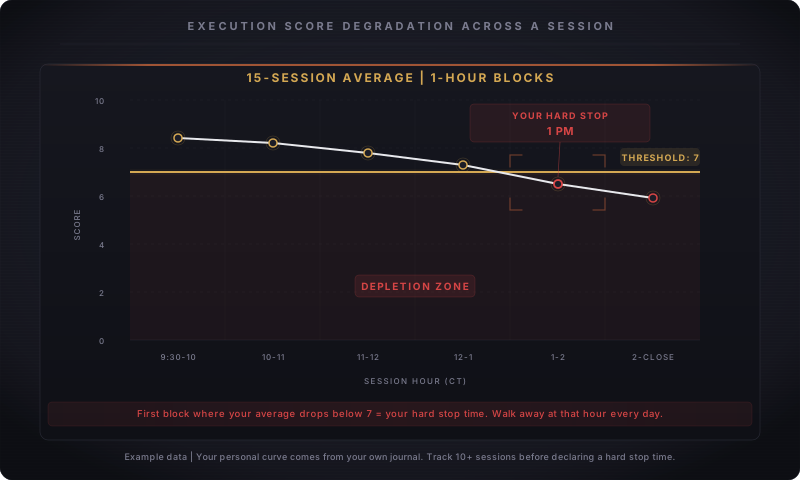
The curve isn't the same for every trader. Some bottom out at 11 AM because they front-load their session with too many setups. Some hold steady through lunch and crash hard at 2 PM. Some can go to the close on quiet days and depletion-fail on choppy ones. Yours is yours. The data shows it.
Six blocks: 9:30-10, 10-11, 11-12, 12-1, 1-2, 2-close. Log every trade in the block where you entered.
After 15 sessions, the block-by-block trade counts look like: 9:30-10 (22 trades), 10-11 (28 trades), 11-12 (19 trades), 12-1 (15 trades), 1-2 (18 trades), 2-close (12 trades). Total: 114 trades, plenty per block.
9:30-10 average = 8.4. 10-11 average = 8.2. 11-12 average = 7.8. 12-1 average = 7.3. 1-2 average = 6.5. 2-close average = 5.9.
12-1 is still at 7.3, just above the line. 1-2 drops to 6.5. Your hard stop time is 1 PM.
Starting tomorrow, you stop trading at 1 PM. Not "around 1." Not "unless something good shows up." 1 PM. Every day for the next 10 sessions, then re-evaluate the data. If your post-1 PM trades on those next 10 sessions show better scores, the threshold may have shifted. If they don't, the threshold was correct and you just bought back the afternoon losses.
The number is data, but the discipline is choice. The trader who hits 1 PM and walks away is the same trader who made the morning's good decisions. The trader who pushes through is the depleted one. Both live in your seat.
The Drawdown Protocol Is a Depletion Detector
In 'Maximum Loss Rules' (Module 1.3, Lesson 6), we covered The Drawdown Protocol: hit 50% of your daily risk limit, cut size in half. Hit 100%, you're done for the day. Close the platform, walk away. We treat it as a capital protection rule, which it is. It's also a cognitive depletion detector, which is the angle the rule doesn't get credit for.
By the time you've burned half your daily risk limit, your execution scores have already dropped. The losses are the output of a depleted brain making compounding decisions, not random bad luck. The 50% trigger gives you a circuit breaker before the damage spreads. The 100% trigger is the override: at that point, your brain is telling you it's done, and your job is to listen.
The hard stop time and the Drawdown Protocol work together. Hard stop is a time-based rule, derived from your hourly data. The Drawdown Protocol is an outcome-based rule, triggered by P&L. Whichever one fires first ends your session. We want both, because depletion shows up in two ways: gradually across hours, and acutely during a bad sequence. One rule catches the slow drift. The other catches the fast spiral.
Screen time itself depletes. Every chart you scan and every setup you evaluate burns from the same pool, even the trades you don't take. Watching without trading is lighter on the budget than trading is, but it's not free. If your hard stop is 1 PM, walking away from the screen at 1 PM does more for tomorrow's decisions than staying to watch "in case something forms."
Key Rules
- Stop trading at your data-derived hard stop time every day. Not "around" it. Not "unless a good setup shows up." At it. The whole point is that the depleted trader can't tell a good setup from a marginal one.
- Track execution scores in 1-hour time blocks for 10+ sessions before declaring a hard stop time. Fewer than 3 trades per block is insufficient data. Keep collecting.
- When your block average drops below 7, that's your line. No hedging. No 6.8 doesn't count. Below 7 is depletion territory.
- Close the platform when you stop, not "in 10 minutes." Watching depletes you. If you wouldn't trade, you shouldn't watch.
- Hit 50% of daily risk limit before your hard stop time? Cut size in half AND move your hard stop 30 minutes earlier. Both tools fire, both responses apply.
- Hit 100% of daily risk limit at any time? Done. Walk away. The Drawdown Protocol overrides the hard stop. 100% means your brain is already past the line.
- Re-evaluate your hard stop time every 30 sessions. Your curve isn't fixed. Sleep, stress, life events shift it. Pull the data, recalculate, adjust.
The afternoon you give back wasn't lost to a bad setup. It was lost to a depleted trader who couldn't tell a setup from a feeling. The next lesson covers the discipline of doing nothing, because once you know when to stop trading, the harder skill is sitting at the screen without acting on every chart that moves.