The Setups That Played Out Without You
The data was unambiguous. Every setup I skipped during those sessions played out like the textbook says. Bull flags broke flag-high and ran. Failed-auction reversals failed and reversed. I had the plan, I had the levels, I had the bias. I sat there and did nothing.
The journal was where the lie lived. Entry after entry said some version of the same thing: "waited for confirmation," "choppy tape," "wanted a better entry." Reading them back, the entries looked reasonable. Then I overlaid the skipped setups on the chart and watched the runner candles. The "choppy tape" was a 4-point trend day. The "needed confirmation" came on the bar after my entry trigger, which is the definition of a chase.
The real reason for every skip was the same. I had banked a green week and was terrified of giving it back. My nervous system locked up, the mouse stayed motionless, and my mind generated whatever language the journal needed to feel okay about it.
That's the trap. Your mind generates a different sentence than the true one. It says "I'm being selective today" instead of "I'm avoiding because I'm scared." Those two sentences feel exactly the same in the head. They produce different outcomes in your account.
Patience and Paralysis Are Twins
Patience and paralysis sit in identical postures. Both involve watching price move without you. Both come with internal narration that says some version of "wait" or "not yet." From the outside, both look like a trader doing the right thing. From the inside, they feel the same.
The thoughts can't tell you which one you're in. The body can. So can the source of the reason.
Think of it like the difference between a planned rest day from the gym and skipping the gym because you don't feel like going. Same outcome on paper. No workout. Opposite states. The planned rest is on the calendar Monday morning and produces recovery. The skip is invented at 5pm when the gym bag is staring at you, and it produces dread that compounds the next day. The empty locker looks identical either way. The difference lives in when you made the decision.
The Body Knows Before the Mind Does
The body produces evidence in real time. The mind builds the story after the fact. If you only ask your mind why you skipped, you get a story. If you ask your body first, you get the truth.
There are two states to scan for. Relaxed watching looks like this: shoulders down, breath normal, hands loose on the desk, narration quiet, no urgency in the chest. Tense watching looks like this: shoulders up near the ears, breath shallow or held, jaw set, hand frozen on the mouse, narration accelerating, a tight feeling in the upper chest.
You don't have to choose your reaction. The body has already chosen for you. Your only job is to look.
In "Fear: The Trade You Never Took" (Module 1.4, Lesson 3) you learned to treat fear as information about your nervous system, not a verdict on the chart. The skip log applies that idea directly. When the body is tense and the plan says go, the fear is data, not a stop sign.
When the body is relaxed and the setup isn't in your plan, that's actual patience. When the body is tense and the setup is in your plan, you're in the mirage. The setup matches; only the body is voting no. That's fear masquerading as selectivity.
The body-scan takes three seconds. I never saw it in a trading book, and I didn't think to do it for years. From now on, before you decide why you're skipping a setup, scan first.
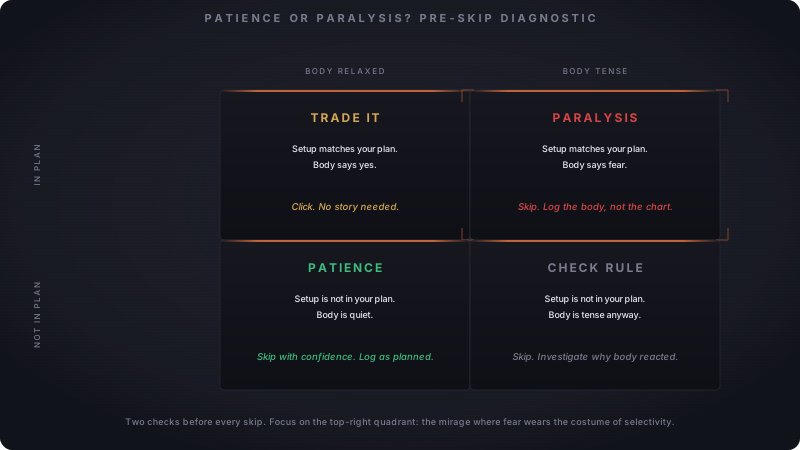
The Plan-Match Test
The second diagnostic is structural. Did the reason you're skipping this trade exist BEFORE the chart resolved?
A pre-planned skip is one your rulebook already named. "No trades in the first 15 minutes." "No reversal entries against a trending day." "No new entries after I've hit one R." Those are real selectivity. The decision was made when your nervous system was quiet. The chart appearing doesn't change the rule.
A rationalized skip is one whose reason appeared only after you looked at the chart. "Felt choppy." "Wanted confirmation." "Didn't like the volume." Those phrases get invented in the moment to explain a body reaction you don't want to acknowledge. They sound strategic. They are not.
In "Building a Pre-Trade Routine" (Module 1.4, Lesson 9), the Pre-Execution Protocol trained you to check size, stop, and bias before pulling the trigger. The plan-match test is the inverse: a pre-skip protocol. Check body, then check plan, before you let yourself off the hook for sitting out a clean setup.
Building Tolerance for Doing Nothing
Patience is a skill, not a personality trait. You build it by sitting through valid setups without trading and surviving the feeling. Reading about it won't move the needle. Reps will.
The deliberate practice is the skip log. Each session, write down every setup you skip and the reason. Do this BEFORE the chart resolves. The discipline is in writing before you know whether the setup would have worked.
Once the chart resolves, your brain will edit the reason to match the outcome. We can't trust ourselves at that point. We've been there too many times.
After 5 sessions of skip logging, calculate your genuine-selectivity ratio.
You wrote down 12 skipped setups in your skip log.
Reviewing the entries, three of them ("first 15 minutes," "first 15 minutes," "opposite-trend pullback") match rules you wrote BEFORE the session.
3 / 12 = 0.25
A genuine-selectivity ratio of 0.25 means three out of four skips were invented after seeing the chart. My working target is above 0.7. The gap between 0.25 and 0.7 is where avoidance is hiding.
Key Rules
- Run a 3-second body scan before deciding why you're skipping a setup: shoulders, breath, jaw.
- Write the skip reason in your journal BEFORE the chart resolves, not after.
- If the reason wasn't in your pre-session plan or written rulebook, classify the skip as RATIONALIZED.
- Track your genuine-selectivity ratio across 5 sessions: pre-planned skips divided by total skips.
- Aim for a ratio above 0.7. Below 0.5 means avoidance is masking as discipline.
- When you skip a valid setup in your plan, log the body signal you observed, not just the price action.
- Treat doing nothing through a clean setup as a skill you build with reps, not a virtue you possess.
The skip log will start surfacing patterns within the first three sessions. Some of those patterns are going to be unflattering. The next lesson, "The Post-Trade Review That Doesn't Destroy You," covers how to face that data without using it as a weapon against yourself.