Why Your Brain Hates Small Trading Wins
There's a reason why a post about a 0.97% gain gets flooded with comments from traders saying "this is the way" while those same traders are secretly disappointed when they close a trade for only 1%.
We're wired for it.
Our brains evolved to seek big rewards. Finding a fruit tree with enough food for a week was way more valuable than finding a handful of berries. The problem? The market isn't a prehistoric forest, and treating it like one will drain your account faster than you can say "just one more trade."
Trading psychology, greed in particular, has nothing to do with being a bad person or lacking discipline. Your brain is doing exactly what it was designed to do in an environment where those instincts work against you.
When you close a trade for a small profit, your brain doesn't release much dopamine. It's underwhelming. Boring, even. But when you imagine that same trade running for 5%, 10%, or more? Now we're talking. Your brain lights up like a Christmas tree.
The cruel irony is that the emotional high you get from imagining the big win is often bigger than the high you'd get from actually achieving the small win in front of you. So you hold. You wait. And you watch your actual profit disappear while chasing the fantasy.
I've done this hundreds of times. You probably have too. You hit your target, but it feels too small. Too easy. Surely the market has more to give, right?
Wrong.
That feeling of "this isn't enough" is the greed trap talking. Whether it's waiting for the perfect entry or holding for the perfect exit, the trap is the same. Understanding how candlestick patterns signal when momentum is shifting can help you take profit when the chart says to, instead of when your ego wants to. And every time you listen to it, you're training your brain that disciplined trading doesn't feel good enough. You're literally rewiring yourself to fail.
The Math That Changes Everything About Consistent Trading Profits
Let me show you something that changed how I think about trading forever.
A trader who makes 1% per day on a $10,000 account, counting only weekdays when the market is open and compounding those gains, would have over $110,000 at the end of one year.
One percent per day. That's it. That's the "boring" gain that feels like it's barely worth the effort.
Now, I'm not saying you'll trade every single day or that you'll never have losses. Real trading doesn't work that way. The point is that small gains trading isn't small at all when you zoom out. Consistency compounds in ways that home runs never will.
Most traders never see this because they're too busy trying to hit 10% in a single trade. They'll risk their whole week trying to make it happen, give back their gains when it doesn't work out, and end the month break-even or worse.
I used to track my trades in a spreadsheet, and honestly, it was too easy to ignore the patterns. I'd remember my winners and conveniently forget about the times I gave back profits chasing more. When I finally started using proper trade journaling and tracking tools, seeing my actual statistics was brutal. I couldn't hide from the truth anymore.
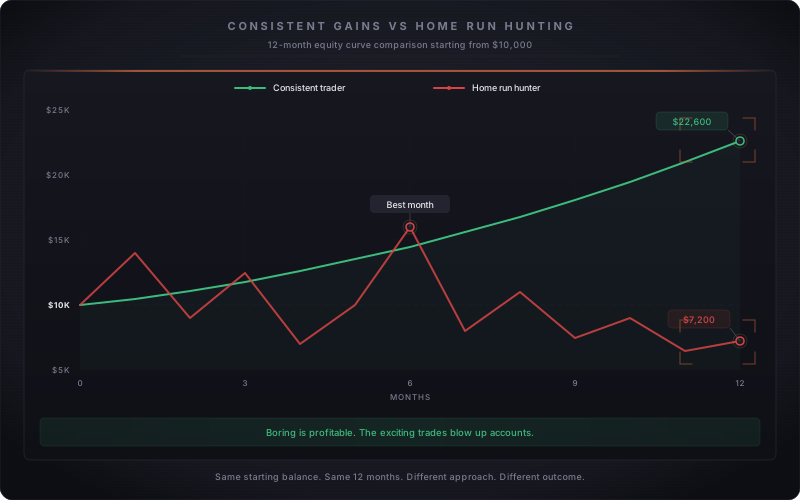
My biggest wins weren't my most profitable trades. My most profitable trades were the ones where I followed my plan, took my small gain, and moved on. The home runs I was chasing? They showed up maybe 5% of the time. And the other 95% of the time I spent trying to manufacture them cost me way more than those rare wins ever made me.
The math is simple: consistent beats spectacular. Every single time.
But knowing the math and actually feeling okay about taking small profits are two very different things.
Breaking Free From Revenge Trading and Unrealistic Expectations
This is where the greed trap gets really nasty. It doesn't just make you hold winners too long. It creates a cycle that's almost impossible to break without serious self-awareness.
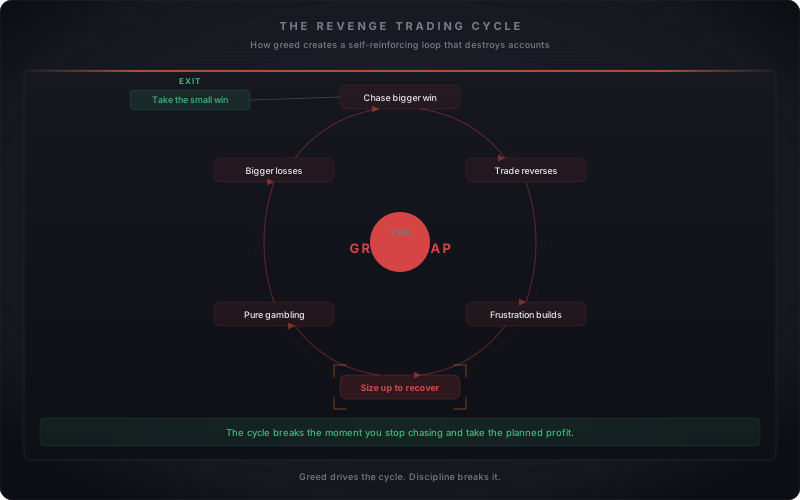
You chase a bigger win. The trade reverses. Now you're frustrated because you had a profit and let it slip away. That frustration turns into determination to "make it back." So you take another trade, probably one that doesn't match your setup, with position sizes your risk rules would never allow, because you need to recover what you just lost.
Every time you hold a winner too long and watch it reverse, you become a trapped trader on the chart, stuck on the wrong side with no good exit. This is the revenge trading cure nobody wants to hear... you have to feel the pain of your mistakes without trying to immediately fix them.
I know that sounds harsh, but stay with me.
Every time you try to make back a loss right away, you're teaching your brain that the solution to emotional trading is more trading. You're reinforcing the exact pattern you're trying to break. If you want to execute trades like a machine, you have to stop letting emotions drive the process. The cycle continues: greed leads to losses, losses lead to revenge trading, revenge trading leads to bigger losses, and bigger losses make you even more desperate for a home run to fix everything.
The way out? Accept that today's loss stays a loss. Tomorrow is a new day with new opportunities, and the only way to get there with your account intact is to stop trying to force the market to give you what you want right now.
When I finally broke my revenge trading pattern, it wasn't because I found some magic strategy or indicator. It was because I built a hard rule that eventually became The Drawdown Protocol: hit 50% of your daily risk limit, cut your size in half. Hit 100%, you're done for the day. Platform closed, walk away. And I added one more layer: if I felt emotional about any trade's outcome, win or loss, I was done too. No exceptions.
At first, this meant a lot of really short trading days. I'd take one trade, feel disappointed about the small gain or frustrated about a loss, and have to walk away. It felt like I was missing opportunities. But here's what actually happened: I stopped giving back my gains. My consistency improved. And slowly, my expectations started to shift.
That's a complete shift from the trash you see on social media. But the proof is in the equity curve.
Small gains stopped feeling disappointing because I wasn't comparing them to fantasy scenarios anymore. I was comparing them to my actual results. And my actual results were finally trending in the right direction.
Rewiring Your Brain for Realistic Trading Expectations
The real work of escaping the greed trap has nothing to do with your strategy. You have to change what feels rewarding to your brain. This is why trading mindset matters more than any indicator or setup.
Right now, if you're like most traders, closing a trade at your target feels slightly disappointing. It feels like you're leaving money on the table. That feeling is the problem, and you can change it.
This is how I rewired my own expectations, and how you can too.
First, start celebrating process over outcome.
I know this sounds like generic self-help advice, but hear me out. When you close a trade at your target, that's a win. Not because of the percentage gain, but because you did what you said you'd do. You followed your plan. You acted like a professional trader instead of a gambler.
In my trading journal, I literally started marking trades as "process wins" even when the dollar amount was small. Over time, getting those process wins became what felt good. The dopamine hit came from discipline, not from profit size. Our lesson on redefining what winning actually means walks through the exact scoring system that makes this shift concrete.
Second, make your small gains visible.
This is where proper tracking tools become genuinely useful, not just for record-keeping but as a psychological tool. When you can see your consistency rate, your average win rate, and your equity curve smoothing out, those small gains stop feeling small. They become data points in a bigger picture of profitability. It's one of the reasons I'm building UpSkalr: to give traders the visibility they need to trust the process instead of chasing feelings.
I have a screenshot of my equity curve from my first three months of truly consistent trading. It's not dramatic. There are no massive spikes. It just trends steadily upward. I look at that image whenever I'm tempted to chase more than my plan allows. That boring, steady line represents more profit than I ever made when I was hunting home runs.
Third, stop treating green trades like they owe you more.
When you close a winner and your first thought is "that should have been bigger," you've already lost the next trade. Your brain just filed the win as a disappointment. Do that enough times and you'll start holding every winner too long, hoping for more, giving back profits you already earned.
Flip it. You saw a setup, you executed, you got paid. That's the whole job. The market doesn't owe you a follow-through. It doesn't care that you need a bigger day to hit your weekly target. When you start treating every profitable exit as your plan working exactly as designed, the urge to hold for more loses its grip.
Finally, set targets based on your actual edge, not your financial needs.
This is huge. So many traders decide they need to make X dollars per day or per week, and then they force trades to try to hit that number. Your edge doesn't care what you need. It produces what it produces.
When you align your expectations with your edge's actual performance, trading becomes so much easier. You stop trying to squeeze more out of setups than they can give. You take what's there and move on. And paradoxically, that's when you start making more money. If you want a structured approach to building these habits from the ground up, the Foundations course covers everything from chart reading to execution discipline.
The Compound Effect of Consistency
What actually happens when a trader commits to small gains and walks away.
The first month feels brutal. You're watching charts after you've closed your positions, seeing moves you "left on the table." You end the month up maybe 5-7% and it feels like nothing compared to the 30% month you had once (before giving it all back the following week).
But month two, something shifts. You're compounding on a higher base. You're not digging out of drawdown holes. Your equity curve, for the first time, actually looks like a staircase going up instead of a heart monitor.
Six months in, whether you're trading ES, NQ, or the micro contracts that make smaller accounts viable, the math starts doing the heavy lifting. That boring 1-2% per week is building on itself. And you haven't given any of it back because you stopped chasing the big move that wasn't there.
This is what consistent trading profits actually look like. Not exciting. Not dramatic. Just relentlessly effective.
The traders who make it aren't the ones chasing 50% months. They're the ones who stack small weeks until they look up six months later and realize their account has quietly transformed.
That's how wealth gets built. Not with one big score, but with hundreds of small ones.
Stop Chasing, Start Stacking
The market will always be here tomorrow. The question is whether you'll still have an account to trade with. Small consistent gains aren't sexy, but they're the difference between making it and blowing up.
If you're tired of the cycle of chasing big wins, giving back profits, and revenge trading your way into bigger losses, the fix comes down to one thing: your rules. Follow The Drawdown Protocol, take the planned profit, and walk away. Stack enough of those days together and the compounding handles the rest.
That's what The Trapped Trader is about: building the discipline to take the small win every single day until it becomes automatic. And if you want tools built around that philosophy, check out UpSkalr for trading discipline and consistency tracking.
Take the small win. Close the trade. Do it again tomorrow.
That's how you beat the greed trap. That's how you win.