The Scoreboard Problem
Most traders check one number at the end of the day: P&L. Green means good. Red means bad. That scoring system is broken because it conflates decision quality with outcome quality. You can make a terrible decision and profit because the market bailed you out. Over hundreds of trades, this trains you to repeat mistakes that got lucky and abandon processes that were working.
Throughout 2025, I lost count of the times I refused to take profit because I was convinced there was more. Sometimes price kept running and I felt like a genius. That feeling trained me to hold every winner past my plan. Then price reversed, I tilted, added to the now-losing position, and blew the account. Over and over. The profitable holds rewarded the habit. The P&L said "good trader" right up until it didn't.
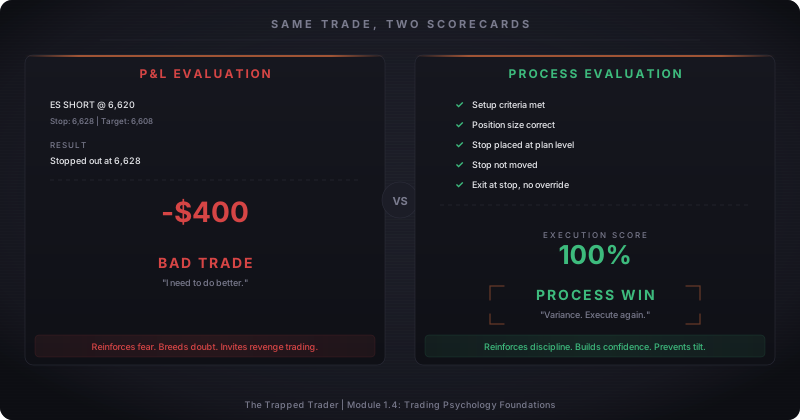
Outcome Bias: Why Profitable Mistakes Feel Like Wins
Poker players call this resulting. You go all-in with pocket aces. Your opponent calls with 7-2 offsuit. The board runs three sevens. Bad decision? No. Best possible decision, unlucky outcome. Flip it: you shove with 7-2, the board runs three sevens, you win. Your chip stack says good decision. Every experienced player says absolutely not.
Your brain's reward system doesn't distinguish between skill and luck. Dopamine fires when the account goes green, and that reward attaches to whatever you did before the profit appeared. You could've entered without a setup and oversized the position. If the market moved in your favor, outcome bias stamps that as "smart trading."
The Process-Outcome Matrix
Separate decision quality from outcome quality, and every trade falls into one of four categories.
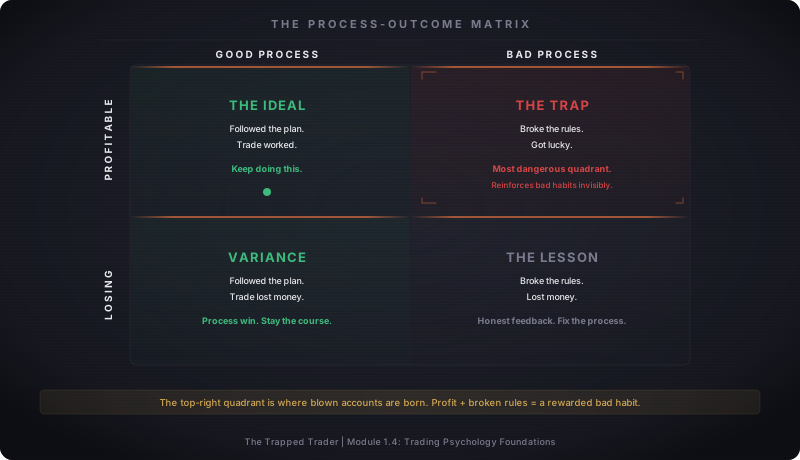
Good process, profitable outcome. You followed your plan and the trade worked. This is the ideal. Keep doing exactly what you did.
Good process, losing outcome. You followed your plan and the trade lost money. Still a process win. The market moved against you. That's variance, not failure. Nothing needs to change.
Bad process, losing outcome. You broke your rules and lost money. This is a clear process loss and the easiest to diagnose. The loss stings, but at least it's honest feedback. Fix the specific rule violation and move on.
Bad process, profitable outcome. You broke your rules and made money. This quadrant does more damage than any other. You just reinforced a rule violation with a reward. Next time, your brain will whisper, "It worked last time." Blown accounts start here.
Building Your Execution Score
Process thinking only works with a concrete way to measure it.
Start with five criteria. For each trade, answer yes or no:
- Did I wait for my setup before entering?
- Was my position size correct per my risk rules?
- Did I place my stop where my plan specified?
- Did I leave my stop alone (no moving it to avoid a loss)?
- Did I exit at my target or stop, with no emotional override?
These five questions give you a framework. For your journal, translate them into a single execution quality score from 1 to 10. A trade that hits all five is a 9 or 10. A trade that misses one is a 7. A trade where you moved your stop, oversized, and chased the entry is a 3. Your plan adherence rate is the percentage of trades scoring 7 or above.
Execution quality measures whether you followed your plan. It doesn't measure whether your plan was right. A perfectly executed trade with a weak thesis is a process win with a strategic gap. Your journal captures both: the execution score tells you how disciplined you were, and the trade thesis tells you how sound your reasoning was. Both matter for the weekly review.
Execution score: 9 (Process Win)
Execution score: 4 (Process Loss)
Execution score: 10 (Process Win)
Execution score: 7 (Process Win)
Execution score: 9 (Process Win)
Weekly plan adherence rate: 4 out of 5 trades scored 7 or above = 80% plan adherence. The P&L for this week was -$180. Without the execution score, this looks like a bad week. With it, you can see that you executed well on 4 out of 5 trades and the negative P&L is likely variance. Tuesday is the only trade that needs a closer look.
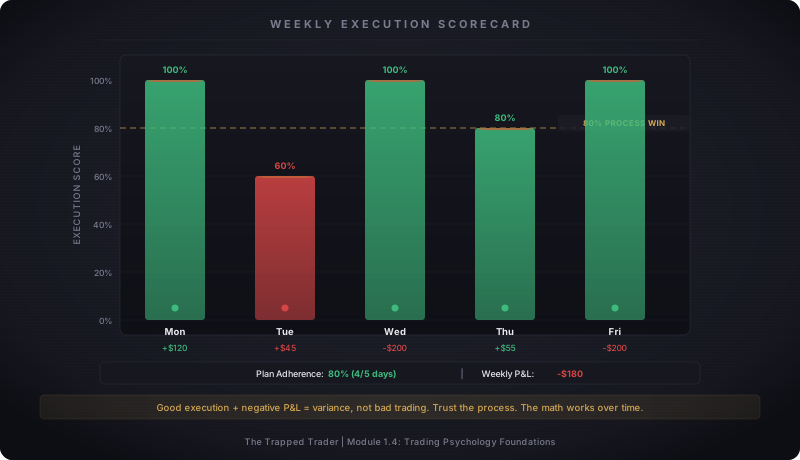
A P&L number tells you what happened. An execution score tells you what to fix. Tuesday's trade failed because you entered early and moved your stop. Those are specific, correctable behaviors.
When the Score Says Stay the Course
Process measurement changes how you experience losing streaks. When you're measuring by P&L, every red trade amplifies fear (Lesson 3), feeds greed (Lesson 4), and eventually ignites revenge trading (Lesson 6).
Switch to process scoring, and a losing streak with high execution scores tells you: you're doing the right things and the results haven't caught up yet. If your execution scores are dropping during a streak, the losses are pulling you off process. Reduce size or invoke your shutdown rules. Process scoring catches the slide before the math turns brutal.
Key Rules
- Score every trade 1-10 on execution quality before looking at P&L. Process first. Always.
- Any trade scoring 7 or above is a Process Win, regardless of the dollar result.
- A profitable trade that broke 2+ rules is a Process Loss. Treat it like a warning, not a win.
- Track your weekly plan adherence rate. Below 70% means your process is eroding.
- During a losing streak, check execution scores first. High scores with negative P&L means variance. Low scores means you're drifting.
- Execution quality and thesis quality are separate. A high execution score with a weak thesis means your discipline is fine but your market read needs work.
- Never change your strategy after fewer than 20 trades executed at 7+ execution quality.
Now that you have a framework for evaluating trades by process instead of outcome, the next lesson introduces the tool that makes this measurement permanent: your trading journal.