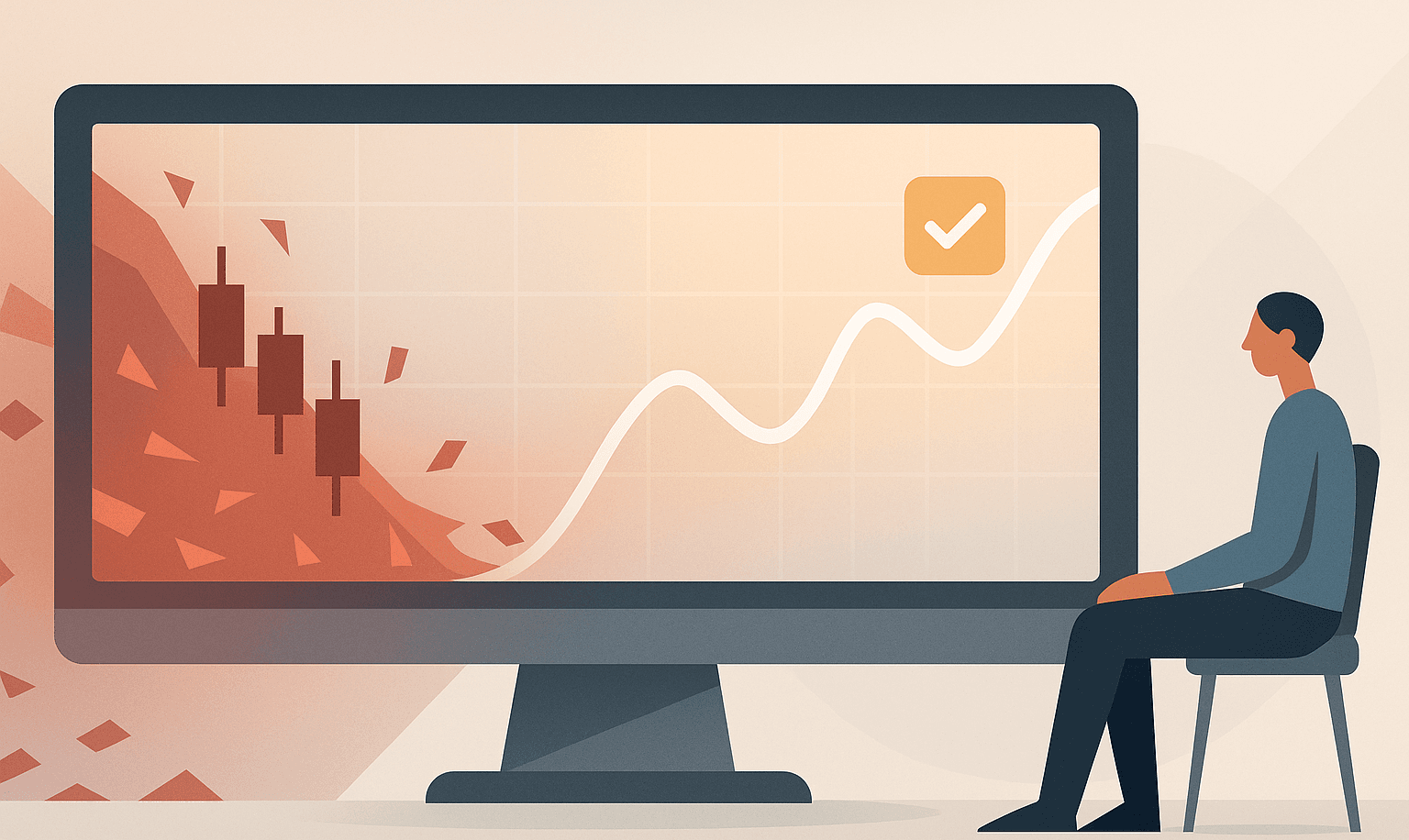
The Perfectionism Paradox: Why "One More Confirmation" Never Comes
The hard truth I had to learn after missing countless winning trades: there is no perfect entry. Not in the way your anxious brain wants there to be.
I remember a Thursday morning last fall, trading NQ. I had marked the perfect support level with multiple confluences: previous day's close, a Fibonacci level, a volume shelf, and the edge of prior day value area. If you want to understand how these support and resistance zones actually form, that context matters here. The market tapped it perfectly. My setup was screaming at me to go long.
But I hesitated. "What if it's a fakeout?" I thought. "Let me see one more bullish candle." That candle came, and I thought, "Okay, but what if that's just a dead cat bounce? Let me wait for the next one." By the time I had my "confirmation," the market had rallied 100 points. That's $2,000 on a single contract I left on the table, and I was stuck watching my analysis play out perfectly without me.
This is trading perfectionism at its worst. It disguises itself as discipline, as being "patient," as waiting for "high-quality setups."
But really? It's just fear finding reasons to keep you out of trades.
The execution trap works like this: your fear of being wrong creates an impossible standard for entry. Since that standard can never truly be met (because the future is uncertain), you're perpetually stuck in analysis paralysis. You're not waiting for the perfect setup, you're waiting for certainty that doesn't exist in trading.
Understanding Execution Anxiety: The Real Cost of Hesitation
Trading hesitation isn't just about missed profits. The psychological damage runs much deeper.
Every time you identify a good setup and fail to execute, you're training your brain in the wrong direction. You're reinforcing the neural pathway that says, "When I see my setup, I freeze." You're literally practicing failure.
And like any skill you practice repeatedly, you get better at it.
I've reviewed hundreds of trades in my journal, and the pattern is consistent: when I struggle with execution anxiety I often have better win rates on my actual trades than I remembered. The real damage shows up in selectivity: I only execute when the setup is SO obvious that everyone else has already entered, leaving me with terrible risk-reward ratios.
Meanwhile, my best setups - the ones that required courage to take - sit in my watchlist or journal as painful "missed opportunity" entries.
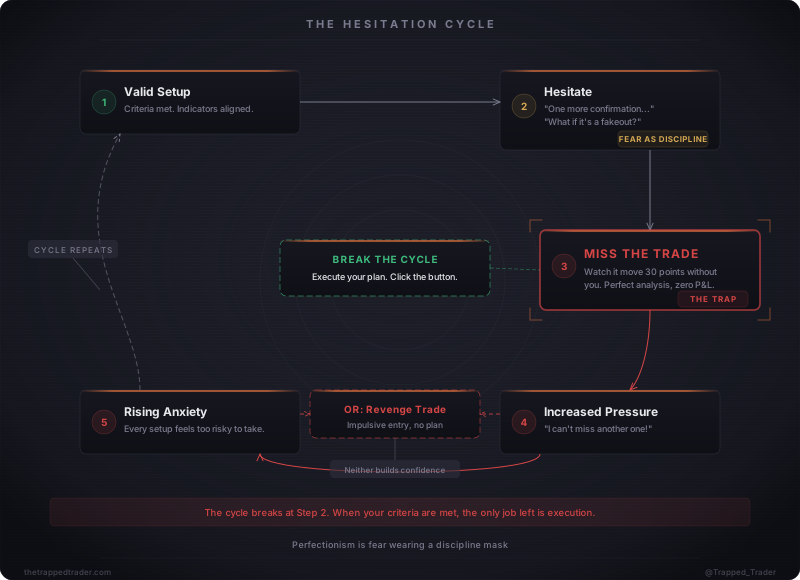
The fear of entry creates a vicious cycle:
- You hesitate and miss a winner
- This increases pressure on the next setup ("I can't miss another one!")
- Increased pressure makes you more anxious
- More anxiety leads to either continued hesitation or impulsive revenge trading
- Neither outcome builds confidence
- The cycle continues
A trader friend of mine said it this way:
"It's like I'm standing at the edge of a pool, and I know how to swim, but I just can't make myself jump in. And then I watch everyone else swimming around having fun, and I feel like an idiot standing there dry."
The Discipline vs. Decisiveness Balance: Where Patience Becomes Paralysis
Now, before you think I'm advocating for reckless trading, let me be clear: patience is a virtue in trading. Waiting for your setup is crucial. Avoiding FOMO trades is essential.
The execution trap has nothing to do with abandoning discipline. The question is whether your "discipline" has quietly morphed into decision-making paralysis. The telltale sign? Your criteria are met, but you're inventing new ones on the fly. You feel regret immediately after staying out. You have a different excuse each time for why you didn't enter.
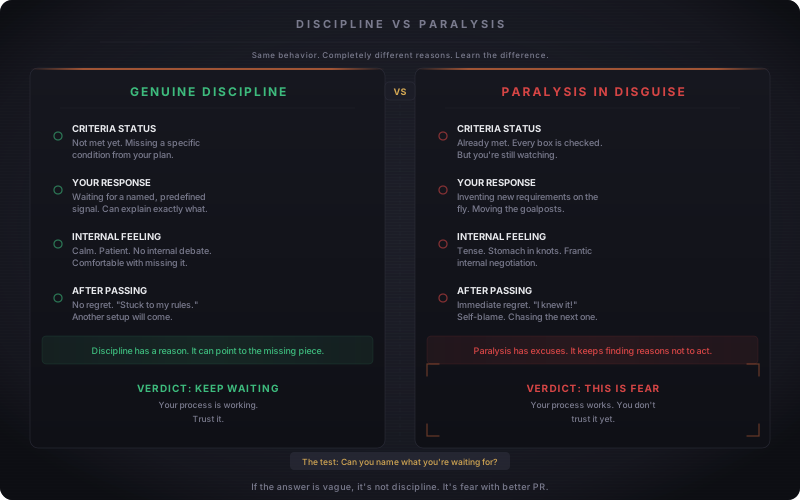
I had to get brutally honest with myself about this. I started tracking not just my trades, but my non-trades, the setups I identified but didn't take. Using a structured journal (UpSkalr includes trade tracking tools built for exactly this), I could actually see the pattern. I was cherry-picking reasons to stay out of trades that matched my criteria. My "discipline" was actually just fear with better PR.
The breakthrough came when I realized that decision-making in trading isn't about achieving certainty, it's about being comfortable with probability. Your edge plays out over many trades, not any single one. But that statistical advantage only exists if you actually execute.
Practical Strategies to Escape the Execution Trap
Okay, enough diagnosis. Time for the cure.
Here are the strategies that helped me move from chronic hesitation to confident execution:
1. Pre-define your entry criteria with zero ambiguity
Write down exactly what needs to be present for you to take a trade. Some examples that maybe resonate with you: Not "strong support," but "price touching the 20 EMA with a bullish engulfing candle." Not "good volume," but "volume 20% above the 10-period average." If terms like these are fuzzy, the lesson on volume breaks down what volume actually tells you. Make it so specific that a stranger could execute your plan.
Before you click, run through the Pre-Execution Protocol: check your size, check your stop, check your bias. If all three pass and your setup criteria are met, you take the trade. Commit to this process for at least 20 trades. No exceptions. No "gut feelings" that override the plan. This removes the decision from the moment of execution, which is when your fear is strongest.
2. Use a countdown timer
This technique forces you to confront whether you're actually waiting for something specific or just avoiding discomfort.
3. Start with smaller size
Trading perfectionism often stems from making each trade feel too significant. If you're trading with size that makes your hands shake, you'll never execute cleanly. Cut your position size in half, or even to a quarter, until execution becomes mechanical. When I dropped from 2 contracts to 1 Micro, I suddenly had no problem clicking the button. The setup didn't change. The fear did. Small, consistent gains beat home run hunting every time. You can always scale up once the psychological barrier is broken.
4. Separate analysis from execution
Do your analysis before the market opens or before you're in a position to trade. Identify your setups, mark your levels, and set alerts. I do this every morning with a clean chart and no positions open. The difference is night and day: when my alert fires, my only job is execution, not evaluation. I've already decided this is a valid setup, now I'm just following through.
5. Reframe failure
The execution trap thrives on the fear of being wrong.
Once I internalized this, everything shifted: taking a trade that meets your criteria and losing is not failure, it's just trading. I used to beat myself up over losers even when the setup was textbook. Now I save that energy for the setups I chickened out of. Missing a valid setup is the real mistake. Taking a valid setup that doesn't work out is just probability playing out.
6. Practice with simulation
If your execution anxiety is severe, spend a week in a simulator with this rule: you MUST take every trade that meets your criteria within 30 seconds of identification. I did this after a particularly bad stretch where I missed five valid setups in a row. No real money on the line removes the fear component and lets you practice the mechanical act of execution. You're retraining your brain's response pattern, building the muscle memory of clicking the button when the criteria are met. When you're ready to move back to real capital, transitioning from sim to live trading is its own skill that deserves a deliberate approach.
Building Your Execution Confidence
The execution trap doesn't disappear overnight. You're rewiring deeply ingrained fear responses, and that takes time and repetition.
But I can tell you from experience, both my own and from traders I've talked with, that it does get better. The gap between seeing the setup and taking the trade shrinks. The internal debate quiets down. Eventually, execution becomes what it should be: a mechanical response to predefined criteria, not an emotional negotiation.
The key is consistency. Every time you identify a valid setup and execute despite the fear, you're building that neural pathway. You're proving to your brain that you can handle the uncertainty. You're collecting evidence that you're a trader who acts, not just analyzes. That evidence collection is what builds a trading identity rooted in action, not willpower.
Start small. Be patient with yourself. But be honest too. Your trading career isn't built on the perfect trades you imagine taking someday. It's built on the imperfect trades you actually take today. If you're working on your trading mindset, this is where the real progress happens.
The market doesn't reward perfect analysis. It rewards executed decisions with an edge over time. And you can't have edge over time if you're not in the game.
One Trade at a Time
Reading about execution means nothing if you don't act on it. So here's your assignment: the next time your setup appears, start the 60-second timer and make a decision before it hits zero. Track the result either way. After 20 trades, review the data. I'm willing to bet your "good enough" entries outperform the ones you hesitated on.
Expect the first few to feel uncomfortable. That discomfort is the old pattern breaking. By trade ten, you'll notice the internal debate getting shorter. By trade twenty, execution starts feeling like what it should have been all along: just the next step after analysis.
The Foundations course builds execution discipline into every module from the start. And UpSkalr gives you the tracking and journaling tools to make every rep count.