Which Trading Path Are You On?
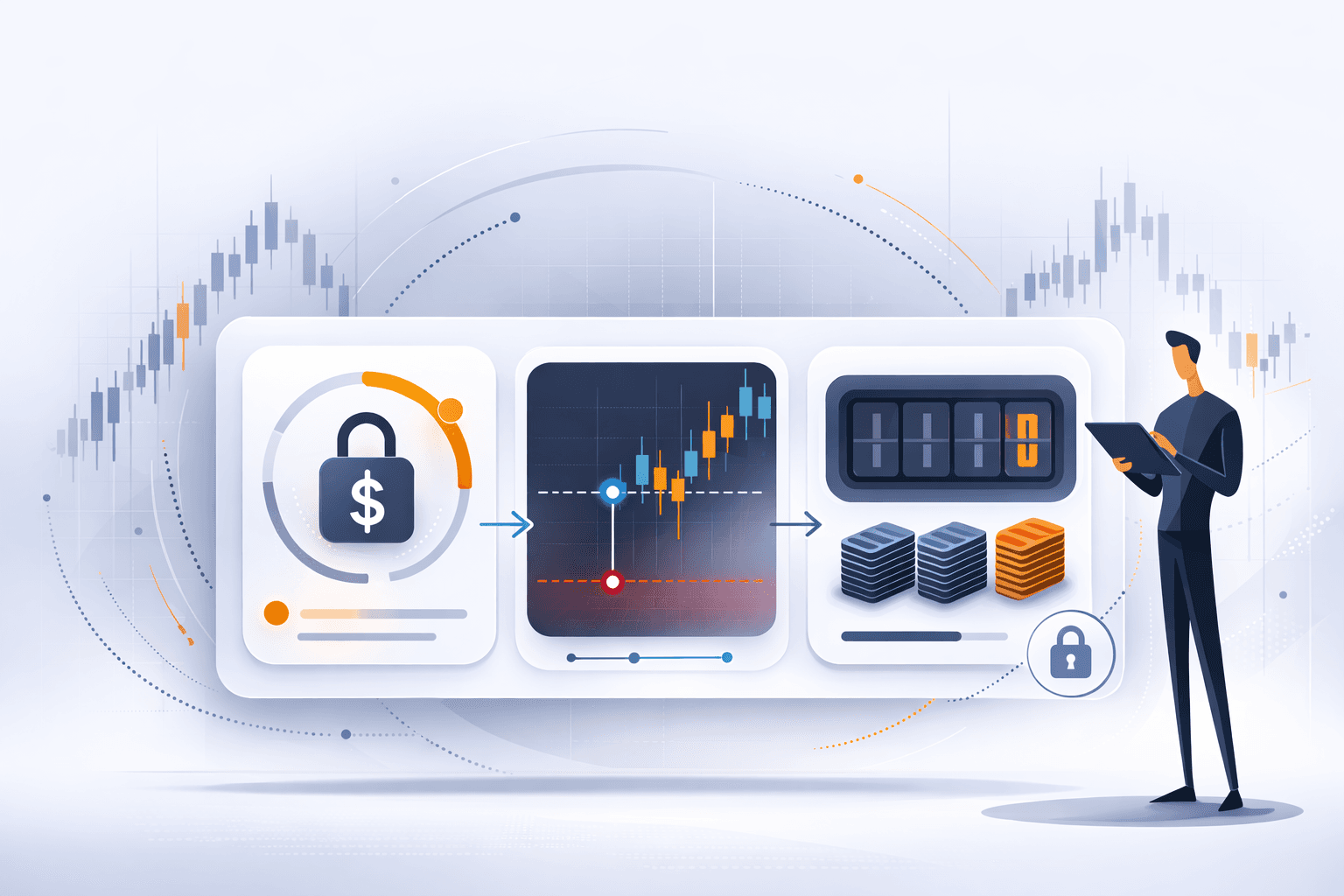
Your trading situation changes everything, because ES vs NQ considerations are entirely different depending on how you're trading:
Personal Account Trading means you're using your own money, primarily worried about margin requirements, while focused on building long-term wealth. You care about preserving capital above all else, and managing overnight risk if you hold after market close because it's your rent or mortgage money on the line.
Prop Trading means you're trading evaluation accounts or funded accounts from firms like Apex, TopStep, Tradeify, or any other of the now dozens of firms in existence. Prop firm rules and pricing change frequently, always verify current terms on each firm's website before signing up. You don't care about margin; the prop firm provides the capital (virtual initially, real capital when moved to Live). Instead, you're laser-focused on daily drawdown limits, maximum drawdown and consistency rules, and hitting profit targets without breaching firm rules and blowing up.
Your path determines everything: position sizing strategies, risk calculations, and even which contract makes sense to start with. Throughout this guide, I'll address both scenarios side by side because the "right" choice between ES and NQ, and between minis and micros, depends entirely on which path you're walking.
Quick Path Check: Trading your own money = Personal Account Path. Trading to pass evaluations or manage funded accounts = Prop Trading Path. Got it? Good, let's continue.
The Social Media Fantasy vs. Trading Reality
Before we go any further into contract specs and calculators, let's address the elephant in the room: social media has completely warped expectations about futures trading.
You've seen the posts. Traders throwing around 20-50 NQ contracts like it's nothing. Screenshots of $50,000 days trading "small size." Young traders on TikTok claiming they're "conservative" while risking $5,000 per trade on $25,000 personal accounts.
Here's the truth: Professional traders with million-dollar accounts trade a conservative amount of contracts most of the time. They only lean into leverage on A+ setups.
The difference between ES and NQ goes beyond the technical. It's deeply psychological. Your instrument choice will either build discipline or destroy it, especially in an age where every losing trade feels magnified by what you see on social media.
ES rewards patience and teaches proper risk management. NQ can teach the same lessons, but it can also create devastating habits that take years to unlearn if you're not prepared for its teachings. I know because I lived it. If you struggle with executing trades like a machine instead of reacting emotionally, your contract choice matters even more.
ES vs NQ Calculator: Find Your Perfect Match
Part 1 of 3: Understanding the Basics
Which contract matches your account size and risk tolerance? Before you enter a trade, you should know how many contracts and of what type you should trade based on your preferred risk, stop loss, and take profit distances. The position sizing calculator at /tools can run those numbers for any account size and contract.
The key is matching your instrument choice to your actual financial situation, not your ego. I learned this through trial and costly error. The contract specs below will help you see exactly which contract fits your account before you risk a penny.
Understanding the Core Differences
Part 1 of 3: Understanding the Basics (Continued)
Before you can choose between ES and NQ, you need to understand each instrument you're trading. If you're new to futures entirely, the lesson on types of financial markets covers where futures fit in the broader market.
What You're Trading
ES (E-mini S&P 500) tracks the S&P 500 index, 500 of America's largest companies across every primary sector. When you trade ES, you're essentially trading the entire U.S. economy. Apple and Microsoft are there, but so are Walmart, Johnson & Johnson, Berkshire Hathaway, and JPMorgan Chase.
NQ (E-mini Nasdaq-100) tracks the Nasdaq-100, a benchmark of 100 large non-financial Nasdaq-listed companies. NQ is heavily weighted toward technology, with Apple, Microsoft, Amazon, Google, Tesla, and NVIDIA dominating the index. When tech moves, NQ amplifies that movement.
Contract Specs
ES and NQ contract specs determine whether you're trading with or against your account size according to official CME Group specifications:
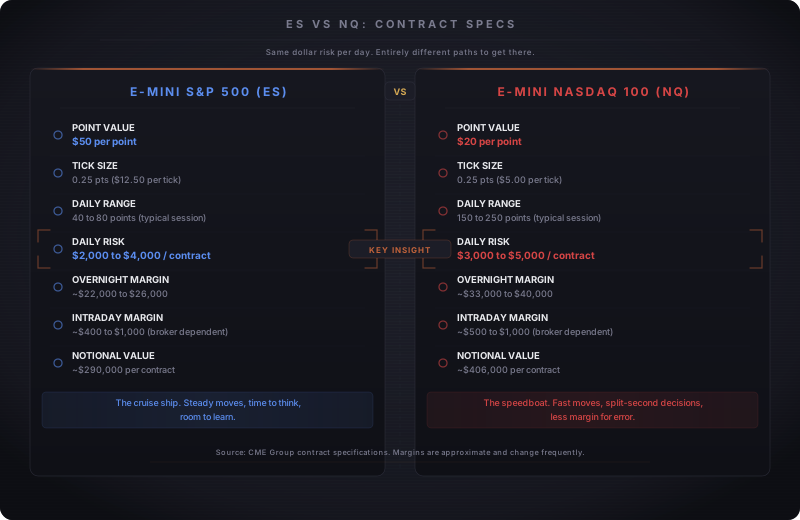
Contract Specification ES (E-mini S&P 500) NQ (E-mini Nasdaq 100)
Point Value $50 per point $20 per point
Tick Size 0.25 points ($12.50) 0.25 points ($5.00)
Daily Range 40-80 points 150-250 points
Daily Risk Exposure $2,000-$4,000 per contract $3,000-$5,000 per contract
Overnight Margin ~$22,000-26,000 ~$33,000-40,000
Intraday Margin ~$400-1,000 ~$500-1,000
Notional Value ~$290,000 (at 5,800) ~$406,000 (at 20,300)
Notice something crucial? Both contracts carry similar dollar risk per day, but they get there in entirely different ways.
ES moves like a cruise ship: gradual, steady, and powerful. You can see the turns coming and have time to react.
NQ moves like a speedboat, quick, jerky, and thrilling. By the time you see the turn, you've already been thrown into the water.
The Psychology Behind Each Market
Part 2 of 3: Psychology & Risk Management
What the contract specifications don't tell you: how each market will mess with your head.
ES Psychology: The Mindset of a Marathon Runner
ES taught me to trade like a professional, though I didn't always appreciate it until recently.
The moves develop slowly, giving you time to think and adjust. It's harder to chase after ES because it doesn't typically move fast enough to trigger FOMO. When ES is up 20 points, you can take a step back and think for a bit. Is this the right time to enter? The smaller, steadier moves allow for appropriate position sizing.
Personal Story: How ES Built My Discipline
I remember my first profitable month trading ES. Nothing exciting, just 15-20 point gains, day after day. My friends trading NQ were making (and losing) 50% in single days while I was grinding out 2-4% daily gains. Small, steady, incremental wins stacked over time.
I felt like I was missing out until something REALLY clicked: I was extracting money from the market into my bank account every week, and it was starting to add up. Those small consistent gains compound faster than you think.
ES's steady rhythm taught me patience. The manageable moves taught me proper position sizing. The time between price swings taught me to plan trades instead of reacting to them.
When you trade ES properly, it feels almost boring. That's the point. Boring builds accounts. Excitement usually destroys them.
Key Takeaway: ES teaches patience and proper position sizing through its steady, predictable movements, and boring is profitable in trading.
NQ Psychology: The Sprint Trap
A lot of professionals trade NQ. I'm not arguing against that. NQ can be amazing and rewards precision, but it punishes hesitation. If you're already prone to second-guessing your entries, NQ will make that problem ten times worse. This creates a dangerous psychological cocktail that I've experienced over and over again firsthand.
Personal Story: The Repeated Failures
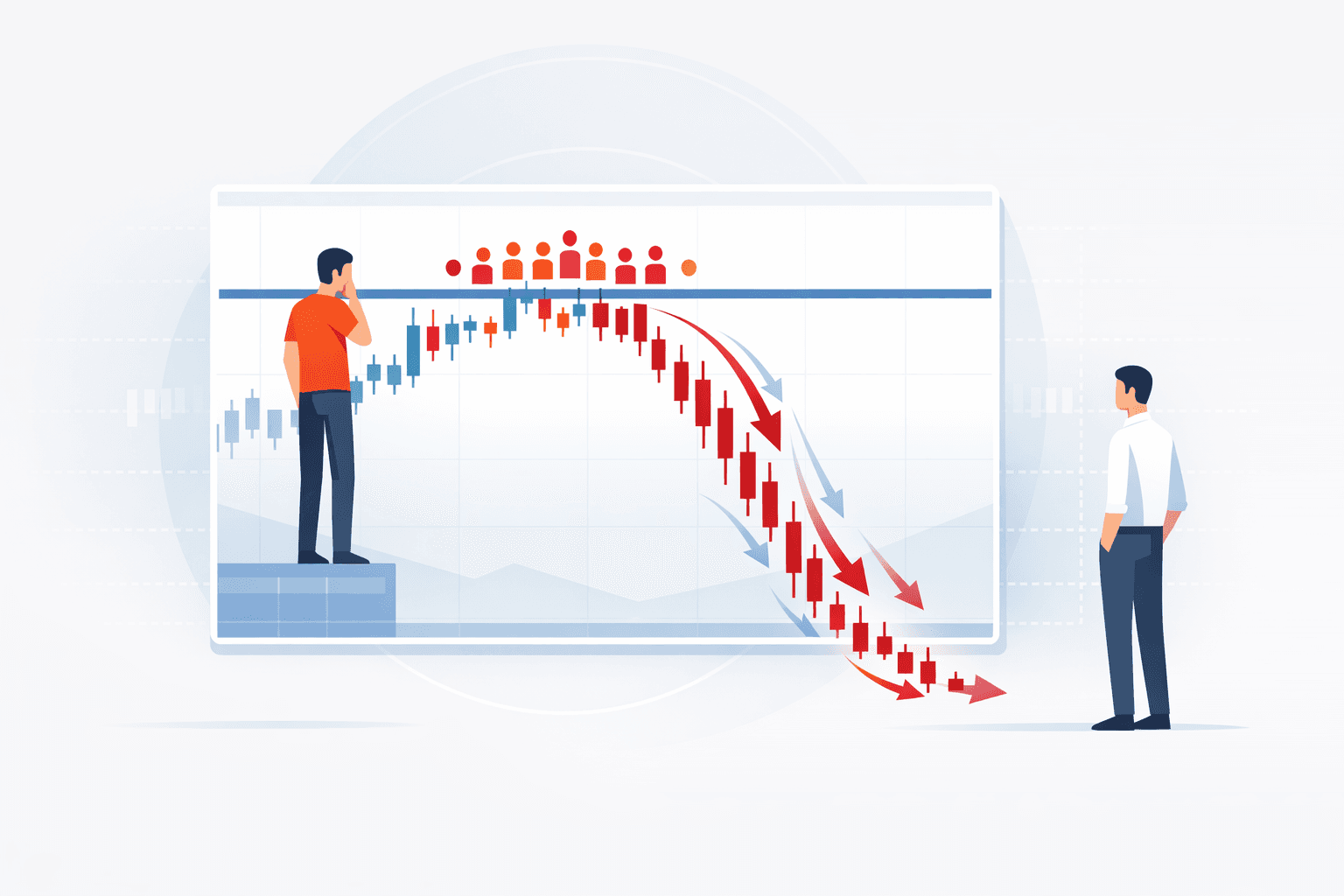
On multiple occasions, I've watched tech stocks plummet, with the NQ dropping hundreds of points. This story has repeated itself too many times in my trading career.
Instead of recognizing a trend, I fought it, convinced it was oversold. The reversion trader in me tried to long one mini contract, expecting a bounce at one of my "key levels." When it dropped another 50 points, I added another contract at the next "key level", still believing it would reverse. In desperation, I added the max size I could to this group of funded prop accounts.
It was a classic case of adding to a losing position, trying to catch a falling knife, and fighting the obvious trend. When it was all over, that group of accounts was gone.
The speed and volatility of NQ turned what should have been a small loss into an account-blowing disaster in less than an hour multiple times. The same mistake on ES would have been painful but manageable. NQ's speed eliminated all the safety nets I thought I had.
When NQ moves 100, or even 200 points in 30 minutes, your brain starts thinking in NQ-sized moves. A 20-point move feels like nothing. You begin using wider stops "because it's so volatile." You start adding size because "I can't miss these moves."
Before you know it, you're revenge trading because you missed an 80-point move and desperately need to catch the next one.
NQ didn't make me a bad trader; it revealed that I wasn't ready for the psychological demands of a high-speed market.
Key Takeaway: NQ's speed can amplify psychological weaknesses; master your emotions on slower markets before attempting to trade a high-speed, violent instrument.
Micro Futures vs Regular Futures (Micros vs Minis): Your Training Ground
This is where the game changes for developing traders: micro futures. If you want a full breakdown of how MES and MNQ work, their contract specs, and exactly how to use them when starting out, I put together a complete micro futures guide for MES and MNQ that covers all of it.
Micros and Minis: Same Market, Different Risk
Micro Contract Regular Contract Point Value Risk Per 10-Point Move
MES ES $5 vs $50 $50 vs $500
MNQ NQ $2 vs $20 $20 vs $200
MES and MNQ move tick-for-tick with their full-sized counterparts. When ES goes up 10 points, MES goes up 10 points. The only difference is that MES risks $50, whereas ES risks $500.
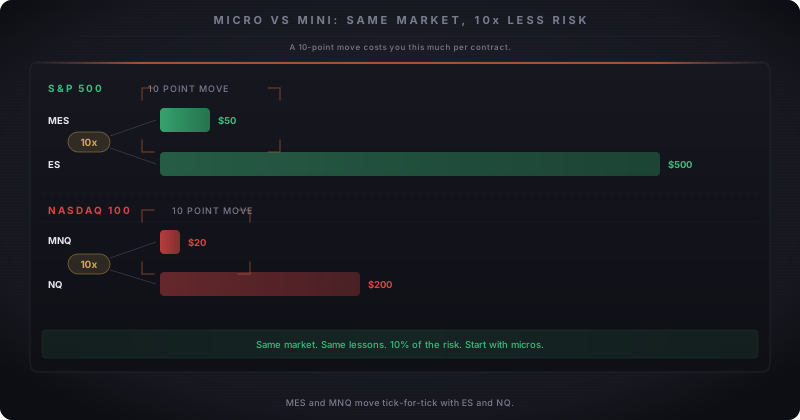
That's a massive advantage for learning. You can experience real market psychology with real money at 10% of the normal risk.
It's just as valuable for recovery. After a period of tough trading or a blowup, you can (and should) switch to micros to allow yourself space to recover with much less risk.
Trading Recovery: How Micro Futures Help You Bounce Back
Let's discuss a topic that many trading educators and coaches tend to overlook: what to do after a significant loss, a blowup, or a rough patch.
Whether you've failed prop evaluations, blown through personal capital, or just hit a devastating losing streak, micro contracts offer a psychological and financial lifeline that didn't exist for previous generations of traders.
The Recovery Process: When I trade micros, I can continue to learn market personality and psychology without the crushing pressure of significant financial consequences. Same market movements, same trading decisions, same lessons, just scaled down to a level where mistakes don't end your trading career, or set you back weeks or months.
Personal Recovery Story: After repeated NQ disasters, I spent months trading only MNQ. Same speed, same volatility patterns, same decision-making pressure. But instead of risking $2,000+ per move, I was risking $200.
I could afford to be wrong. I could afford to learn. Most importantly, I could afford to rebuild my confidence without rebuilding my account from zero. Micros are also the best tool for bridging the sim-to-live gap when you're making that transition for the first time. Trust me, this goes against almost everything you'll see on social media.
Why Recovery Matters: The difference between traders who come back stronger and those who quit isn't talent; it's having a path back that doesn't require perfect performance immediately. Micros provide that path. You're still able to trade, still able to learn, and still developing skills. The difference is that you're doing it with less pressure.
Trading MNQ means you can learn NQ's personality for $200 instead of $2,000. Same psychological lessons, same speed, same volatility patterns, just scaled down to a survivable level.
Most successful ES or NQ traders I know started with MES or MNQ, built discipline and consistency, then scaled into their mini counterparts carefully. They learned about high-speed decision-making and proper mindset without over-leveraged account destruction.
The Beginner's Progression Path
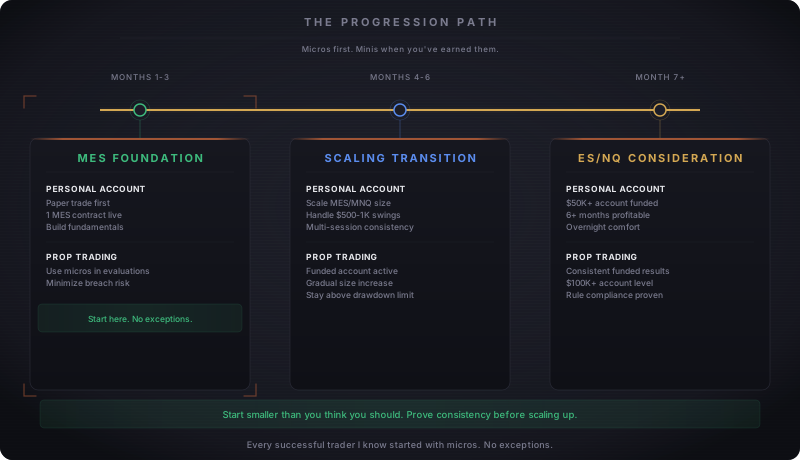
Below is a sample month-by-month progression for both trading paths. You can adjust the timing, but for beginners, it takes time to form good habits:
Personal Account Progression Prop Trading Progression
Months 1-3: MES Foundation. Your goal is to build the fundamentals while preserving capital. Learn platform functionality, understand margin and overnight risk, develop risk management discipline, and build market flow intuition. Focus on paper trading until consistently profitable, start with tiny position sizes (1 MES contract), and develop pre-market routines. Success means achieving consistent profitability across 30+ trades, with no single trade risking more than 2% of the account, maintaining comfort with overnight positions, and identifying market sentiment and key levels. Evaluation Phase: Start conservatively. Your only goal is to pass the evaluation without breaching drawdown rules. Use MES or MNQ to learn the market's personality while minimizing breach risk. Focus on hitting modest profit targets (6-10%) while staying well within daily drawdown limits (2-5%). Many successful prop traders use 3-5 micro contracts during evaluations instead of 1 mini contract; same market exposure, but with a fraction of the drawdown risk.
Months 4-6: MES/MNQ Scaling Transition. Now you're scaling up while managing larger capital requirements. Your goals shift to handling overnight margin exposure, managing larger P&L swings, and learning to trade different sessions. Learn sector rotation and broader market analysis, and practice scaling in and out of positions. Success metrics include profitability with MES or MNQ for 60+ trades, comfort with $500-$1,000 P&L swings, ability to manage overnight margin risk, and understanding of economic data impact. Funded Phase: Scale Strategically. Once funded and above drawdown, you can gradually increase position sizes, but remember, funded accounts still have drawdown and consistency rules most of the time. Scale into larger positions only after proving consistency with smaller sizes, and far above your drawdown trail.
Month 7+: ES/NQ Consideration (Both Paths)
Before considering ES or NQ mini contracts, consider the prerequisites: consistent profitability with MES or MNQ, appropriate account size or funded status, proven risk management, rock-solid discipline, and the ability to make quick decisions under intense pressure.
Personal Account Requirements Prop Trading Requirements
-
$50K+ account minimum
-
6+ months of MES/MNQ profitability
-
Demonstrated ability to handle overnight risk
-
Successfully funded with consistent performance
-
$100K+ account size (for comfortable daily drawdown management)
-
Proven ability to stay within firm risk rules
Warning Signs to Stop (Both Paths): If you find yourself increasing position sizes impulsively, revenge trading after losses, using wider stops to "handle volatility," getting angry with the market or market makers, or checking positions obsessively, you're not ready for minis yet, regardless of your trading path.
The Seasonality Factor
Both markets have personalities that change throughout the day, week, and year.
Both ES and NQ show peak activity during market open (9:30-10:30 AM ET) with the highest volume and volatility. Fed announcement days bring dramatic moves on policy decisions, economic data releases at 8:30 AM ET typically create significant movement, and market close (3:30-4:00 PM ET) sees institutional rebalancing activity. The lesson on trading sessions and market hours goes deeper on how each session behaves and why it matters for your execution.
NQ experiences extra volatility during tech earnings season (concentrated in specific weeks per quarter), Apple/Microsoft/Google product announcements or earnings, semiconductor news cycles that affect major NQ components, and options expiration (third Friday of each month) bring increased volatility. Recently, we've seen 1,000+ point moves in one trading session.
Summer months (June-August) typically see reduced volatility in both contracts as institutional trading decreases. This is ideal for learning, as it provides real market conditions with slightly lower risk. However, price action is often very choppy during this time, so take caution. September-November usually brings the highest volatility of the year as institutional flows return, earnings season intensifies, and economic policy decisions cluster.
Your Next Step: Making the Right Choice
Part 3 of 3: Making Your Decision
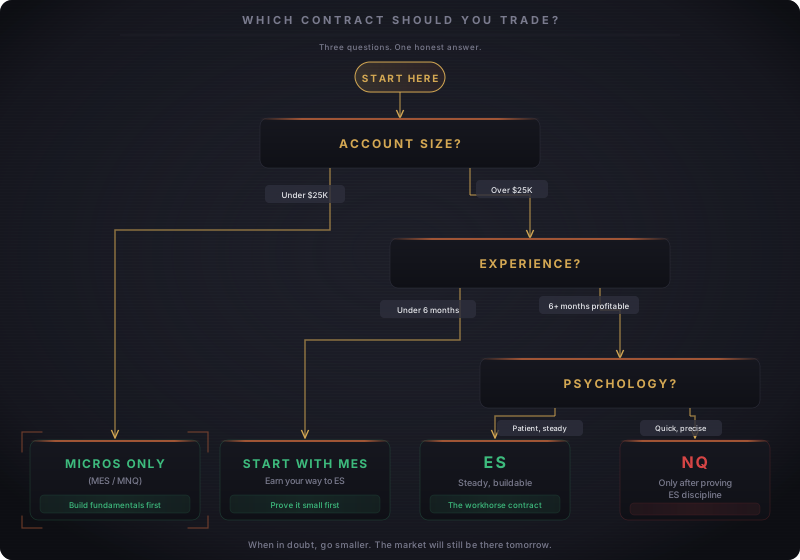
The best futures contract is the one that matches your psychology, account size, and experience level.
Don't guess. Don't be swayed by what your favorite trading influencer trades. Don't pick based on which one "moves more" this week. And don't let perfectionism keep you from choosing at all.
Use the decision framework:
Personal Account Path Prop Trading Path
-
Calculate your actual account requirements using proper risk management (1-2% per trade)
-
Assess your psychological tolerance for speed and volatility
-
Choose the appropriate progression path (MES → ES → MNQ → NQ)
-
Start smaller than you think you should
-
Prove consistency before scaling up
-
Understand your firm's drawdown rules (daily and maximum limits)
-
Calculate position sizes based on drawdown risk, not profit potential
-
Choose instruments that fit within daily limits (often micros during evaluations and initial stages of funding)
-
Focus on passing evaluations first, scaling profits second
-
Prove rule compliance before attempting aggressive strategies
Ready to build your trading foundation the right way? Check out UpSkalr for tools and resources built for futures traders.
Most importantly, understand that your choice between ES and NQ doesn't have to be permanent. Those who trade personal accounts can build capital and transition to larger contracts in the future. At the same time, prop traders can start with evaluations, get funded, then scale into higher-risk/higher-reward strategies. And futures are just one path. Our lesson on choosing your instrument track walks through how to decide between futures, options, and stocks based on where you are right now.
ES vs NQ Decision and Recovery Kit
To put this guide into action, I've built three resources specifically for traders making this decision:
-
Trading Recovery Blueprint: A step-by-step guide for traders who've been through blowups and need a structured path back. No fluff, just the recovery process that works. Download the Trading Recovery Blueprint.
-
Trader's Psychology Profile: Who you are as a trader matters more than what you know. Your personality, risk tolerance, and psychological tendencies determine which contract fits you better than any technical analysis ever will. Download the Trader's Psychology Profile.
-
Position Sizing Calculator: Takes the guesswork out of position sizing for any account size, contract type, and risk tolerance. Plug in your numbers and get an honest answer about what you should be trading. Use the interactive Position Sizer.
Prop firm rules and pricing change frequently, always verify current terms on each firm's website before signing up.
The market doesn't care which contract you choose. But your account balance and your sanity do.
Choose wrong and you'll spend months learning expensive lessons about psychology, risk management, and proper position sizing. Choose the right approach and you'll lay the groundwork for long-term success in futures trading.
The futures contract you choose to trade is the first and most important of those decisions. Make it count.