Module 1.2·Lesson 1 of 10

Candlestick Patterns That Matter

Read: 8 min | Full lesson: 35 minFree
10%

I spent months trying to memorize every candlestick pattern in the book. Dozens of three-candle combinations with names I'd forget the second I closed the tab. None of it helped in real time. What actually changed my trading was learning to read pressure. I started watching for long lower wicks on higher timeframes, then dropping to a lower timeframe to watch for a retest of that wick. If price retested the area and made a higher high, I had my entry. That's not a pattern from a textbook. That's reading what the candle told me about who lost the fight, then waiting for proof that the winners showed up again. Once I stopped matching shapes and started reading pressure, it became instinct.

Most candlestick textbooks list 50 or more patterns. Three-candle combinations with names you'll forget by tomorrow. You don't need them.

Six candlestick patterns cover every meaningful thing a candle can tell you about who's winning the fight between buyers and sellers. Once you understand the pressure behind these patterns, you can read any candle on any chart without looking up a name.

Every Candle Is a Fight

In 'What Is a Chart?' (Module 1.1, Lesson 5), you learned that each candlestick shows four prices: open, high, low, and close. That's the data. But a candle tells you much more than four numbers.

Think of every candle as a one-round boxing scorecard. The body (the thick part) tells you who won the round. A green body means buyers finished higher than they started. A red body means sellers finished lower. The wicks (the thin lines above and below the body) tell you about the fight that happened during the round.

In trading terms, the body is your result and the wicks are the struggle that produced it. A candle with a tiny body and huge wicks had a brutal fight with almost no winner. A candle with a big body and no wicks was a knockout.

A long lower wick means sellers pushed price down hard, but buyers fought back and recovered most of the ground before the candle closed. A long upper wick means buyers pushed up aggressively, but sellers knocked them back down. A tiny body with long wicks on both sides means nobody could hold their ground.

Stop seeing candles as shapes with names. Start seeing them as compressed stories about who was winning and who was losing during that time period. And this reading works the same whether you're looking at ES futures, SPY, or any stock. Buyer/seller pressure shows up the same way on every chart, in every timeframe. In 'Timeframes and What They Mean' (Module 1.1, Lesson 7), you learned that higher timeframes smooth out noise. A hammer on a 5-minute chart might just be a wick on a 15-minute candle. Same pressure, different resolution.
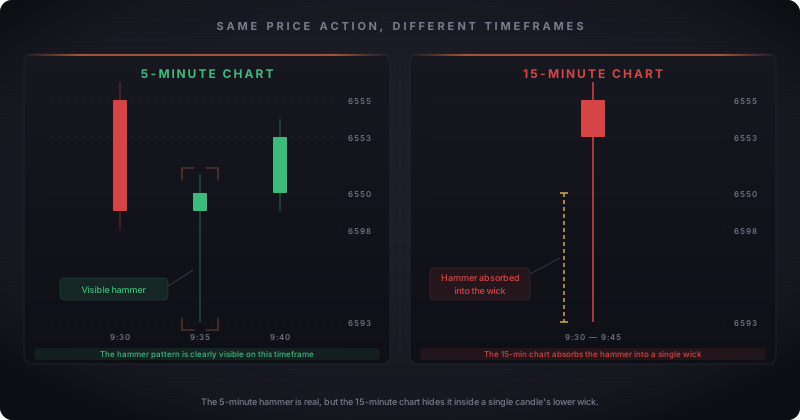
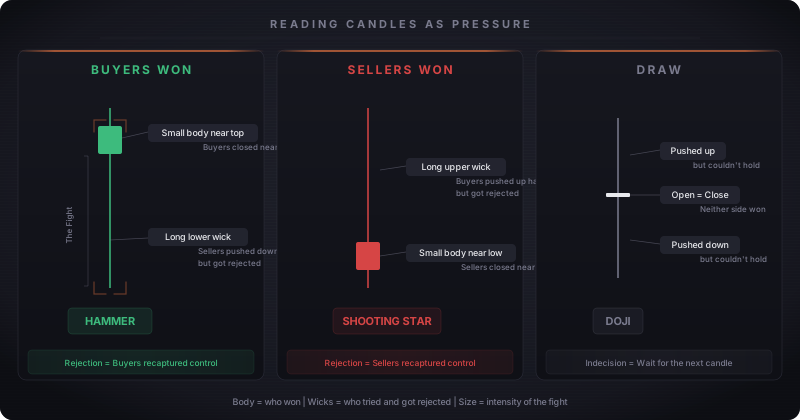
Same 15 minutes of ES price action shown on a 5-minute chart with a visible hammer pattern versus a 15-minute chart where the hammer is absorbed into a single candle's lower wick Candlestick anatomy showing body and wicks as buyer/seller pressure indicators, with annotations explaining where sellers pushed, where buyers recovered, and what a draw looks like

Single-Candle Patterns: Reading Rejection

Four of the six patterns you need are single-candle patterns. They all tell the same fundamental story: one side tried to push price, and the other side rejected that move.

The Hammer

Small body near the top of the candle. Long lower wick. Sellers pushed price down during the period, buyers rejected it and closed near the high. The longer the lower wick relative to the body, the stronger the rejection was.

The hammer is the most useful single-candle pattern because it shows aggressive rejection of lower prices. When it forms after a move down, it's telling you: "Sellers tried here, and buyers said no."

The Shooting Star

The mirror image of a hammer. Small body near the bottom of the candle. Long upper wick. Buyers pushed price up, sellers rejected it and closed near the low. Same rejection story, opposite direction.

The Doji

Open and close are nearly identical, creating a tiny or nonexistent body. Buyers and sellers fought to a draw. Neither side could win the period.

A doji after a strong trend move or at a key price level is worth paying attention to because it means the dominant side just lost momentum exactly where it matters. A doji in a sideways range just confirms what you already knew: nobody has conviction.

The Pin Bar

An extreme hammer or shooting star. The wick is at least two to three times the length of the body. This is the loudest rejection signal a single candle can produce. It earns its own name not because it's a different signal, but because the intensity is qualitatively different. A hammer says "buyers pushed back." A pin bar says "buyers crushed the move and left no doubt."

Some traders draw a hard line between pin bars and hammers. Don't get caught up in the naming debate. If you see a candle where the wick dominates and the body is tiny, the message is the same: one side got completely overpowered.

And if that rejection candle also shows a spike in volume, as you learned in 'Volume: The Market's Footprint' (Module 1.1, Lesson 8), the rejection carries even more weight. High volume on a pin bar means more participants were involved in that fight.

Multi-Candle Patterns: Momentum Shifts and Compression

The last two patterns involve two candles. They show different stories: one about a shift in momentum, the other about compression before a move.

The Engulfing Pattern

The second candle completely swallows the first candle's body. A bullish engulfing has a green candle that engulfs the prior red candle's body. A bearish engulfing has a red candle that engulfs the prior green candle's body.

What this pattern is really saying: the side that lost the previous candle came back and won so decisively that they erased the prior period's entire move, plus more. It's not just a change in direction. It's a statement.

The Inside Bar

The second candle's entire range (high to low) fits inside the first candle's range. The market is compressing. Neither buyers nor sellers want to push beyond the prior candle's boundaries.

Inside bars show pause. The market is coiling, building potential energy. This is different from a doji: a doji shows indecision within one candle. An inside bar shows indecision across two candles, with the second candle refusing to test either boundary of the first.

When inside bars form after a strong move, they often precede a continuation in the trend direction. When they form at a key level, they can precede a reversal. But "often" and "can" aren't certainties.
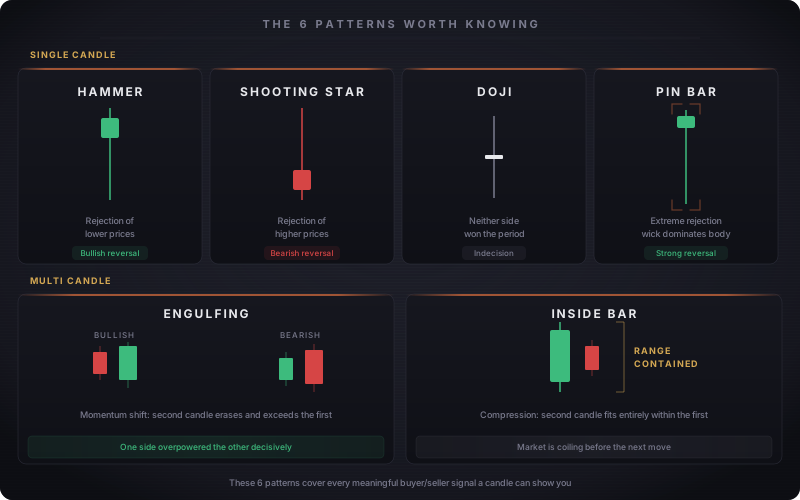
Comparison grid showing the 6 key candlestick patterns with their structure and what each signals about buyer/seller pressure

Context Is Everything

Most beginners think candlestick patterns predict what price will do next. They see a hammer and think "buy." They see a shooting star and think "sell." This is the most common mistake in pattern recognition, and it will cost you money.

The reason this wrong model is so sticky: every YouTube tutorial and pattern encyclopedia presents candles as predictive signals. "Hammer = bullish reversal." And sometimes a hammer IS followed by a reversal, which reinforces the belief through confirmation bias. You remember the hammer that worked and forget the 10 that didn't.

A candlestick pattern shows what happened during that time period. It tells you about buyer/seller pressure in the past tense. It does not predict the future. The same hammer pattern means completely different things depending on where it forms on the chart.

The "where" matters more than the "what." A mediocre pattern at a great location beats a perfect pattern at a meaningless location. Every time.

Same hammer pattern shown at a tested support level versus in the middle of a range, demonstrating how location determines whether a pattern is a signal or noise

The Patterns You Can Skip

Candlestick textbooks love naming things. Morning star, evening star, three white soldiers, abandoned baby, harami cross. Some encyclopedias list 60 or more named patterns.

Skip most of them. They're multi-candle combinations of the same pressure dynamics you just learned.

A morning star is a three-candle hammer: down candle, small indecision candle, then an up candle that erases the down candle. That's rejection of lower prices told over three candles instead of one. An evening star is a three-candle shooting star. Three white soldiers is a strong trend. Every "advanced" pattern reduces to the same question: who was pushing, who was rejecting, and who won?

Once you internalize the six core patterns and the pressure they represent, you can read any candle formation you encounter without needing to look it up. You'll see the body, see the wicks, see how candles relate to each other, and know the story.

That's the skill. Not memorization. Recognition. And in the next lesson, you'll learn where to point that recognition: support and resistance levels, the locations on a chart where patterns actually mean something.

01Test

You’ve finished reading. Time to check what landed.

Check Your Understanding

1 / 5

1.A candle has a small body near the top and a long lower wick. What does this tell you about what happened during that time period?

02Practice

Knowing isn’t enough. Put it into practice.

Practice Exercise

Chart Markup·~20 min

Open any charting platform (TradingView is free) and pull up a 15-minute chart of ES or SPY for the first 2 hours of the most recent regular trading session. Identify at least one example of each of these patterns: hammer or shooting star, doji, engulfing pattern, and inside bar. For each pattern you find, write down: (1) the time it formed, (2) which pattern it is, (3) a 2-3 sentence explanation of what the candle tells you about buyer/seller pressure (who pushed, who rejected, how strong was the rejection), and (4) whether the pattern appeared at a significant location (near the day's high/low, a round number, or a prior reaction point) or in the middle of nothing.

03Reflect

Before you move on, anchor these ideas.