The Four Players
In "What Is a Market and Why It Exists" (Lesson 1), you learned that price moves because of supply and demand imbalances. Those imbalances come from real participants placing real orders. Four types generate virtually all the volume on your chart.
Institutional traders are the heavyweights: hedge funds, pension funds, banks, sovereign wealth funds. A single institutional order might be 500 or 1,000 ES contracts. They can't enter or exit all at once without shoving price against themselves, so they break large orders into smaller pieces and work them over hours or days. When you see price grind steadily in one direction for an hour with no obvious news catalyst, that's often institutional flow.
Retail traders are you, me, and every independent trader with a brokerage account. We're trading 1 or 2 contracts of ES, maybe 10 contracts of MES. Individually, a retail order doesn't move price.
Market makers continuously quote prices on both sides of the order book. They don't care about direction. They profit from the spread. Market makers are the reason you can always find someone to trade with, whether it's the middle of a Tuesday session or 3 AM on a quiet Wednesday night.
Algorithmic traders execute strategies at speeds no human can match: market-making algos, momentum algos, and arbitrage algos that keep prices aligned across related markets. A majority of ES volume is algorithmic. When price snaps 3 points in half a second, that's algorithms reacting to other algorithms.
You don't need to match their speed. You need to use what they can't: the ability to do nothing until conditions favor you. You can close your laptop and come back tomorrow.
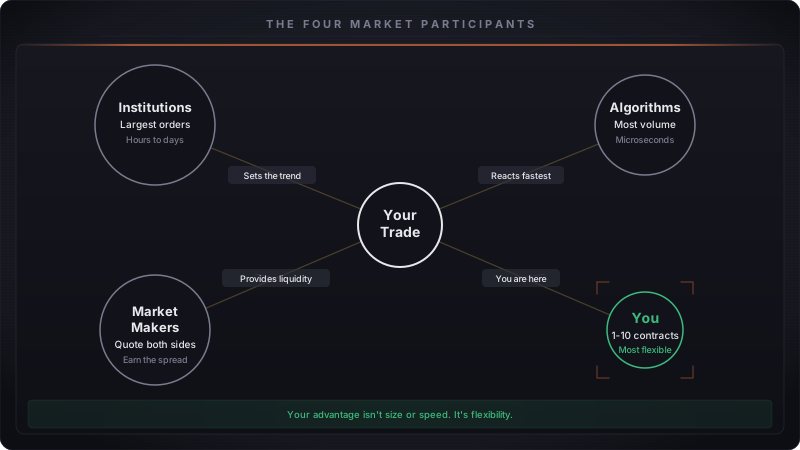
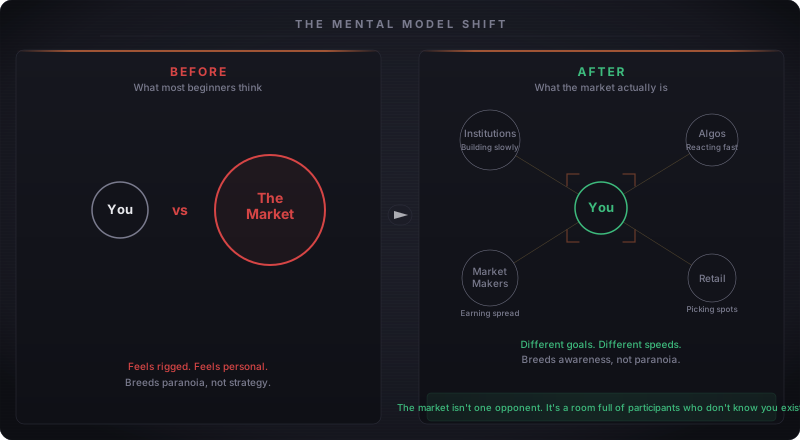
You're not trading against "the market" as one unified opponent. An institution is building a position over three days. A market maker is collecting spreads over three seconds. An algorithm is arbitraging a price difference over three milliseconds. None of them care about your 2-lot MES position.
The Arena: How Exchanges Make It Work
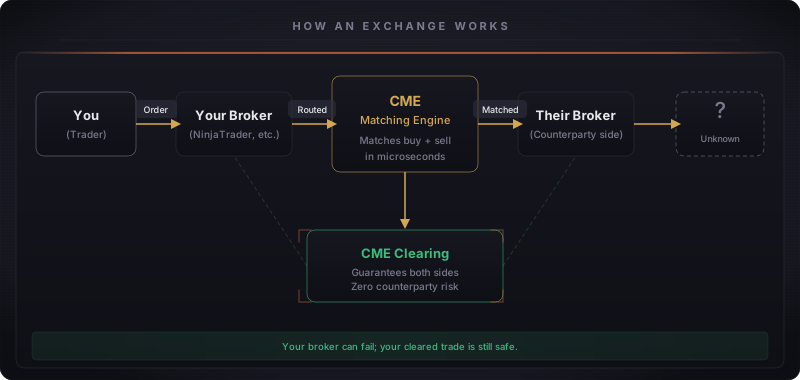
All four participant types need a place to meet, rules to follow, and a guarantee that the other side won't cheat. That's the exchange.
The CME Group is where ES and NQ futures trade. It standardizes contracts (one ES contract always equals $50 per point), matches orders in microseconds, and guarantees settlement through its clearinghouse. If one side goes bankrupt, the clearinghouse covers it. Zero counterparty risk.
Why This Changes How You Trade
Knowing who's on the other side changes your behavior. You're in an arena with hedge funds, algorithms, and market makers. That's not a reason to quit. It's a reason to be realistic about your edge. You can sit out when conditions don't favor you. You can change your mind in a second. A fund managing $10 billion can't do any of that.
If algorithms dominate the first 30 seconds after an economic release, that's not the time for a retail trader to click buttons (Lessons 9 and 10 cover when to trade and when to sit out). You don't need to beat the algorithms. You need to trade in the spaces where your flexibility matters more than their speed.
Key Rules
- Your 2-lot MES order is a rounding error to institutions trading 500+ ES contracts. They don't know you exist. Trade accordingly.
- Market makers fill your small orders. They profit from the spread, not from picking direction. Accept this.
- The CME clearinghouse eliminates counterparty risk. Your cleared trade survives even if your broker fails.
- ES processes over 1 million contracts per day. The majority is algorithmic. Never compete on speed.
- When algorithms are firing thousands of orders per second (first 30 seconds after a data release), sit out. Your edge is patience, not reaction time.
- Institutions can't sit on their hands. You can. That flexibility is your actual advantage.
Now that you know who's in the market and how the exchange holds it together, the next lesson covers the different types of financial markets and why this course starts with futures.