The Four Order Types That Matter
There are dozens of order types across different platforms, but four cover 95% of what you'll use as a futures trader. Master these before you worry about anything else.
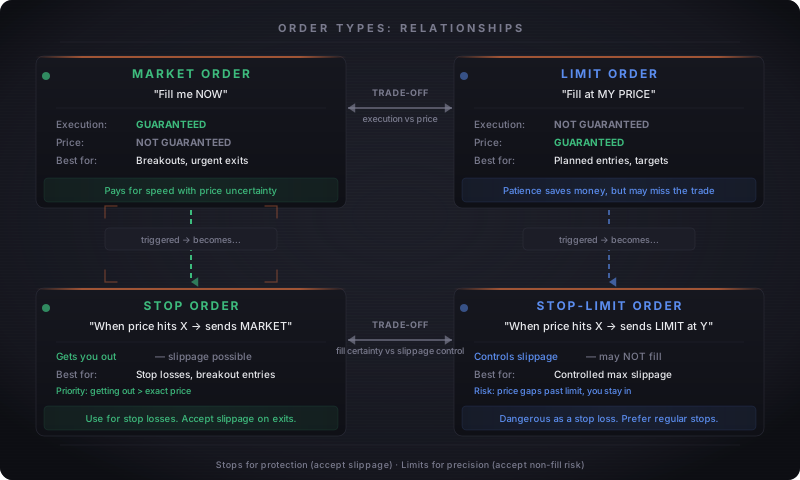
Market Order: "Fill me right now at whatever price is available." A market order guarantees execution. You will get filled. But you don't control the exact price. In a fast-moving market, the price you see on screen and the price you actually get can be different. That difference is called slippage, and we'll get to it.
Limit Order: "Fill me at this price or better, or don't fill me at all." A limit order guarantees price. You set the exact price you're willing to pay (for a buy) or accept (for a sell). The catch: if price never reaches your level, you don't get filled. You get price certainty at the cost of execution certainty.
Stop Order (Stop Loss): "When price hits this level, send a market order." A stop order sits inactive until the market reaches your specified price. Then it triggers and becomes a market order. This is how most traders protect their downside. But here's what trips people up: because it becomes a market order when triggered, your actual fill can differ from your stop price. In calm markets, the difference is usually a tick or two. In volatile moves, it can be worse.
Stop-Limit Order: "When price hits this level, send a limit order at this other price." This is a two-price order: a trigger price (the stop) and a limit price (the maximum you'll pay or minimum you'll accept). The advantage is protection against extreme slippage. The danger is that if price gaps past your limit, your order never fills and you're left in a losing trade with no protection.
Most beginners think a stop loss guarantees you exit at your stop price. It doesn't. A stop order becomes a market order the moment your stop price is hit. Your actual fill depends on what's sitting in the order book at that instant. The misconception feels right because in calm markets, the difference between your stop price and your fill is usually just a tick or two, so it looks like the stop "worked perfectly."
But during fast moves, news events, or overnight gaps, price can blow right past your stop level and your fill comes back significantly worse. Understanding that a stop is a trigger, not a guarantee, is the difference between planning for slippage and being surprised by it.
What Happens When You Click Buy
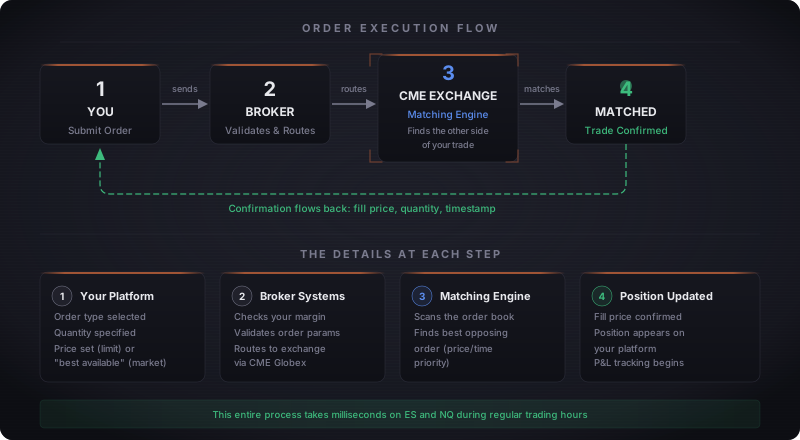
When you hit the buy button on your platform, your order doesn't magically appear as a filled position. Here's what actually happens.
Your order leaves your trading platform and travels to your broker's systems. Your broker routes it to the exchange (the CME for ES and NQ). The CME's matching engine receives your order and attempts to match it with an existing order on the other side.
In "Who's on the Other Side of Your Trade" (Lesson 2), you learned that the CME's matching engine pairs buyers with sellers. That engine maintains an order book: a running list of all resting buy orders (bids) and all resting sell orders (asks) at every price level. When your buy market order arrives, the engine matches it against the lowest-priced sell order currently resting in the book. That's your fill.
If you sent a limit order instead, it either matches immediately (if your price is at or above the best ask) or it sits in the book and waits. Your limit buy at 5,290 won't fill until someone is willing to sell at 5,290 or lower.
This entire process takes milliseconds. But those milliseconds matter, especially in fast markets.
Here's an analogy. Think of the order book like two lines at a service counter. Buyers are lined up on one side, sorted by who's willing to pay the most (highest bid at the front). Sellers are lined up on the other side, sorted by who's willing to sell for the least (lowest ask at the front).
When the front of both lines can agree on a price, a trade happens. Everyone else keeps waiting.
The gap between the best bid and the best ask is called the spread. For ES during regular trading hours, this is usually just 1 tick (0.25 points, or $12.50). For less liquid contracts or during overnight hours, the spread can widen. We'll cover the spread in detail in the next lesson.
There's a tool that lets you see the order book in real time on your trading platform: the Depth of Market (DOM). The DOM shows you all resting orders at each price level: how many contracts are waiting to buy at each price below, and how many are waiting to sell at each price above. It looks like a vertical ladder of prices with quantities stacked on either side. You can place and manage orders directly from the DOM by clicking at specific price levels, which makes it much faster than typing prices into an order ticket. You'll work with the DOM extensively in later modules. For now, just know it exists and that it's a visual representation of the order book we've been discussing.
Slippage: When Price Moves Before You're Filled
Slippage is the difference between the price you expected and the price you actually got. It's a fact of life in trading, and pretending it doesn't exist will cost you.
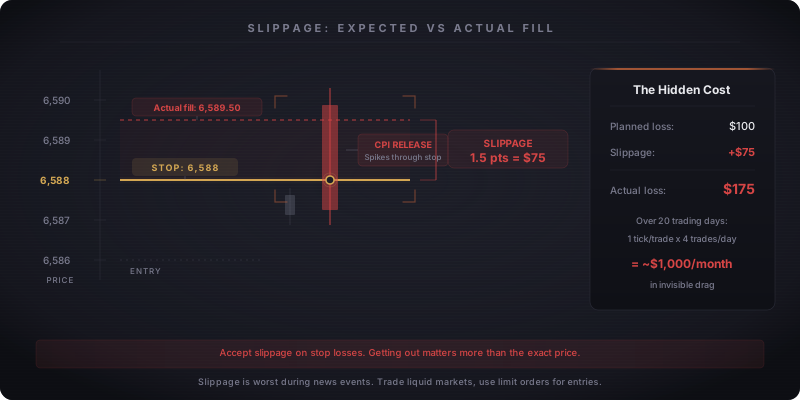
Consider this scenario: a trader is short 1 ES contract with a stop loss resting 2 points above their entry. A major economic release (CPI, FOMC, NFP) hits, and price spikes through the stop in a single tick. The fill comes back 1.5 points past the stop price. That's $75 of slippage on one contract, turning a planned $100 loss into a $175 loss. This happens routinely around scheduled news events, and it's one of the most common surprises for new traders.
Short 1 ES contract at 4,386. Stop loss at 4,388 (2 points above entry). Planned risk: 2 x $50 = $100
Price spikes through your stop. Fill comes back at 4,389.50 instead of 4,388. Actual loss: (4,389.50 - 4,386) x $50 = 3.5 points x $50 = $175
$175 actual - $100 planned = $75 extra loss from slippage (1.5 points of slippage)
On a single trade, $75 of slippage might seem manageable. But if you trade 4 times per day and average even 1 tick of slippage per trade ($12.50), that's $50/day or roughly $1,000/month in invisible execution costs. Slippage must be factored into your risk math, not ignored.
Four ways to minimize slippage:
You can minimize slippage in four ways. First, trade liquid markets. ES and NQ have deep order books and tight spreads, while illiquid contracts during off-hours will cost you. Second, avoid entries and exits during news releases. CPI, FOMC, and NFP cause the book to thin out, and slippage spikes when volatility spikes. Third, use limit orders for entries when possible. If price can come to you, a limit order eliminates entry slippage entirely. Fourth, accept slippage on stop losses. Your stop must be a stop (market) order. Getting out matters more than the exact price. A stop-limit that doesn't fill is far worse than a tick of slippage.
Choosing the Right Order for the Job
Order type selection isn't a one-time decision. It's part of every single trade, and it should be part of your pre-trade planning.
This is where the Pre-Execution Protocol starts to matter. The protocol's three core questions are: what's my position size, where's my stop, and what's my directional bias. But in addition to those three, there's a question most traders skip entirely: what order type am I using to enter, and what order type is my stop?
The practical breakdown:
Entering a planned setup at a specific level: Use a limit order. Place it at your intended entry price and let price come to you. If it doesn't reach your level, the setup wasn't meant to be. Move on. This is patient execution, and it saves you money over hundreds of trades.
Entering a breakout or momentum move: Use a market order or a stop entry order. Breakouts don't wait for you. If price is moving and you need to be in, a limit order sitting 2 points below might never fill. Accept the slippage cost as the price of participating in the move.
Protecting an open position: Use a stop order. Period. Your stop loss should be a stop (market) order, not a stop-limit. The purpose of a stop loss is to get you out. A stop-limit that doesn't fill because price moved too fast defeats the entire purpose.
Taking profit at a target: Use a limit order. You know the exact price where you want to exit. There's no reason to leave that to chance with a market order.
When you start placing trades in simulation (or if you already have), pay attention to which order type you reach for by default. Most new traders use market orders for everything without thinking about it. That habit costs real money once you go live. Ask yourself: did I choose this order type deliberately, or did I just click the button that was there?
The order type you choose is as much a part of your trade as the direction you pick. Treat it that way. The next lesson covers the bid, the ask, and the spread, which is where order types meet the order book in real time.