Module 1.1·Lesson 3 of 10

Types of Financial Markets

Read: 9 min | Full lesson: 32 minFree
30%

Not all markets work the same way, and the one you pick shapes everything about how you trade. Your capital requirements, your risk per trade, your available hours, even the psychological pressure you feel. We start with futures in this level for specific, structural reasons, and by the end of this lesson you'll understand why. (Later levels cover stocks and options as separate tracks.)

Many traders start in stocks and hit the Pattern Day Trader rule within their first week. Four day trades in five business days on a margin account under $25,000, and the broker flags you as a pattern day trader and locks you out. The same rule applies to equity options. That restriction pushes a lot of active traders toward futures, where no PDT restriction exists and you can take as many trades as your plan allows.

Flow diagram showing the common active trader migration path: start in stocks, hit PDT rule, discover futures with no PDT restriction, start with micro contracts at 1/10th risk, then build skills before sizing up

The Five Markets You'll Encounter

There are five major markets most retail traders run into. Here's what you need to know about each, without the textbook fluff.

Stocks (Equities) are ownership shares in companies. You buy Apple stock, you own a tiny piece of Apple. Most beginners start here because it's familiar, but the PDT rule (FINRA Rule 4210: four or more day trades in five business days on a margin account under $25,000 flags you as a pattern day trader) kills most small-account active traders before they start.

Futures are contracts to buy or sell an underlying asset at a set price on a future date. They're derivatives: ES futures derive their value from the S&P 500 index. You don't own shares of anything. You're trading a contract on the direction of the index. No PDT rule, nearly 24-hour access, and built-in leverage make futures the go-to market for active traders with smaller accounts.

Forex (Foreign Exchange) is trading currency pairs. The market is massive ($9.6 trillion in daily volume per the most recent Bank for International Settlements Triennial Survey, published 2025), but the retail side has problems: unregulated offshore brokers, widening spreads at the worst times, and leverage ratios that vaporize accounts in seconds.

Options give you the right (but not obligation) to buy or sell at a specific price before a certain date. They add a time dimension that makes them powerful but complex. One thing that catches stock traders off guard: the PDT rule applies to equity options too. Day trading options in a margin account under $25,000 counts toward your PDT limit. (Futures options are exempt, same as futures.) We cover options in a dedicated track after you've built your trading foundations here.

Crypto trades 24/7 and attracts traders who already understand volatility. But exchange infrastructure varies wildly, counterparty risk is real, and the regulatory framework is still evolving.
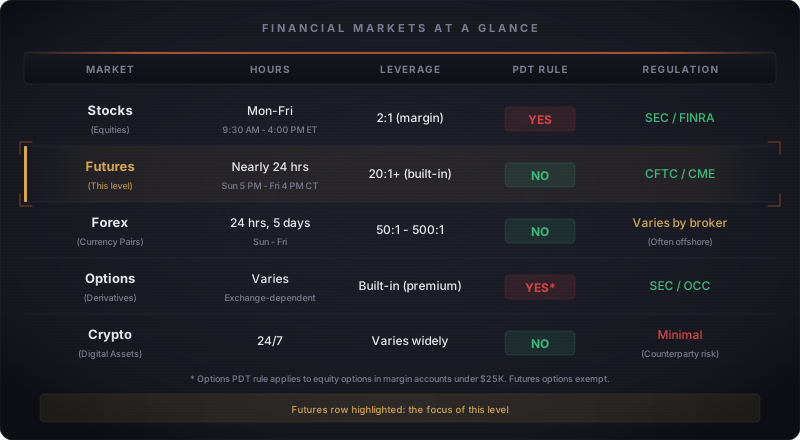
Each of these markets has legitimate uses. They're not interchangeable, though, and picking the wrong one for your situation costs real money. The comparison below covers the details that matter most to active traders:

Side-by-side comparison of stocks, futures, forex, options, and crypto across trading hours, leverage, PDT rule, and regulation

What Makes Futures Different

Futures have structural advantages that matter specifically for active traders. These aren't marketing bullet points. They're mechanical differences in how the market operates.

No PDT rule. Futures are regulated by the CFTC (Commodity Futures Trading Commission), not FINRA or the SEC. The Pattern Day Trader rule (FINRA Rule 4210) doesn't apply. You can day trade with a $5,000 account and take as many trades as you want. For traders with smaller accounts, this is the single biggest structural advantage.

Built-in leverage. When you buy one ES contract, you're controlling roughly $265,000 worth of the S&P 500 (at 5,300 x $50 per point). Your broker only requires a fraction of that as margin. But here's where most explanations stop, and where most beginners get dangerous ideas about what "margin" means.

Most beginners think futures margin works like stock margin: you're borrowing money from your broker to buy more than you can afford, and you owe interest on the loan. That mental model feels right because the word "margin" is the same in both contexts and because both let you control more value than the cash in your account. But the mechanics are completely different.

Stock margin IS a loan. Your broker lends you money, charges interest on it, and you owe that money back regardless of what happens to your position. Futures margin is a performance bond. You're depositing collateral with the exchange to prove you can cover potential losses. Nobody lends you anything. You don't pay interest. You're not in debt.

An analogy makes the difference concrete. Think about renting an apartment. The landlord requires a security deposit before you move in. That deposit isn't a loan, and the landlord isn't lending you the apartment. You're putting up money that proves you're good for potential damages. If everything goes fine, you get it back. If you trash the place, they keep what they need to cover the cost.

Now compare that to a car loan, where the bank gives you money you don't have, charges you interest every month, and you owe the full amount regardless of what happens to the car's value. Stock margin is the car loan. Futures margin is the security deposit. Your futures margin isn't creating debt. It's sitting at the exchange as collateral, and the exchange adjusts your requirement daily based on how your position is doing.

If the position goes against you beyond your margin, you'll get a margin call asking for more collateral. But at no point did anyone lend you money.

Leverage Comparison: Stocks vs Futures
Buying SPY stock worth $265,000

You need $265,000 in cash, or $132,500 on 2:1 stock margin, which IS a loan with interest

Buying 1 ES contract, same exposure

You post about $12,000 in margin: a good-faith deposit, not a loan, no interest

Capital efficiency

Futures give you the same market exposure with roughly 4-5% of the capital tied up as collateral

The catch

A 2% adverse move wipes out $5,300 of your margin, nearly half your deposit. Leverage amplifies both gains AND losses.

Futures leverage lets you control large exposure with small capital, but that same leverage means a small percentage move creates a large dollar impact on your account. This is why position sizing and stop losses are non-negotiable.

Nearly 24-hour trading. ES and NQ trade from Sunday 5:00 PM to Friday 4:00 PM CT, with a 1-hour daily maintenance break. You can react to overnight news, trade the European open, or close a position at 2 AM if you need to. Stock traders have to wait until 9:30 AM and hope their gap doesn't destroy them.

Centralized clearing. Every futures trade clears through the exchange's clearinghouse (CME Clearing for ES and NQ). There's no counterparty risk. Your broker could go bankrupt and your position is still protected. Compare that to forex, where many retail brokers are the counterparty to your trades, meaning they profit when you lose.

Tax treatment. Futures contracts in the US fall under the 60/40 rule (Section 1256). 60% of gains are taxed as long-term capital gains, 40% as short-term, regardless of how long you held the position. For active traders, this can be a meaningful difference. Consult a tax professional for your specific situation.

Why We Start With Futures

Three things make futures the right starting point for active traders, and none of them are about making more money.

Clean fills on a centralized exchange. Every order routes to the CME, where the matching engine pairs buyers and sellers transparently. Compare that to forex, where your broker might be the counterparty to your trade, or to crypto, where exchange infrastructure varies wildly and counterparty risk is real. With futures, you always know who's holding the system together: the CME clearinghouse, the same institution that's been doing it since 1898.

Predictable costs. Commissions and exchange fees are fixed and disclosed upfront. You know the exact cost per round trip before you click the button. In forex, your real cost is the spread, which widens during volatility and news events, exactly when you most need to exit. In stocks, commissions might be "$0," but you're paying through order flow routing and wider effective spreads. With futures, the cost is the cost. No surprises.

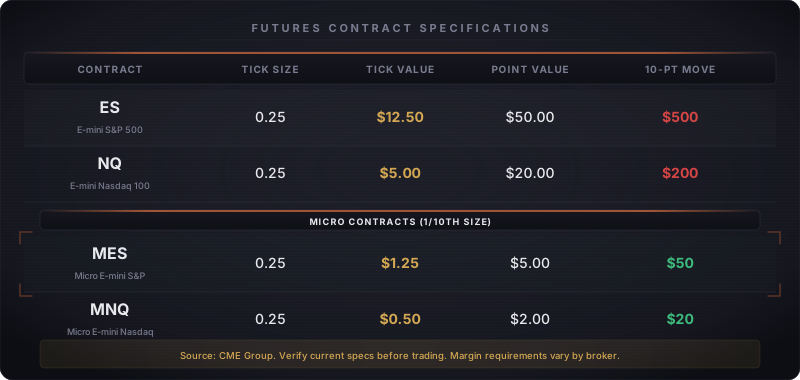
Clear risk per tick. Each tick of ES is always worth $12.50. Each tick of NQ is always $5.00. This never changes based on time of day, volatility, or your broker. That means your risk math is exact, every single time. When you calculate "my stop is 2 points away, that's $100 on ES," you know that number is right. You can't say the same for forex spreads or crypto slippage.

ES, NQ, MES, and MNQ futures contract specifications including tick size, tick value, point value, and risk per 10-point move

We focus on ES and NQ futures in this level because they offer the best structural foundation for active retail traders. The prop firm industry is built almost entirely around these contracts. The liquidity is deep. The mechanics are fair. And the path from simulation to funded trading is well-established.

Once you've built your foundation here, you'll have the option to branch into stocks and options tracks, each with their own dedicated modules. But futures are where the skills transfer best, so they're where we start.

Micro Contracts: Your Starting Point

If standard ES and NQ contracts feel too big (and for most beginners, they should), micro contracts are where you start.

The CME introduced Micro E-mini contracts in 2019 specifically for smaller accounts and developing traders. They trade the exact same market, on the exact same exchange, with the exact same price action. The only difference is size: micro contracts are 1/10th the value of their full-size counterparts.

Standard vs Micro: Same Market, Different Scale
ES (standard) 10-point move

10 points x $50/point = $500 profit or loss

MES (micro) same 10-point move

10 points x $5/point = $50 profit or loss

NQ (standard) 10-point move

10 points x $20/point = $200 profit or loss

MNQ (micro) same 10-point move

10 points x $2/point = $20 profit or loss

Micro contracts let you trade the exact same chart, same price action, and same setups as the full-size contracts, at 1/10th the dollar impact. Your learning is identical. Your risk of ruin is dramatically lower.
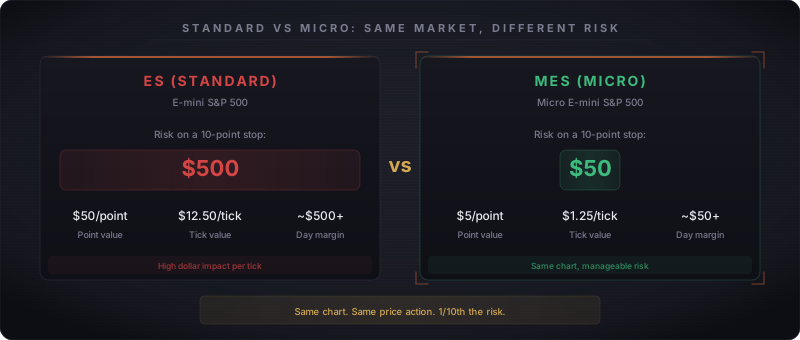
Standard ES contract vs Micro MES contract: same chart, same price action, 1/10th the risk per trade

Micro contracts aren't "baby contracts." They're training tools. Professional athletes practice before they compete. Surgeons train on simulations before they operate. You should practice on micros before you size up. That's not weakness. That's the whole point of this level: building skills at a scale where mistakes teach you instead of breaking you.

The next lesson covers how orders actually work, because the gap between clicking "buy" and getting filled is where a lot of money gets lost.

01Test

You’ve finished reading. Time to check what landed.

Check Your Understanding

1 / 5

1.What makes futures a derivative?

02Practice

Knowing isn’t enough. Put it into practice.

Practice Exercise

Calculation·~15 min

Calculate the capital requirements and costs for getting the same S&P 500 exposure through stocks vs futures. Use the contract specifications from this lesson and show every step of your math.

03Reflect

Before you move on, anchor these ideas.