What the Bid and Ask Actually Mean
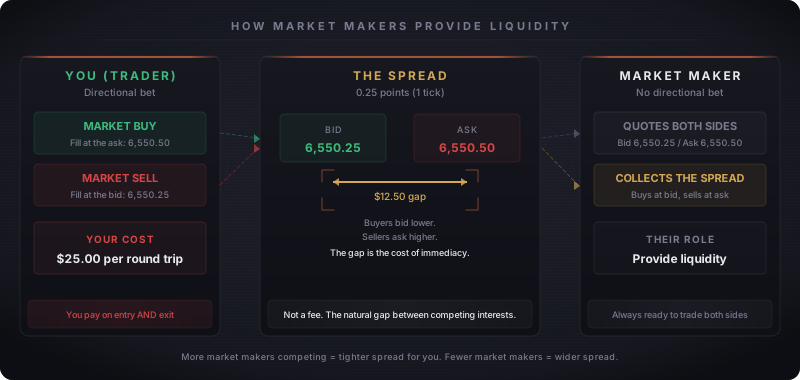
The bid is the highest price any buyer is currently willing to pay. The ask is the lowest price any seller will accept. The bid-ask spread is the gap between them. When you send a market buy order, you fill at the ask. When you sell, you fill at the bid. Every market order costs you the width of the spread.
ES is showing a bid of 6,600.25 and an ask of 6,600.50. The spread is 1 tick (0.25 points). If you buy at the ask and immediately sell at the bid, you lose $12.50 per contract without price moving at all. That's the cost of immediacy, like exchanging currency at an airport: the booth's markup is the price of not waiting.
The instinct is to think the spread is a fee the exchange charges. It's not. Nobody pocketed that fee. It emerged naturally from the gap between what buyers will pay and what sellers will accept. Fees are fixed. The spread changes constantly, and those changes tell you something about the market.
Who's on the Other Side: Market Makers
In a liquid market like ES, a market maker often takes the other side of your trade. They continuously post both bid and ask orders, profiting from the spread itself rather than directional bets.
Does a limit order pay the spread? No. When you post a limit order at the bid, you're providing liquidity like a market maker: waiting for a seller to come to your price. The trade-off is your order might not fill at all.
Liquid markets like ES have tight spreads because dozens of market-making firms compete for order flow. When market makers step away (news events, overnight sessions, thinner contracts), the spread widens.
Why the Spread Changes
The spread moves throughout the day based on three factors.
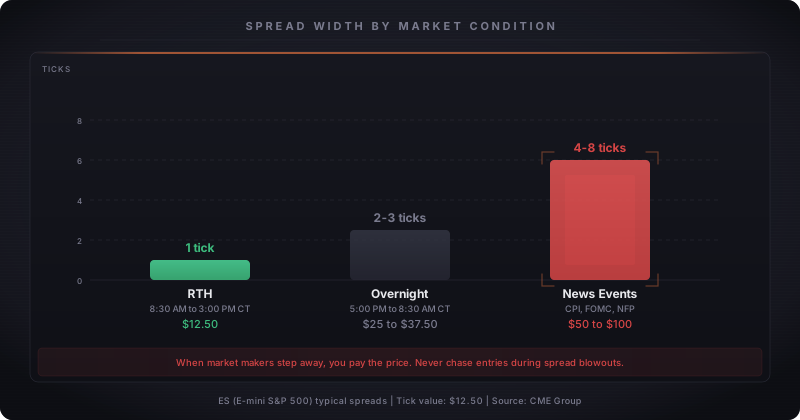
Time of day is the biggest factor. During RTH (8:30 AM to 3:00 PM CT), ES typically holds a 1-tick spread. During overnight sessions, a 2-tick or 3-tick spread isn't unusual.
News events cause the book to thin out fast. Before CPI, FOMC, or NFP, market makers pull their orders. The spread can blow out to 4-8 ticks on ES in the seconds surrounding a release.
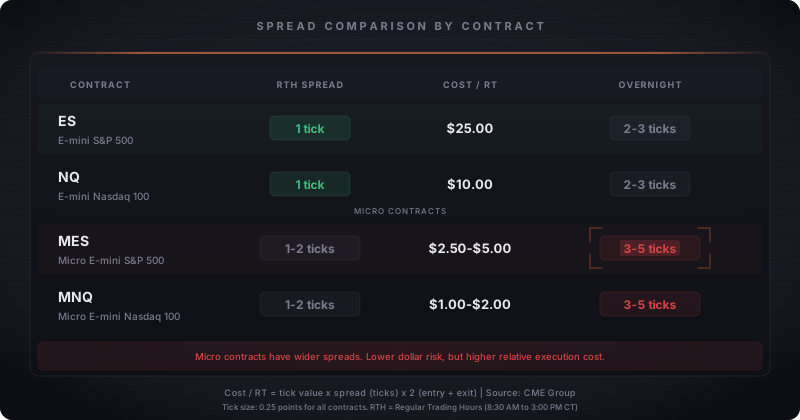
The contract you trade matters. ES and NQ have tight spreads. MES often shows 1-2 ticks during regular hours and can widen to 3-5 ticks overnight.
MES keeps your dollar risk small while you build skills, but you're paying relatively more in spread costs per trade. As you move from MES to ES, you get cheaper execution.
How Spread Costs Add Up
One tick on ES is $12.50. You pay the spread on every entry and exit. A single round trip costs $25 in spread. Take 5 round trips a day and that's $125, or $2,500 per month before commissions.
0.25 points x $50/point x 2 (entry + exit) = $25.00
$25 x 3 = $75/day = $1,500/month
$25 x 5 = $125/day = $2,500/month
$25 x 10 = $250/day = $5,000/month
At 5 round trips per day on ES, the spread alone costs $2,500/month. On a $25,000 account, that's 10% of your capital every month just in spread costs, before a single commission dollar. On a $50,000 prop firm account, it's 5%. The math is the same: the more you trade, the more the spread eats.
The tighter your targets, the more the spread matters. A setup targeting 8 points on ES ($400) absorbs a 1-tick spread easily. A setup targeting 2 points ($100)? The spread ate 25% of your potential profit before the trade started.
Key Rules
- ES round-trip spread cost: $25.00 (1 tick x $50/point x 2 crossings). Calculate this for your contract before trading.
- Spread cost on 10 daily ES round-trips: ~$250/day, $5,000/month. The math is non-negotiable.
- Spreads widen during overnight sessions and news events. A 2 AM trade costs 2-3x more in spread than the same trade at 10 AM.
- Limit orders avoid the spread. Market orders pay it. Use limit orders for entries when price can come to you.
- MES has a wider spread than ES during regular hours. Accept the higher relative cost as a training expense.
- Never enter a trade during a spread blow-out (4+ ticks on ES). Wait 5-10 minutes for conditions to normalize.
Now that you can calculate what the spread costs you per trade, per day, and per month, the next lesson shifts to reading price charts.