You watched ES break above resistance, entered long, and within two candles the move reversed and ran your stop. Later you looked at the chart again and noticed the breakout bar had barely any volume. Nobody was behind the move. You bought a breakout that had no conviction, and the market punished you for it.
Volume counts contracts traded during a given time period. It counts transactions, not people. If 100 contracts change hands, that's 100 units of volume whether it was one institution or 100 individuals.
Throughout this lesson, we're focused on per-bar volume (the volume on each candle), because that's what you compare against a session average to spot meaningful activity.
How to Read Volume Bars
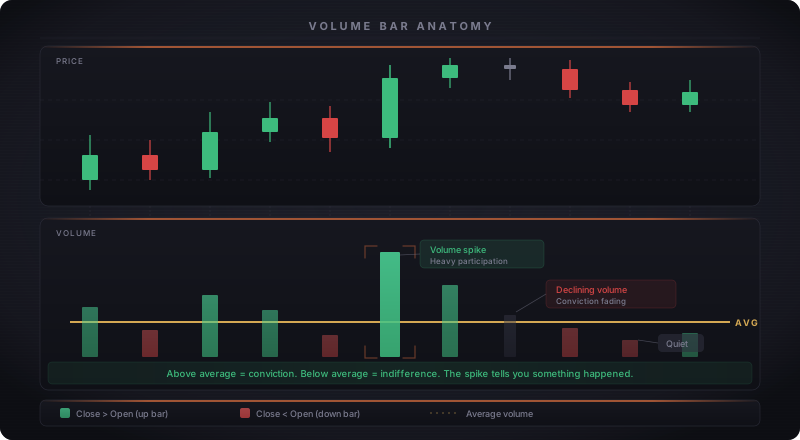
Volume bars sit below each price candle. Tall bars mean heavy activity. Short bars mean quiet. The height matters more than the color.
The key habit: compare each bar against the session average, not random bars. Add a 20-period moving average to the volume pane as your baseline. Anything above that line is above-average participation.
Comparing Volume to Session Average
Session average (ES, 5-min chart, RTH)
Roughly 15,000 contracts per bar during normal RTH activity
Bar you're analyzing
45,000 contracts on a breakout bar = 3x the session average
Next bar
8,000 contracts = roughly half the average
Interpretation
The breakout bar had strong participation (3x average). The follow-through bar saw participation drop below average. Interest surged, then faded.
When volume is 3x or more above the session average, something meaningful is happening. When it drops below average immediately after, the urgency didn't sustain. Watch the next few bars to see if buyers or sellers re-engage.
Three patterns to watch for. Volume spikes: bars dramatically taller than surrounding ones, signaling forced participation. Declining volume: participation fading over several bars, the move losing conviction. Average volume: your baseline for comparison.
Volume as Confirmation
Volume doesn't predict direction. It tells you whether traders agree with the move already happening. A massive volume bar on a down move is bearish conviction, not a buying signal. Volume measures intensity, not polarity.
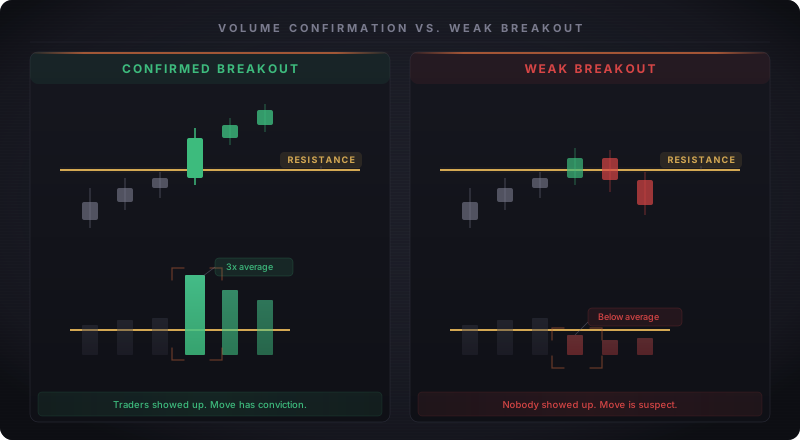
When price breaks through resistance and volume jumps above average, that's volume confirmation: the move has participation. When volume stays flat on a breakout, nobody showed up. Those moves reverse more often than they hold.
When Volume Surges but Price Doesn't Move
When a bar shows 5x the session average but price barely moves, it means aggressive buying and selling are roughly matched. A tug-of-war. This pattern shows up at significant levels: round numbers, previous day's high or low. The stalemate won't last. The longer the fight and the higher the volume, the more explosive the resolution.
Futures Volume vs. Tick Volume
Futures volume is centralized and real: actual transactions on the CME. In forex and CFD markets, "volume" usually means tick volume (price change count, not transactions). The patterns you just learned are more reliable with real data.
Volume at Price: A Preview
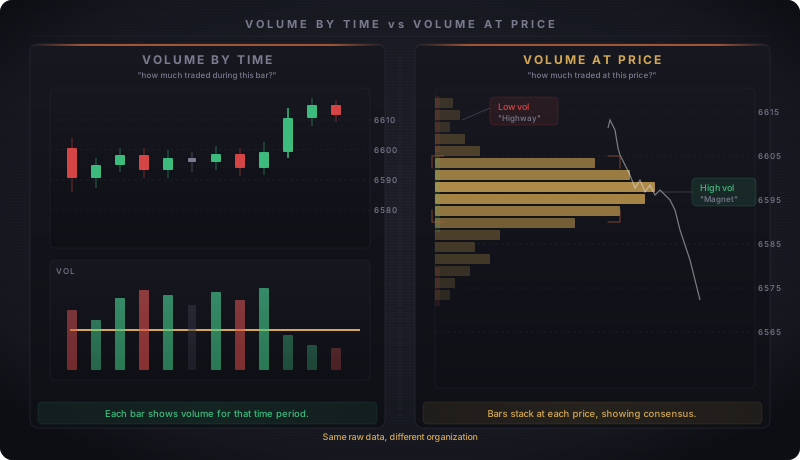
Everything above looks at volume through time. There's another lens: volume at price, which asks how much trading happened at each price level. High-volume prices act like magnets. Low-volume prices act like highways. You'll work with volume profile tools in later modules.
Key Rules
Compare volume bars to the session average, not to random bars. Use a 20-period moving average on the volume pane as your baseline.
A breakout on 3x+ average volume has conviction. A breakout on below-average volume is a warning sign.
ES averages 1.2 to 1.5 million contracts per day during RTH. Know what "normal" looks like for your contract.
High volume + no price movement = tug-of-war at a significant level. Watch for the resolution.
Declining volume during a trend means participation is fading. The move is losing fuel.
Futures volume is real (actual contracts). Forex tick volume is approximate (price changes). Trust futures data more.
The next lesson covers trading sessions and market hours, because "high volume" at 2 AM and 10 AM mean completely different things.
01Test
You've finished reading. Time to check what landed.
Check Your Understanding
1 / 5
Scenario
1.You're watching a 5-minute ES chart during RTH. The average bar is printing about 14,000 contracts. You spot a bar with 56,000 contracts that coincides with a sharp move down. What does this tell you?
02Practice
Knowing isn't enough. Put it into practice.
Practice Exercise
Calculation·~20 min
Open a 5-minute chart of ES or MES from any recent regular trading session (8:30 AM to 3:00 PM CT). For the first 30 minutes of RTH (the first 6 bars starting at 8:30 AM), add up the total volume across all 6 bars. Divide by 6 to get your per-bar average. Then scan the rest of the session and find 3 bars where volume exceeded 2x your calculated average. For each spike bar, write down: (1) the actual volume count, (2) the multiple of your average (e.g., 3.2x), (3) what price did on that bar (up, down, doji), and (4) whether the next 2-3 bars confirmed or faded the move. Finally, estimate the session's total volume and calculate what percentage occurred in the first 30 minutes.