Why Write It Down
Module 1.3 covered how to manage risk: position sizing, stop losses, and the daily loss limit. Module 1.4 covered the emotional triggers that make you break those rules. So why do you need a written plan?
Because knowing and doing are different things under pressure. Every trader who has followed their rules calmly in simulation, then broken all of them inside 20 minutes of a live session, already knows this.
For years, my trading rules lived in my head. I knew my daily loss limit, knew when I was supposed to stop, knew my entry criteria.
The problem wasn't that I forgot them. It was that under pressure, every rule felt negotiable. After a bad open, down two losses before 9 AM, I'd tell myself the next setup was different. There was no document on my desk to tell me otherwise. Just a vague intention in my head, and intentions don't hold up when the market is moving.
I eventually built UpSkalr specifically to solve this. Not to trade for me, but to force the formalization: a written plan, rules specific enough to actually follow, and a way to track whether I held to them. Writing the rule makes it harder to pretend it doesn't apply.
Without a written plan, the gap between what you know and what you do widens the moment money is on the line. You take two losses in the first 30 minutes of the session. Your trailing drawdown just moved closer to your account floor. A clean setup forms on the 5-minute chart, and you tell yourself this one is different. Without a written rule that says "after two consecutive losses, cut size in half or stop for the day," that voice in your head wins every time.
Think of a trading plan like a pre-flight checklist. Pilots don't skip checklists because they've flown a thousand times. They use them precisely because high-pressure situations are when humans forget the basics. Your plan is the checklist you read before every session and the rulebook you follow when your instincts are screaming at you to do something reckless.
The Six Components
Your plan doesn't need to be long. A single page is enough. But every line needs to be specific enough that you could hand it to another trader and they'd know exactly what to do.
1. Market and Instrument. Pick one instrument and learn how it moves. ES moves $12.50 per tick. MES moves $1.25 per tick. NQ moves $5.00 per tick. These numbers set your actual dollar risk on every trade.
Two contracts of MES with a 10-tick stop costs you $25. The same setup on ES costs $250. On a $50K evaluation, that's the difference between a scratch and half a percent of your account on a single trade. Don't split your attention across multiple instruments at this stage. ES and NQ are highly correlated during regular trading hours, so trading both often means doubling your directional exposure without realizing it.
2. Timeframe and Sessions. This defines when you trade and when you walk away. The futures market runs nearly 23 hours a day, but the tradeable action concentrates into specific windows.
The opening drive (8:30-10:30 AM CT for ES/NQ) carries the highest volume and cleanest directional moves. Most experienced day traders do the majority of their work in this window. The midday session (10:30 AM-1:00 PM CT) turns choppy as volume drops, and momentum setups that work at the open tend to chop you up during lunch. The afternoon picks back up after 1:00 PM CT but rarely matches the morning's clarity.
Your plan needs to name which sessions you trade and which you avoid. "I trade the 5-minute chart during the opening drive, 8:30-10:30 AM CT, and take no new positions after 10:45 AM" is a rule. "I trade when I'm free" is how you give back your morning gains during lunch.
3. Entry Rules. What specific conditions must exist before you take a trade? If you haven't chosen a strategy yet, write placeholder rules and mark them for revision. A placeholder entry rule looks like: "Look for breakouts at key levels." That gets you started, but it doesn't tell you what constitutes a breakout, what the confirmation signal is, or where the stop goes. A completed rule answers all three: "Enter long when price closes above a resistance zone with at least 2 prior touches, confirmed by a follow-through candle on the next bar. Stop 2 ticks below the breakout candle's low." The placeholder gives you a structure to fill in. The completed version gives you a decision you can execute without asking yourself any questions. Your entries will evolve as you build screen time in simulation, and that's expected. In Level 2 you'll learn specific setups you can use to fill those placeholders. The goal right now is to have the structure in place. Later in this lesson, the Stranger Test gives you the tool to evaluate whether any rule, including your entries, is specific enough to actually follow.
4. Exit Rules. Where does your stop go, and what determines your target? Exits are where most plans break in practice, because closing a position triggers different psychology than opening one. You need rules for three situations: where the stop goes before entry and that it doesn't move once placed, how you determine your reward-to-risk target, and what you do if the trade stalls at breakeven. "I'll exit when it feels right" guarantees inconsistency. "Stop 2 ticks below the support zone, target 2:1 R:R, close the trade if price stalls at breakeven for 15 minutes" gives you a decision for every scenario.
5. Risk Rules. Everything else in your plan is negotiable. This section is not. How much do you risk per trade? What's your daily loss limit?
The Pre-Execution Protocol (check size, check stop, check bias) goes here. The Drawdown Protocol (50% of daily limit = cut size in half, 100% = done for the day) goes here. These constraints override everything else in your plan. They're not habits you developed separately and imported here. They're the load-bearing sections of the document.
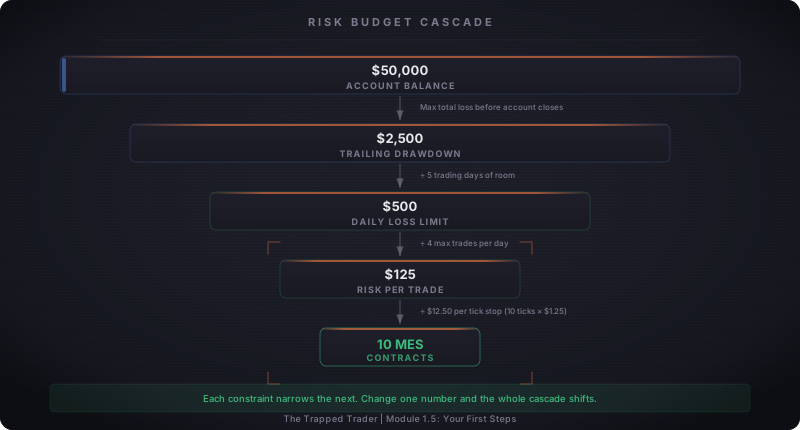
If you're trading a prop firm evaluation, your risk numbers need to work backward from the firm's rules. A $50K account with a trailing drawdown around $2,500 means your daily loss limit should be $500-750 at most. You need multiple days of room to absorb normal losing streaks without the drawdown ending your account.
The five-day buffer in the cascade diagram is an illustration assumption. Your evaluation's specific parameters may be different. Build your own cascade using your actual account size and your firm's drawdown rules.
6. Daily Routine. Beginners tend to skip this section entirely, but it matters more than your entry rules. What do you do in the 15 minutes before the session opens? Review overnight price action, check the economic calendar for scheduled releases, note where price sits relative to yesterday's range.
During the session: follow your plan, log each trade in real time, and enforce your Drawdown Protocol thresholds without negotiation. After the session: journal for 10 minutes while the trades are still fresh and rate your plan adherence on a 1-5 scale. A routine converts discipline from a daily willpower test into a habit.
A pre-session block in your plan might look like: "Review overnight price range, mark yesterday's high and low on the chart, check the economic calendar for 8:30 AM CT releases, note whether current price is above or below the prior session's midpoint." That level of specificity means the same 10 minutes happens every morning. You're not deciding what to check. You're executing a checklist.
Writing Rules You Can Follow
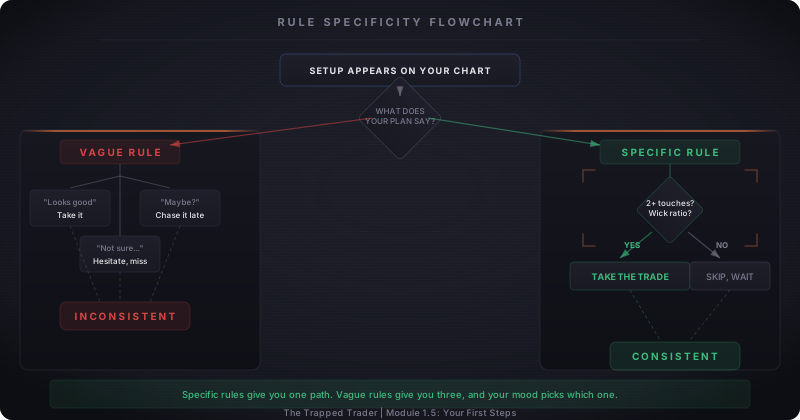
Vague rules are what sink a first trading plan. "I'll manage my risk" means nothing when you're staring at a losing position. "I'll be disciplined" means nothing after three stops in a row. A rule is only real if someone who has never met you could read it and execute it without asking a single question.
The entry section of a first trading plan is usually the longest. Three paragraphs on the setup, the confirmation signal, the timeframe. The risk and constraint sections are usually one bullet point, or missing entirely.
This happens because refining entries feels like craftsmanship. You're building something specific to you: a pattern you recognize, a trigger you've trained yourself to see, a setup that reflects your read of the market. Each revision makes the entry sharper. You can point to it and say you're working on your trading. There's a real sense of progress in that, and it doesn't feel wrong because entries are genuinely important.
Writing constraint rules has none of that satisfaction. "Stop trading after losing 3% of your account" takes two minutes to write and feels like bureaucracy compared to the entry condition you just spent an hour refining. Risk percentages don't require creativity, they just require honesty about your limits. So the constraint section stays thin, the entry section grows, and the plan becomes a document that describes what you want to trade but says almost nothing about what stops you from trading badly when the session goes sideways.
But that priority is backwards. The entry section is the easiest part to change as you develop your edge. The risk section is what keeps you alive long enough to develop one.
The Plan vs. The Trade
There's a distinction that trips up beginners: your trading plan and a trade plan are not the same thing.
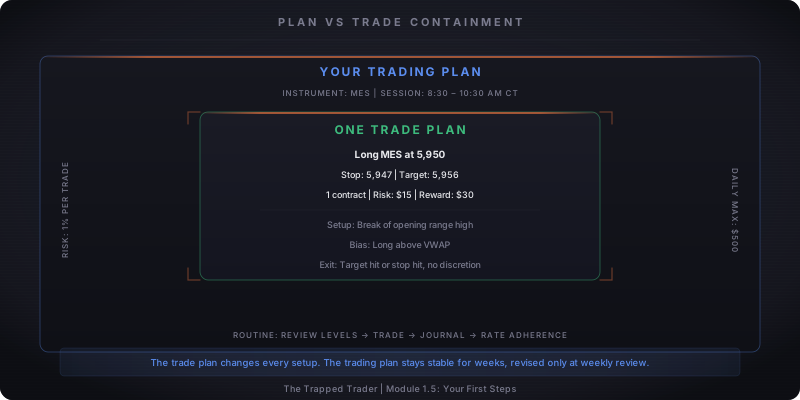
Your trading plan is the permanent rulebook. It defines which instrument you trade, which sessions you're active in, what risk parameters you follow, and what your daily routine looks like. It stays stable during any given session. You revise it weekly or monthly based on journal reviews, not in the middle of a trading day.
A trade plan is specific to a single setup: direction, entry, stop, target, and size for one opportunity. "Long MES at the 5,950 support zone, stop at 5,947, target 5,956. 1 contract, risking $15 to make $30." That trade plan lives and dies with that one setup. The trading plan's rules do not change.
The relationship: every trade plan must fit inside the trading plan's constraints. If your trading plan says you risk 1% per trade, no individual trade plan can exceed that. If your trading plan says you're done after hitting your daily loss limit, it doesn't matter how clean the next setup looks. The trading plan is the law. The trade plan is one application of that law to a specific moment in the market.
Your Plan Is a Draft
The trading plan you write today will change. It's the first version of a document you'll revise for as long as you trade.
The revision cycle works like this: write the plan, trade with it in simulation, journal every session, review your journal at the end of the week, and update the plan based on what you find. Maybe your entry rules are too vague and you keep interpreting them differently each day. Tighten them. Maybe your session window is too wide and your worst trades cluster during the midday chop. Narrow it.
But not every losing stretch means your plan is broken, and the journal is what tells you which one you're dealing with. Three red days in a row with plan-compliant execution is normal variance. A drawdown where your journal shows you followed every rule is not a reason to overhaul your plan. Two or three trading days is not a sample. Give it at least two weeks of journaled sessions before you decide whether you're dealing with normal variance or a structural flaw in the plan.
A drawdown where your journal shows you broke your session rules twice and sized up after a loss is a behavior problem, not a plan problem.
The journal is the feedback loop. Without it, every drawdown looks the same and you'll either change a plan that was working or keep a plan that needs fixing. With data, you can tell the difference.
Open your trading plan and journal side by side every Friday. The knowing-doing gap from Module 1.4 applies here too: intending to do that weekly review and actually doing it are different things. That revision habit, adjusting the plan based on what the journal actually shows, keeps the document calibrated to how you actually trade. The plan you improve each week is more valuable than a perfect plan you never revise.
If you want a dedicated place to store your plan as it evolves, UpSkalr has a Strategy & Rules section for exactly this: your Playbook for the overall framework and your Rules for the specific constraints you hold yourself to. It keeps your plan accessible every morning instead of buried in a Google doc you open once a month.
Two failure modes show up at this stage: being too patient with your simulation performance and not demanding enough from yourself, or not patient enough and already thinking about going live before you've earned it. The next lesson covers how to calibrate your expectations so you know which one applies, and what consistently profitable actually looks like in futures.