What Consistent Profitability Actually Looks Like
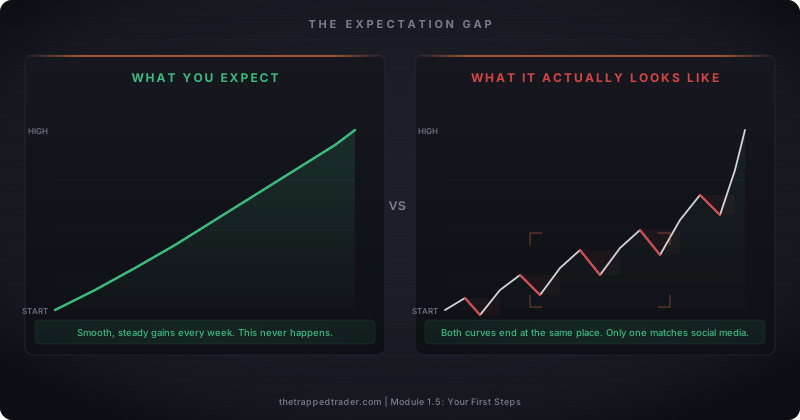
Most people who start trading futures imagine profitability as a series of big winning days. Green screenshots. Four-figure P&L numbers. The account climbing in a smooth upward line. That's the image social media delivers, and it doesn't just mislead you. It actively sets you up to feel like a failure even when you're doing well.
Consistent profitability looks more like training for a marathon than hitting a jackpot. Marathon training is months of boring, repetitive work. You don't feel fast. Your daily runs aren't exciting. Nobody posts their Tuesday morning 6-mile jog. But each week, your pace drops by a few seconds. Your endurance creeps up. The improvement is real, but it's invisible on any single day. In trading, the P&L chart of a consistently profitable trader doesn't look like a smooth upward line. It looks choppy. Red days mixed in with green ones. Some weeks are flat. An entire month might end up barely positive. The account grows, but it grows slowly and unevenly.
When I started trading futures, I thought I'd be profitable within a few months. Trading looked easy from the outside. Buy low, sell high, collect your money. I'm over four years into this now, and I only recently reached the kind of consistency I assumed would come in the first quarter. Four years of blown accounts, restarts, and slowly learning that the gap between "I know what to do" and "I actually do it every day" is wider than any chart pattern.
Most beginners think that profitable traders have big green days and then hold on to those gains. What actually happens is different: profitable traders have a mix of small wins, small losses, breakeven days, and occasional larger moves in both directions. The edge shows up across dozens or hundreds of trades, not in any single session.
The reason the "big winner" mental model feels right goes deeper than just social media. Loss aversion makes losses feel roughly twice as painful as equivalent gains feel good, so your brain assumes winners must be big to offset the pain. Your early trading experiences reinforce this: most beginners oversize their positions, which creates dramatic swings in both directions. When a big win lands, it feels like proof that trading works this way. And the only results anyone shares publicly are the impressive ones. Nobody screenshots a $47 Tuesday. These forces combine to build a mental model that feels intuitive but is completely wrong.
The Math of Small Gains
"Small consistent gains" sounds good as a concept. But what does it actually mean for your specific account? Let's ground this in real numbers.
A strong performance target for a developing futures trader is 1-2% per month on account equity. That's not a misprint. One to two percent. Monthly. If that number feels small, pay attention, because your reaction to it is the expectation gap in action.
$25,000 x 0.01 = $250/month
$250 / 20 = $12.50/day
$250 x 12 = $3,000/year
On a $25,000 account, a 1% monthly return means averaging $12.50 per day. That's one tick on a single ES contract. One tick. That's what "consistent profitability" looks like at this account size.
Now bump it to 2%:
$25,000 x 0.02 = $500/month
$500 / 20 = $25/day
$500 x 12 = $6,000/year
Two percent monthly on $25,000 is $25/day. Two ticks on a single ES contract. Still not the windfall most beginners picture, but it's a 24% annual return. Most hedge funds would take that number without hesitation.
You won't always trade one contract. As your account grows, the same percentage compounds on a larger base. But you can't skip the small-account phase by taking bigger risks. That's how accounts blow up.
How Long Does This Take?
No amount of honesty about return targets matters if you think you'll get there in three months. The timeline is the other half of the expectation gap.
Academic research on trader survival is blunt. A study of nearly 20,000 day traders in Brazilian futures markets (Chague, De-Losso, and Giovannetti, 2019) found that 97% of traders who persisted for more than 300 days lost money. Only about 1% earned more than the local minimum wage from trading. A separate study covering 14 years of data from the Taiwan Stock Exchange (Barber, Lee, Liu, and Odean) found that roughly 80% of day traders quit within two years, nearly 40% quit after just one month, and fewer than 1% demonstrated reliably profitable trading.
I'm not sharing those numbers to scare you off. I'm sharing them so the next time someone on X tells you they went full-time in three months, you have the data to know how unlikely that really is.
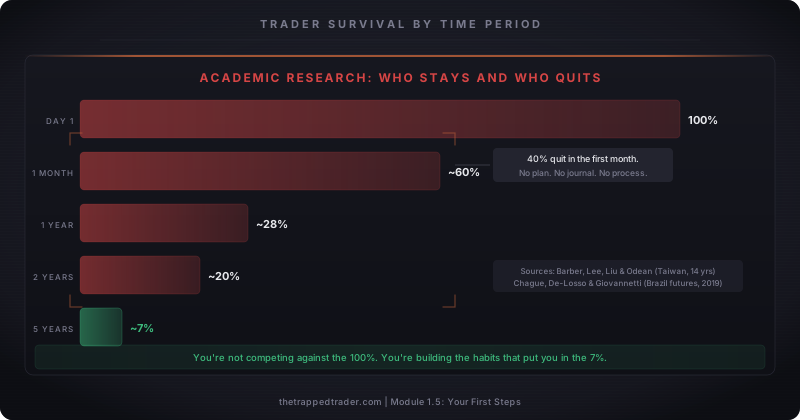
The 40% who quit in the first month almost certainly didn't have a plan. They didn't journal. They didn't use simulation properly. They walked in expecting quick returns, and when the first losing week hit, they walked back out. They could have learned. They just never gave themselves enough time.
In 'Paper Trading: Your Training Ground' (Lesson 3), you learned how to use simulation as a structured practice environment. That lesson exists specifically because the timeline is long. Sim isn't a box to check before going live. It's where you spend the majority of your first year.
What Keeps Traders in the Game
If the survival numbers are that stark, what do the traders who make it through actually do differently?
Talent doesn't explain it. Starting capital doesn't either. The difference is process attachment.
Think about it like learning a musical instrument. Two students start piano lessons the same week. One measures progress by whether they can play their favorite song. The other measures progress by whether their finger positioning improved this week. Student A quits in month three because they still can't play the song. Student B is still practicing in year two because they can see the incremental improvement in their technique. The song will come, but it comes from the technique, not from wanting it hard enough.
In 'Building Your First Trading Plan' (Lesson 4), you wrote a set of rules for yourself. That plan is your technique tracker. Every day you follow your rules, regardless of P&L, you're making progress. Every journal entry where you identify what went right or wrong in your process gives you data. After three months, you have a real picture of your strengths and weaknesses. After six months, you have enough data to know whether your edge is developing.
The traders who survive are patient enough to let the data accumulate. They stop checking their P&L after every trade and start checking their process metrics instead: plan compliance, journal consistency, risk rule adherence, and deliberate skill practice.
Setting Honest Milestones
Your first milestone isn't profitability. It's survival: protecting your capital long enough to collect meaningful data about your own trading. If that sounds underwhelming, good. That reaction is the expectation gap talking.
A realistic milestone framework for your first year:
Months 1-3 (Simulation): Follow your trading plan with at least 70% compliance. Journal every session. Focus on execution quality, not P&L. Your goal is habit formation.
Months 4-6 (Simulation): Achieve 80%+ plan compliance. Start tracking your edge: win rate, average win vs. average loss, profit factor. You're collecting data on yourself.
Months 7-9 (Simulation or micro-live): Two consecutive months of positive returns in sim, using proper position sizing. If you're considering live trading, start with micro contracts (MES, MNQ) at minimum size. Your goal is to test whether your sim habits hold when real money is at stake.
Months 10-12 (Micro-live): Consistent execution with real money, even at minimal size. One contract. No scaling up until you've proven you can follow your rules with skin in the game.
If you have existing market experience from stocks or options, some of the early phases move faster. You already understand order types, chart reading, and the emotional weight of real money. But don't skip the sim phase for a new instrument. The mechanics of futures leverage are different enough that even experienced traders need time to calibrate.
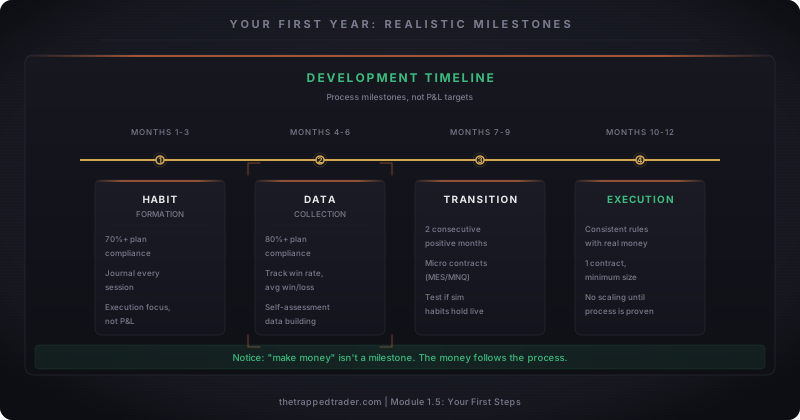
Notice that "make a lot of money" doesn't appear anywhere on that timeline. That's intentional. The money follows the process, but only after the process is solid. Trying to shortcut the timeline by trading bigger or going live too early costs developing traders more money than any other mistake, and it's almost always driven by the expectation gap.
Now that you've calibrated your expectations to reality, the next lesson covers a force that actively works against everything you just learned: social media. The comparison trap pulls your expectations back toward fantasy even after you've calibrated them. Knowing it exists is the first step to defending against it.