Why Sim Trading Gets Dismissed
"Why would I practice with fake money? It doesn't feel real, so what's the point?"
That objection comes up constantly in trading forums and Discord servers. It's especially common among traders who plan to go the prop firm route. "I'll just learn during the evaluation. Why waste time in sim when I could be working toward a funded account?"
Think about flight simulators. Pilots don't skip simulator training because "it's not real flying." They spend hundreds of hours in simulators before they ever touch a real aircraft. The simulator teaches the mechanics: which switches to flip, how to read instruments, how to respond to specific scenarios. It can't teach how your hands shake when turbulence hits with 200 passengers behind you. But nobody argues that makes the simulator useless.
Sim trading works the same way. Just as the simulator teaches instrument recognition and procedure execution but can't build the composure that holds when turbulence hits at altitude, sim teaches order entry, setup recognition, and risk management, but it can't build the emotional steadiness that survives when your trailing drawdown is 70% eaten. It builds the mechanical habits that need to be automatic before any kind of real stakes enter the picture. If you can't follow your rules when there's zero pressure, you have no chance of following them when your evaluation fee is on the line.
Why Sim Profits Don't Transfer
For most futures traders, the gap doesn't appear all at once. It shows up in stages, and each stage turns up the psychological pressure:
- Sim trading has zero stakes. No money at risk, no consequences for mistakes. Pure mechanical practice.
- Prop firm evaluation is still simulated capital, but now you've paid $50-200+ for the attempt. There's a trailing drawdown limit that can end it, a profit target you need to hit, and in some cases a time limit. That's enough to change how you trade. And most traders don't stop at one account. Running two or three evaluations simultaneously across different firms is common, turning a single $150 attempt into $400-500+ at risk before you've placed a single funded trade.
- Funded account puts real money in play, the firm's capital with your name on it. Profit splits mean your wins pay out. Drawdown violations mean you lose the account and start over.
- Personal capital is your own money in your own brokerage. Every dollar lost comes directly out of your pocket.
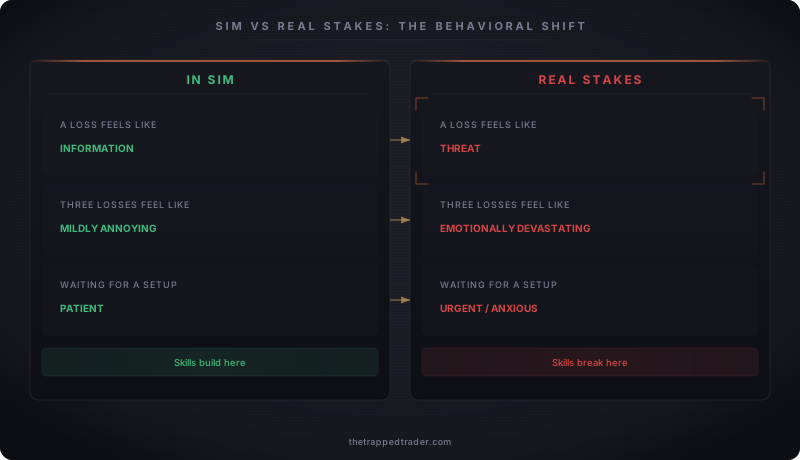
Each transition creates a version of the same three behavioral shifts:
Your threat response activates. In sim, a losing trade is information. The moment real stakes enter, a losing trade becomes a threat. Your brain's fight-or-flight system doesn't care whether it's your money or the firm's. A $500 loss on a funded account triggers the same response as a $500 loss from your bank account. The result: you move stops, cut winners early, and hesitate on entries you'd take instantly in sim.
Losses compound emotionally. In sim, three consecutive losses are mildly annoying. In an evaluation, three consecutive losses put you dangerously close to the trailing drawdown limit, and now every trade feels like it could end the attempt. In a funded account, three losses can trigger revenge trading, tilt, or a complete abandonment of your plan. The knowing-doing gap from Module 1.4, Lesson 1 (The Knowing-Doing Gap) widens at each stage.
Your relationship with time changes. In sim, you're patient because you have nothing to lose by waiting. In an evaluation with a profit target, every minute without a trade feels like falling behind. In a funded account, the fear of giving back gains creates urgency that leads to chase entries and overtrading.
The first time I moved from sim to a funded account, I noticed the difference before I even placed my first trade. In sim, every decision is weightless. Nothing real is at stake, so the signal is clear and the execution is clean. There's no overthinking when there's nothing to protect.
The best traders I've seen, the ones who pass evaluations and keep funded accounts under real pressure, somehow carry that weightlessness with them. Most traders don't. Most discover they were relying on the absence of stakes to trade well, not on their actual process.
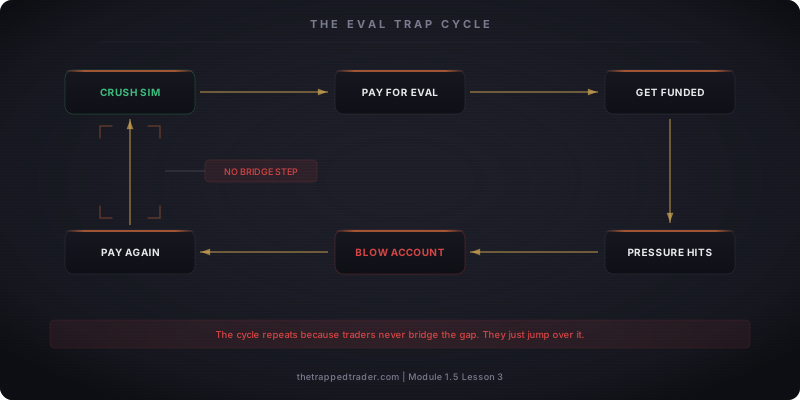
The gap alone won't destroy your account. The cycle it creates will. In the prop firm world, this cycle has a very specific shape: crush the sim, pay for an evaluation, pass the eval or blow it, get funded, blow the funded account, pay for another evaluation, and repeat. Each time around, traders blame the market or bad luck instead of recognizing the pattern: they never built the mechanical foundation in sim that would survive the pressure.
They just kept paying to skip it. Some run two or three accounts across multiple firms at once, reasoning that more shots means more chances. It doesn't. It means the same broken habits cost three times as much per month.
Five Rules for Sim Trading That Counts
Sim trading is only as useful as the rules you follow while doing it. Whether your next step is a prop firm evaluation or a personal live account, five rules make the difference between productive sim practice and wasting time clicking buttons.
Rule 1: Trade realistic sizes. If you're planning to take a 50K prop firm evaluation, sim with the same contract sizes and risk limits you'll face in that eval. If you're funding a personal account with $25,000 and risking 1% per trade, sim with $250 risk per trade. Not $2,500. Not the platform's default $100,000 account. Your position sizes in sim should match the conditions you're preparing for.
Rule 2: Run the Pre-Execution Protocol every trade. In Module 1.1, Lesson 4 (How Orders Actually Work), you learned the 3-step checklist: check size, check stop, check bias. Run it on every single sim trade. Not because you need it to avoid disaster in sim, but because it needs to be automatic before real stakes enter the picture.
Rule 3: Journal every trade. Write down the same things you'd track live: why you entered, where your stop was, how you felt, whether you followed your plan. If you won't journal in sim, you won't journal live. And without a journal, you're generating random trades with no way to learn from them.
Rule 4: Enforce your daily loss limit. This is the rule most traders break first, and the one with the most direct consequence in an evaluation. Set a sim daily loss limit and stick to it. When you hit it, close the platform. If you're preparing for a prop firm evaluation, match the eval's daily loss limit exactly.
Most sim traders blow right past this. They hit the limit and keep trading because "it doesn't matter." But in a prop firm evaluation, blowing through the daily limit can end the attempt. The habit of quitting when the limit is hit needs to be trained in sim where it's free to practice, not in an evaluation where it costs you the account.
Rule 5: Trade at realistic times. Don't sim at 2 AM on the overnight session and call it practice for trading the regular session open. Practice during the hours you plan to trade live. Market behavior changes drastically between sessions, and your sim experience needs to match your live environment.
Knowing When You're Ready
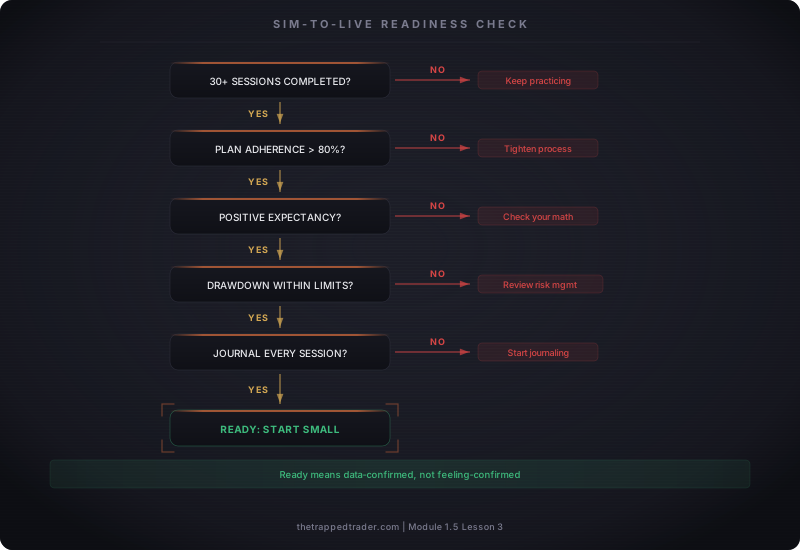
The hardest question in sim trading isn't "am I profitable?" It's "am I ready to take my first evaluation?" Those are different questions, and they get confused for a simple reason: sim profitability is measurable and concrete. After a few weeks of trading, you have a win rate, a return percentage, a dollar figure. Numbers feel like evidence.
But those numbers can't tell you whether you followed your rules on marginal setups, held your stop when it was uncomfortable, or kept your sizing consistent during a losing streak. P&L in sim can come from one or two outsized winners that masked a dozen rule violations. Process discipline is invisible in the results. It only reveals itself when the pressure is real.
Confusing the two burns through evaluation fees fast. Every failed evaluation costs $50-200+. Many traders run multiple accounts at different firms simultaneously, so a single bad month can mean $400-600 gone before any funded trading happened. String those months together without solid sim preparation, and you've spent more on evaluation fees than most people spend on trading education.
Notice what's not on that list: a specific win rate, a dollar profit target, or a time minimum measured in weeks. Also notice what it demands: all five criteria simultaneously. Meeting four out of five isn't "almost ready." The one you're missing is exactly the habit that will break when the pressure is real.
Three weeks of sloppy sim trading teaches you less than two weeks of disciplined practice with full journaling. The criteria are about process quality, not calendar time or P&L. If you're preparing for a prop firm evaluation, add one more check: can you stay within the evaluation's specific drawdown limits for 20 consecutive sessions in sim? If you can't do it with zero pressure, the evaluation fee is wasted money.
When you do transition, start at the lowest stakes available to you. For most futures traders, that means a prop firm evaluation rather than funding a personal account. I wrote about the full psychology of this shift, including why evaluations create their own unique pressure, in The Sim-to-Live Gap.
For a deeper look at evaluation-specific psychology, see Prop Firm Evaluation Psychology. The short version: whether it's an evaluation or a personal account, trade the smallest size allowed for your first 10-20 sessions. You're not trying to make money yet. You're testing whether your sim habits survive contact with real stakes.
The Bridge, Not the Destination
Picture two traders starting out at the same time. The first treats sim as a formality, clears a few weeks of casual screen time with no journal, then pays for his first evaluation. He blows it. He pays for a second. Blows it.
He's now on his fourth evaluation, each one for a different firm, each one funded by the same problem he never diagnosed. He's not unlucky. He's never built the foundation that would let him keep a funded account under pressure.
The second trader spends six weeks in structured sim practice. She journals every session, tracks her plan adherence, and identifies a specific problem with her exits under the first evaluation's drawdown rules. She passes her first funded evaluation and keeps the account for three months. When she eventually takes a loss-heavy week, she goes back to sim to work through it before risking her funded status.
Sim is not a phase you graduate from. It's the tool you return to when something breaks or when you want to test a change to your approach without risking live capital. Blew a funded account? Work through the breakdown in sim before paying for another evaluation.
Coming back after time off? Use sim to rebuild your feel for the market before anything real is on the line.
Now that you have a framework for making your sim time count, the next lesson covers something you'll need before you take any trade, sim or evaluation: your first trading plan. A plan turns "I think this looks good" into a repeatable, reviewable process.