What Level 1 Built
Before you look forward, take stock of what you actually know now that you didn't when you started.
You understand how the order book works. You can look at a candlestick chart and read what price is doing at support and resistance without layering on five redundant indicators. You know how to size a position using position sizing so one bad trade doesn't crater the account, and you have two frameworks that enforce that discipline: the Pre-Execution Protocol (check size, check stop, check bias before every entry) and The Drawdown Protocol (cut size at 50% of your daily risk limit, stop entirely at 100%). You understand why your brain fights you on execution, why FOMO and revenge trading happen, and what to do when you feel them coming.
In this module, you've set up your platform, practiced in simulation with structure (Lesson 3: Paper Trading, Your Training Ground), built your first trading plan (Lesson 4: Building Your First Trading Plan), and started tracking your performance with a trade log.
That's the toolkit. Every piece of it transfers to whichever instrument you pick next.
The Three Instrument Tracks
Level 2 is where the curriculum branches. Instead of one path forward, you choose from three instrument tracks based on what fits your capital, schedule, and temperament.
Think of it like choosing a sport after finishing a general fitness program. The cardio, strength, and flexibility you built transfer to whatever you pick. But you can't train for soccer, tennis, and swimming at the same time and expect to compete in any of them. You pick one, train seriously, and your general fitness makes you better at whichever sport you chose.
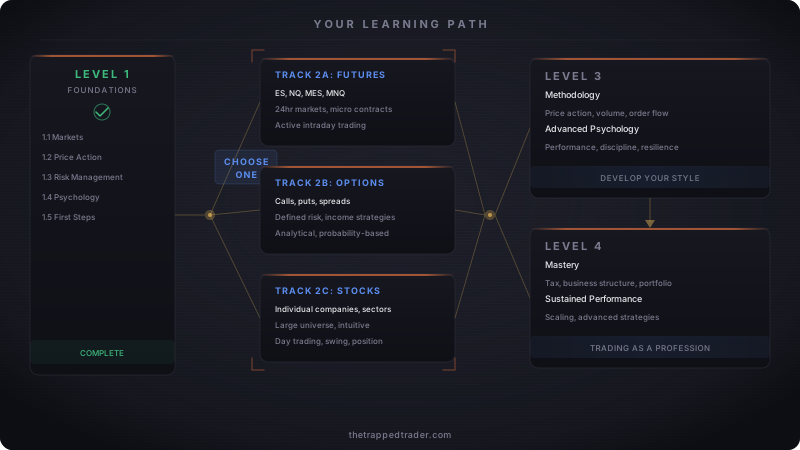
Track 2A: Futures
Futures contracts are agreements to buy or sell an asset at a set price on a future date. In practice, you're trading price movement on indices like the S&P 500 (via ES), commodities, or interest rates.
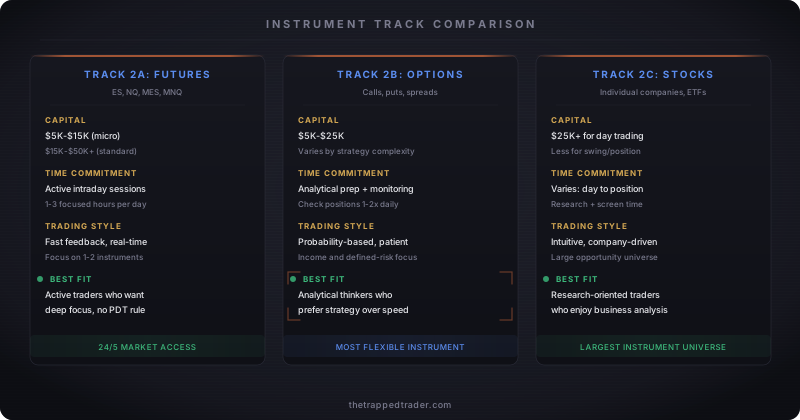
Why traders choose futures: Nearly 24-hour markets (Sunday evening through Friday afternoon), clean price action without the noise of thousands of individual stocks, built-in leverage through margin, and no pattern day trader rule. Micro contracts (MES, MNQ) make futures accessible with smaller accounts.
Capital range: $5,000-$15,000 for micro contracts. $15,000-$50,000+ for standard contracts. These ranges vary by broker and change over time, so check current requirements before funding.
Best fit: Traders who want to focus on one or two instruments deeply, prefer active intraday trading, and want to trade outside standard stock market hours.
Track 2B: Options
Options give you the right, but not the obligation, to buy or sell an underlying asset at a specific price before a specific date. They're the most flexible instrument: you can profit from moves up, down, or sideways.
Why traders choose options: Defined-risk strategies where you know your maximum loss before entering, income generation through premium selling, and the ability to express complex market views. Options reward patience and analytical thinking over fast reflexes.
Capital range: $5,000-$25,000 depending on strategy complexity and underlying instrument.
Best fit: Traders who think probabilistically, prefer setting up positions they can manage without watching every tick, and are drawn to income strategies over pure directional bets.
Track 2C: Stocks
Stocks represent ownership in individual companies. Stock trading ranges from buying shares for long-term growth to active day trading of momentum setups.
Why traders choose stocks: The most intuitive instrument (you're buying and selling pieces of businesses), a massive universe of opportunities across sectors, and extensive news and research coverage. Stock trading connects naturally to understanding the broader economy.
Capital range: $25,000+ recommended for active day trading. The pattern day trader (PDT) rule requires this minimum for accounts making 4+ day trades per week. Swing trading and position trading work with smaller accounts since you're holding overnight.
Best fit: Traders who enjoy researching individual companies, prefer a large selection of opportunities, and don't mind the PDT constraint or are willing to swing trade with a smaller account.
Picking Your Primary Track
The word "primary" matters. You're not locking yourself into one instrument forever. You're choosing where to build depth first. Skills transfer between instruments: a trader who develops strong price action reading on ES futures can apply that same ability to stock charts or options analysis later. But that transfer only works if you build real depth first.
I came to futures from options. After months of watching theta eat my positions and trying to juggle Greeks on every trade, futures felt like a relief. Buy or sell. That's it. No decay, no IV crush, no multi-leg complexity. Just price direction and risk management. That simplicity is what let me finally focus on the parts of trading that actually mattered.
A common mistake is trying to learn all three instruments at the same time. The logic sounds reasonable: "I'll try everything and see what clicks." That approach works in most domains. College majors, career paths, hobbies: you sample broadly, discover what resonates, and then specialize.
Trading breaks this pattern because each instrument requires deep pattern recognition that only develops through hundreds of repetitions on that specific instrument. Surface-level exposure across three instruments doesn't generate enough reps on any one of them to build real recognition skill. It's the equivalent of studying three languages simultaneously: you end up with surface-level phrases in each and fluency in none. Pick one, get competent, then expand.
When you're making your own decision, weigh these factors honestly:
- Capital you can afford to lose. Not your savings. Not your rent money. Capital specifically allocated for learning, with the genuine expectation that some of it won't come back.
- Hours per day for screen time. Futures reward active, focused sessions. Options reward analytical preparation with periodic monitoring. Stocks fall somewhere between, depending on your timeframe.
- Your temperament. Do you want fast feedback or are you comfortable waiting days or weeks for a trade to play out? Do you enjoy math and probability, or do you prefer reading price movement in real time?
Beyond Instruments: Levels 3 and 4
After you complete your instrument track, the curriculum converges again.
Level 3 layers methodology on top of your instrument skills. You'll study specific analytical approaches: price action frameworks, volume analysis, order flow reading, and others. You'll also go deeper into trading psychology with dedicated modules on performance under pressure, discipline maintenance, and building mental resilience. Level 3 is where you develop a personal trading style by testing different analytical approaches against your own strengths.
Level 4 treats trading as a profession. Tax strategy, business structure, portfolio management, advanced techniques, and the psychology of sustained performance over years rather than weeks. Level 4 is for traders who've proven consistency and want to scale.
The answer: methodology without instrument competence is theory without practice. You need to know how your instrument moves, what its quirks are, and how execution actually works before you can meaningfully test whether a particular analytical approach fits you.
Your Next Step
You're at the end of Level 1. You've covered more structured ground than most retail traders ever do.
Everything you built in Level 1 travels with you regardless of which track you choose. The Pre-Execution Protocol works the same way whether you're entering an ES futures trade, selling a put spread, or buying shares of a stock. The Drawdown Protocol protects your capital in any instrument. Your track choice determines what you trade, not how you manage risk or handle your psychology.
Your immediate action: complete the self-assessment exercise below and choose your primary track. Then start Level 2.