Why Your Brain Does This
Comparing yourself to others isn't a character flaw. It's wiring. Humans are social animals, and we've been measuring ourselves against peers for as long as we've existed in groups. In most areas of life, this works fine. You see someone fit, you exercise more. You see someone with a clean house, you tidy up. The comparison triggers a useful behavioral response.
Trading breaks this system.
Think of it like a poker table where you can only see other players' winning hands. Every time someone wins a big pot, the dealer announces it. Every time someone loses, silence. After an hour at that table, you'd assume everyone is profitable except you. You'd start playing looser, betting bigger, chasing pots you should fold. Not because your strategy changed, but because your perception of everyone else's results is completely distorted.
Trading social media amplifies comparison in a way that a normal social circle doesn't. You're not measuring yourself against 5 or 10 people you know personally. You're measuring yourself against thousands of strangers who are all broadcasting their best moments simultaneously. The volume of "winning" content creates a false baseline that no real trading experience can match.
The reason this bias feels invisible is that your brain treats visible data as a representative sample. When you see 50 green screenshots in a week, your pattern-recognition system concludes "most traders are winning" the same way it would conclude "most cars on the road are white" if you only counted white cars. The missing data (the losses, the blown accounts, the traders who quit) never enters your mental model because it was never posted. You don't feel like you're looking at a biased sample. It feels like you're seeing reality. Social media algorithms compound this: high-engagement content (big P&L numbers, dramatic wins) gets pushed to the top of your feed, so the most extreme, least representative results are the ones you see most often. Exceptional outcomes start to feel like the baseline.
The Highlight Reel Effect
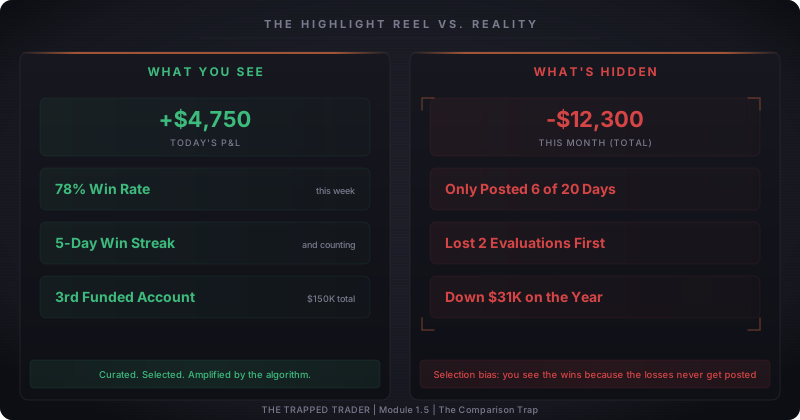
Every trading screenshot you see online has passed through at least three filters before it reached your eyes.
Filter 1: The poster chose to share it. Nobody posts their worst day. A trader might have 14 red days and 6 green days in a month. They post 6 times. You see a feed that looks 100% green.
Filter 2: The timeframe is selected. That "$5,000 day" screenshot might be from a trader who's down $30,000 on the year. The daily P&L is real. The context is missing.
Filter 3: The platform rewards it. Social media algorithms push content that generates engagement. A screenshot of a $10,000 day gets likes, retweets, and followers. A screenshot of "I broke even today after working on discipline for six months" gets ignored. The algorithm trains traders to post wins and hide everything else.
The natural assumption is that those screenshots represent typical results. They don't. They represent the top 1% of someone's top 1% of days, selected and amplified by a system designed to maximize engagement, not accuracy.
How Comparison Corrupts Your Decisions
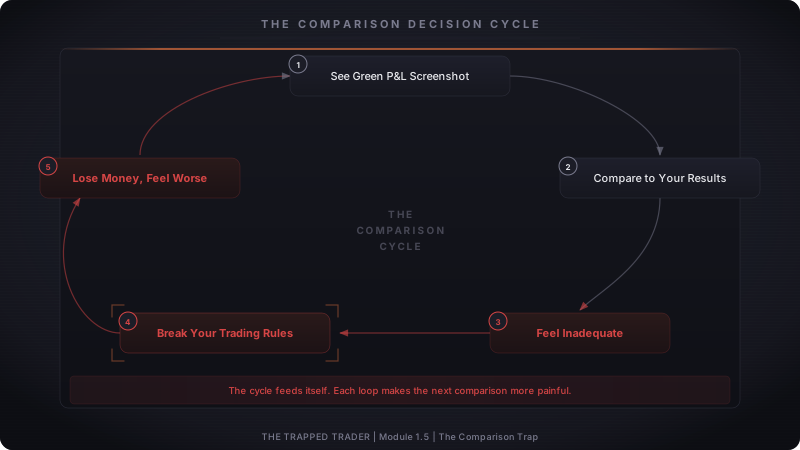
Comparison doesn't stay in your head. It leaks into your platform. When you feel behind, you act differently, and every change comparison triggers moves you further from the trading plan you built in 'Building Your First Trading Plan' (Lesson 4).
Strategy-hopping. You see someone crushing it with a strategy you don't use. Suddenly your approach feels inadequate. You abandon three weeks of practice to try their method, lose the reps you'd accumulated, and start from zero with something you don't understand. Two weeks later, another post from a different trader, another switch, another reset.
Sizing up. Someone posts a $3,000 day. You made $150. The math feels wrong, so you double your position size to close the gap, ignoring the risk rules in your trading plan. One bad trade at the inflated size wipes out a week of disciplined gains.
Trading when you shouldn't be. You see posts about overnight moves, news trades, and after-hours setups. You start entering trades outside your planned sessions because it feels like you're missing opportunities everyone else is catching. I wrote about how this same emotional spiral drives revenge trading and losing streaks, and the comparison trap is often where that cycle begins.
Building Your Information Diet
Your social media feed is a trading input. It affects your emotional state, your confidence, your risk tolerance, and your patience. Treat it with the same intentionality you'd give your chart setup. In 'Setting Up Your Charts' (Lesson 2), you learned to strip your charts down to only what helps you make decisions. Apply the same principle to your feed.
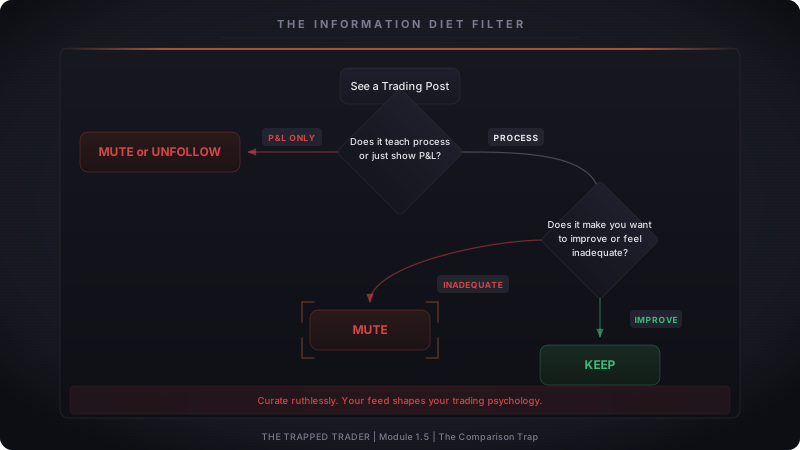
What to follow: Traders who share their process, not just their P&L. People who talk about what they learned from a losing trade. Educators who explain the reasoning behind setups. Accounts that normalize the struggle of early development.
What to limit: P&L screenshot accounts, "lifestyle trader" content, daily prediction calls. These aren't necessarily harmful in small doses, but they skew your perception of what normal trading looks like. If you notice yourself comparing after seeing specific accounts, that's your signal.
What to mute or unfollow: Guaranteed-profit claims, "copy my trades" services, and anyone who makes trading look effortless. If an account consistently leaves you feeling behind or inadequate, the content isn't worth whatever educational nugget might be mixed in.
One nuance: "educational" content isn't automatically safe. The format matters less than the effect it has on your decision-making.
An information diet isn't a one-time purge. It's ongoing maintenance. But filtering what comes in only solves half the problem. The other half is having your own data to measure against, so you're evaluating your progress on your terms instead of someone else's highlight reel. That's exactly what the next lesson builds. In 'Record Keeping Fundamentals' (Lesson 7), you'll set up a trade log that captures what actually happened in your trading, not what social media says should be happening. When your own data becomes the benchmark, the comparison trap loses most of its power.