The Trust Problem Behind Every Missed Trade
The hard truth? Most execution problems aren't technical. They're emotional.
You probably already know what a good setup looks like. You've studied the charts. You've backtested. You've got rules written down somewhere. But when it's time to pull the trigger, something happens. Your brain floods with doubt. This is the knowing-doing gap at work, and it's one of the most common problems in trading psychology.
"Is this really the setup?" "What if I'm wrong again?" "Maybe I should wait for more confirmation..."
This is where trading patience gets confused with fear-based hesitation. And they're not the same thing at all.
I spent two years confusing the two. I'd tell myself I was being "patient and disciplined" while watching perfect setups sail away. In reality, I was just scared. The market punishes both the reckless and the terrified with equal efficiency.
The shift happened when I realized I didn't have a timing problem. I had a trust problem. I didn't trust my process because I hadn't proven to myself it actually worked.
Building Trade Execution Conviction Through Process Trust
You can't manufacture conviction out of thin air. You can't just "believe in yourself" harder.
Trading conviction comes from one place only: evidence.
Not evidence that you'll win every trade... that's impossible.
Evidence that your process, followed consistently, produces a positive expectancy over time.
This is where most traders skip a crucial step. They learn a strategy, maybe paper trade it for a week, then jump into live trading expecting to feel confident. That's the sim-to-live gap in action, and it doesn't work that way.
What actually builds conviction:
- Track everything obsessively. I mean everything. Not just wins and losses, but how you felt before each entry. Whether you followed your rules. What made you hesitate. What made you jump in early. This is one of the reasons I built UpSkalr: tracking emotional states alongside trade data so you can review patterns over time. You need this data to separate signal from noise in your own head.
- Review your valid signals versus your fear signals. Go back through your journal and mark every time you had a valid setup according to your rules. Then note whether you took it or not. You'll probably discover something uncomfortable: you're hesitating most on the trades that would have worked and jumping in on the marginal ones. That's normal. It's also fixable once you see the pattern.
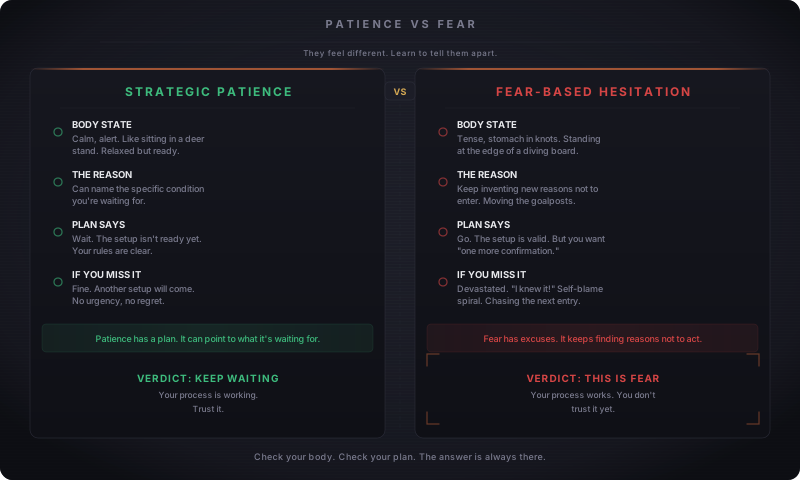
- Calculate your "rule-following expectancy." This is different from your overall win rate. This is: "When I follow my rules exactly, what happens?" You might discover you're profitable when you follow your process, but your overall account is red because you keep taking random trades out of boredom or FOMO. That's powerful information.
I did this exercise after September 2024 destroyed me. I had 20 Apex evaluation accounts and was on track for a combined $40,000 payout, money I personally really needed at the time.
Instead of following my rules, I started pressing. Oversizing. Chasing entries on NQ because I "knew" where it was going. I blew through drawdown limits on account after account. By the end of the month, every single payout was gone.
When I finally sat down and ran the numbers on that month, the data was brutal but clear. My actual strategy, when I followed my rules, had a solid win rate with roughly a 1.8 R-multiple average winner. But I was only following my rules about 40% of the time.
The other 60%? Garbage trades that bled my accounts dry. If you've ever been caught in that cycle of taking bad trades to recover from losses, check out my piece on executing trades like a machine.
Seeing that data changed everything. I didn't need a new strategy. I needed to trust the one I had.
Recognizing Valid Signals vs. Fear-Based Hesitation
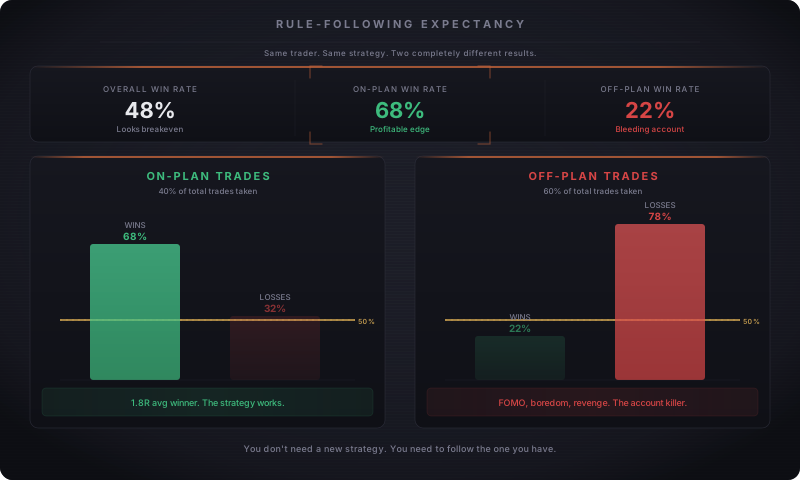
So how do you actually tell the difference in the moment? When you're staring at the chart and your heart is pounding, how do you know if you should wait or act?
I use what I call the Pre-Execution Protocol before every entry. It takes about 15 seconds and has saved me thousands of dollars. Three questions, same ones every time.
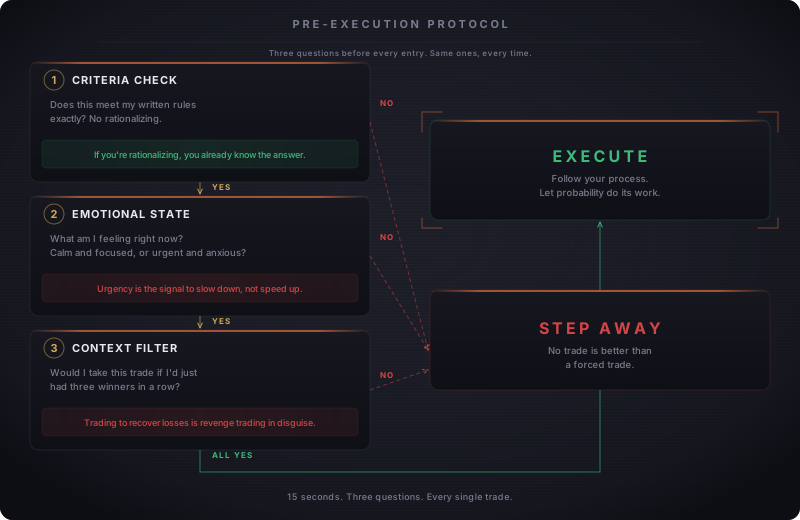
That third question is the one that catches most people. If you'd only take the trade because you're down and "need" a win, it's probably revenge trading in disguise.
Perfect entries are a myth. The goal is to enter when your edge is present, with proper risk management, and then let probability do its work. I've taken "perfect" entries that stopped me out and "okay" entries that ran for what seemed like forever. The difference wasn't the exact entry tick, it was whether I followed my process.
When you hesitate on a valid signal, you're usually dealing with one of these:
- Loss recency bias: Your last few trades were losers, so you don't trust the next setup. If you've already hit half your daily risk limit, this isn't the time to prove your process works. Cut your size in half. If you've hit your full limit, close the platform and walk away. That structured response to drawdowns is what keeps a bad day from becoming a bad week. The lesson on fear and missed trades digs into why this recency effect is so powerful.
- Perfectionism: You're waiting for a "sure thing" that doesn't exist (I wrote more about this in my post on trading perfectionism)
- Unclear rules: Your criteria are vague, so every setup feels questionable. Learning to identify support and resistance with precision makes your rules concrete instead of fuzzy.
- Insufficient testing: You haven't proven to yourself the setup actually works
The solution to all of these is more data and clearer rules. I know that's not sexy. But it works.
Building Execution Confidence: The Practice Nobody Talks About
The thing most traders get wrong about execution confidence: you build it by executing, not by thinking about executing.
Sounds obvious, but most traders try to think their way into confidence. They study more. They watch more YouTube videos. They tweak their indicators. All while avoiding the actual act of taking trades according to their rules.
Execution confidence is a muscle. You build it through progressive exposure, just like any other skill.
Start with this...
Micro-commitment practice. If you're struggling with execution, start absurdly small. Trade 1 MES contract, or whatever the minimum is for your instrument. Your only goal is to follow your process, not to make money. Over the next two weeks, take 20 trades following your rules exactly. No shortcuts, no "just this once" exceptions. Track every one. Review them at the end. See what happens.
This does two things:
- First, it removes the pressure that's probably causing your hesitation.
- Second, it gives you data about whether your process actually works, which builds genuine conviction.
Pre-trade routines. The Pre-Execution Protocol I described above is part of a broader checklist I run through before every trade. Setup criteria, risk calculation, entry trigger, stop placement, target zones. Every single time. This removes decision-making from the moment of execution. I'm not deciding whether to take the trade, I'm just following my process. Our lesson on building a consistent pre-trade routine walks through the full process step by step. Having a solid grasp of how to read a price chart is what makes the checklist feel automatic instead of overwhelming.
Post-trade reviews within 5 minutes. Right after I enter, I screenshot the chart and write three sentences: Why I took it, how I felt, and what I expect to happen. This creates a feedback loop that's immediate and honest. When I review my journal later, I can see patterns in my execution quality.
The traders who master the waiting game aren't more patient than you. They're not smarter or more disciplined by nature. They've just built systems that remove emotion from execution. They've proven to themselves, with data, that their process works.
And they've practiced following that process enough times that it becomes automatic.
The Uncomfortable Truth About Missed Trades
Let me tell you something that took me way too long to accept. You're going to miss trades. Lots of them. Some of them will be massive winners that haunt your dreams.
And that's completely fine. Actually, it's better than fine, it's necessary.
If you never miss a trade, you're probably overtrading. You're probably taking marginal setups out of FOMO. You're probably not being selective enough.
The goal isn't to catch every move. The goal is to catch enough of the moves that meet your criteria to be consistently profitable over time. That's it.
I keep a "missed trade" log. Sounds masochistic, but it's actually liberating. When I see a perfect setup that I missed, I log it. Setup type, why I missed it, what it did.
Over time, I've noticed something interesting: I don't actually miss that many valid setups. What I think are "missed trades" in the moment are often trades that didn't fully meet my criteria, or trades I would have exited early anyway because they didn't align with my process.
The few I do legitimately miss? They bother me for about an hour, and then I move on. Because I know another setup will come. They always do. And when it does, proper position sizing makes the execution feel routine instead of terrifying.
Overcome hesitation by accepting that selective execution is the goal, not perfect execution.
Put This Into Practice
Here's your assignment for your next trading session: run the Pre-Execution Protocol on every single setup, whether you take the trade or not. Write down your answers to all three questions. At the end of the session, review them. You'll see exactly where trust breaks down and where your process is already solid.
If you want to go deeper into the mindset side of execution, the Trading Psychology Foundations course walks through this step by step, from identifying your fear patterns to building the kind of process trust that makes execution automatic.
The waiting game isn't about perfect timing. It's about building enough trust in your process that you can execute when your edge appears and walk away when it doesn't.
That's the whole game. Everything else is just noise.