
The Sim-to-Live Gap Is Real (And It's Not About Skill)
Every trader I've talked to has some version of this story. They crush it in sim for weeks, build real confidence, go live, and immediately start making trades they'd never take in practice. Different stops, different sizing, different entries. Same person, same chart, same setup. The only thing that changed was the account type.
I've lived this cycle more times than I'd like to admit. I passed multiple prop firm evaluations. The evals felt tough, but I got through them. Then I'd get my funded account, and within a day or two, I'd blow it. Sometimes faster.
The evaluations were technically sim accounts, but passing one and getting funded changes everything. Suddenly you can withdraw real money. That payout button sitting in your dashboard rewires how your brain processes every single trade.
A $200 loss in the eval was just a number. A $200 loss in a funded account is $200 you could've withdrawn, money you already felt like you earned. That shift, from "practice points" to "my money," hit me harder than I expected every single time.
If you've been through this, you probably blamed yourself. You thought you lacked discipline or just weren't ready. But the gap between sim and live trading isn't a discipline problem. It's a neurological response to real financial risk.
Research from Kahneman and Tversky (1979) shows that humans experience losses 1.5 to 2x more intensely than equivalent gains. This isn't metaphorical. Your brain literally processes a $500 loss with more neural intensity than a $500 win.
In sim, there's no real loss to trigger that asymmetry. The moment real money enters the equation, your amygdala activates, and you start making decisions from a completely different part of your brain. Every trade follows an emotional cycle from anticipation through outcome, and real money amplifies every stage of it.
How strong is this effect? A clinical study by De Martino et al. (2010, PNAS) found that patients with amygdala lesions showed almost zero loss aversion, with coefficients of 0.76 to 1.06 compared to 1.52 to 1.76 in healthy controls. Your amygdala is literally the organ that makes losses hurt more than gains feel good. In sim, it stays quiet. In live, it runs the show.
You know how this goes, right? You had a plan. You knew the level. And then the trade went live and suddenly everything felt different.
Biology, not weakness.
The prop firm evaluation twist
Prop firm evaluations sit in a strange middle ground between sim and live. You're trading simulated capital, but the evaluation fee makes the stakes feel real. Fail the eval and you lose $100 to $300. That's enough for your amygdala to treat it like a live account. You start trading tighter, second-guessing setups that were automatic in free practice, and managing the P&L instead of the process. It's the sim-to-live gap in miniature, and it catches traders who think they've already solved it. If you've ever traded differently during an eval than you did in the free practice that came before it, you've felt exactly this dynamic.
What Actually Changes When Money Gets Real
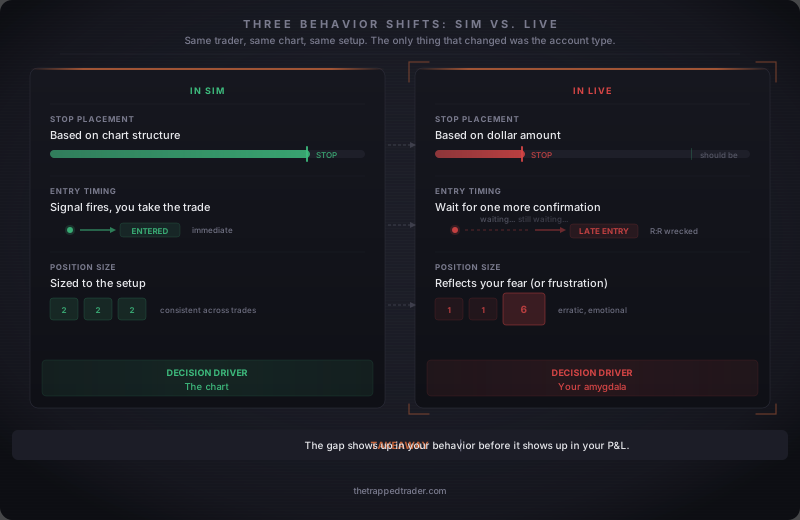
The gap doesn't show up as one big mistake. It shows up as three subtle behavior shifts that compound into a completely different trading profile.
You tighten your stops
In sim, you set your stop based on the chart. Support is at a level, you put your stop below it, and you let the trade breathe. In live, that same stop suddenly feels too wide. You start thinking about the dollar amount, not the price level. So you tighten up "just a little" and get stopped out on noise that would've resolved in your favor.
You hesitate on entries
In sim, you see the setup and take it. In live, you want one more confirmation before pulling the trigger. You wait for the candle to close. You wait for a pullback that never comes. By the time you enter, your risk-to-reward is wrecked, or the move is gone entirely.
You distort your size
Some traders go too small out of fear, making their wins meaningless. Others go too big trying to "make it count" or recover from early losses. Either way, the size no longer reflects the setup. It reflects how you feel about the setup, and those are two different things.
Paper Trading vs Real Trading: Why Sim Still Matters
You'll hear traders say "sim is useless, just go live with small size." That sounds tough and practical, but it skips the part where sim actually does important work.
Sim trading builds three things that live trading can't teach you efficiently:
- Mechanical execution speed. You learn where the buttons are, how to set stops quickly, how to adjust size on the fly. These need to be automatic before real money enters the picture, which is why picking the right platform matters so much.
- Pattern recognition without emotional noise. In sim, you can study setups objectively because there's no P&L screaming at you. You learn to see the structure of price action without your amygdala filtering the information.
- Strategy validation with a real sample size. You need 50 to 100 trades to know if a strategy has an edge. Running those in sim is faster, cheaper, and gives you data you can actually trust. Our paper trading lesson walks through the rules that make sim practice actually transfer to live execution.
Too many traders treat sim as the finish line instead of the foundation. A profitable sim track record means you've built the mechanical and analytical skills. It doesn't mean you've built the emotional skills to execute under real risk. That's the knowing-doing gap in its purest form: you have the knowledge, but your nervous system won't let you use it when the stakes are real.
That's what made my own funded account blowups so frustrating. I had the data. I had hundreds of sim trades proving my strategy worked. I had evaluation results showing I could execute under pressure.
And then I'd get the funded account, see that withdrawal balance sitting at zero, and start trading like a completely different person. I'd tighten my stops because I didn't want to "give back" money I hadn't even made yet. I'd hesitate on entries because every trade felt like it had to count.
I'd revenge trade after a small loss because the idea of ending a funded account in the red, when I could've just withdrawn and walked away, felt unbearable. The gap wasn't about what I knew. It was about what my nervous system did when the stakes became real.
The 3-Step Sim-to-Live Transition Protocol
Don't just "go live and see what happens." That's how accounts get blown in the first two weeks. Treat the transition as its own phase with specific rules and benchmarks.
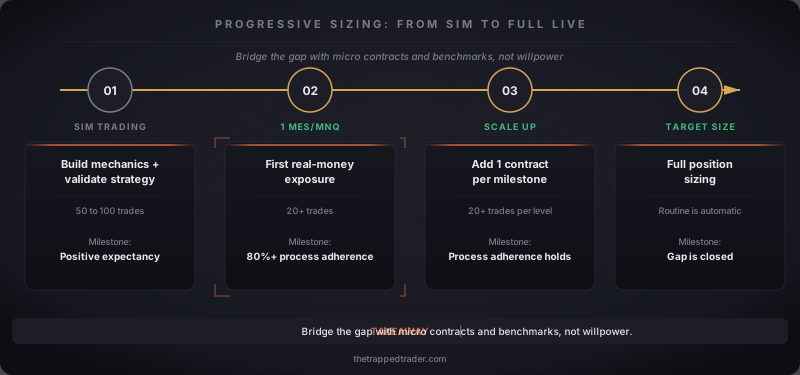
Step 1: Start with micro contracts
Don't jump from sim ES to live ES. Start with MES or MNQ. Micro contracts let you trade the same product, the same chart, the same price action, but at one-tenth the financial exposure. Your brain still registers the loss as real (because it is), but the magnitude won't trigger a full fight-or-flight response. If you're not yet familiar with how MES and MNQ work, I wrote a dedicated guide to starting with micro futures that explains the specs, costs, and how they reduce that gap.
Step 2: Keep your routine identical
Change only the account type. Everything else stays the same: the same pre-market prep, the same charting layout, the same time blocks, the same Pre-Execution Protocol (check your size, check your stop, check your bias before every trade). If you change your routine when you go live, you've introduced two variables at once and you won't know which one caused the problem.
Step 3: Progressive sizing with benchmarks
Start with 1 MES contract. Trade at least 20 trades. If you maintain 80%+ process adherence (not win rate, process adherence), add 1 more MES. Keep scaling until you reach your target size. If at any point your process adherence drops below 80%, cut back to the previous level and rebuild.
The Drawdown Protocol works as your safety net during this phase: if you hit 50% of your daily risk limit, cut your size in half. If you hit 100%, you're done for the day. Screen off, walk away. This prevents one bad session from becoming a blown account during the most vulnerable phase of your transition.
Tracking your sim and live results side by side is how you know the gap is closing. I built UpSkalr to help with exactly this kind of tracking, giving you a structured way to measure your progress as you scale from micro contracts to full size.
The full trading curriculum covers these concepts in more depth, including journaling frameworks for tracking process adherence and position sizing formulas that scale with your confidence and your data. I also break down the emotional side of risk management on the mindset page, if you want a broader view of how psychology shapes every trade you take.