What Support and Resistance Actually Are
Support is a price zone where buyers have stepped in before. Resistance is a price zone where sellers have stepped in before. Not indicators. Not formulas. Just areas where the market has shown its hand.
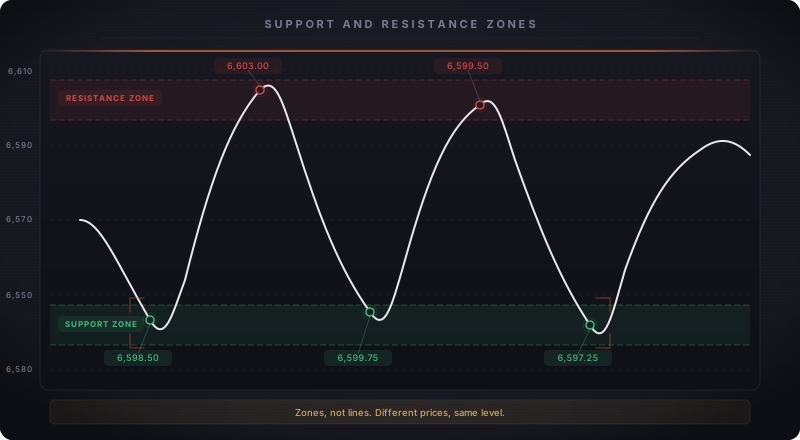
Price doesn't respect 6,550.00 exactly. It might bounce at 6,548.50 one day, 6,551.25 the next, and 6,549.75 the day after. Those are all the same level. If you set your stop at 6,549.99 because you drew a line at 6,550.00, you'll get stopped out by normal noise and watch the level hold without you.
Think of S/R as zones, a few ticks to a few points wide. Give levels room to breathe.
Why Levels Work
Why would a price that bounced before bounce again? Think about parking at a mall. You found a great spot last Saturday. This Saturday, you drive there first. So does everyone else. S/R works the same way. Three forces drive it:
Memory. When ES bounces off 6,550 and rallies 50 points, traders remember 6,550. Some place limit buy orders near it. Others set alerts. That memory turns into order flow the next time price approaches.
Order clustering. Round numbers and prior reaction points attract orders. Stop losses stack below support, limit orders pile at the level itself. That creates concentrated liquidity at specific zones.
Self-fulfilling behavior. The more traders believe in a level, the more orders they place there, the more price reacts. This doesn't make S/R fake. It makes it a product of collective behavior, which is exactly what all price action is.
Not All Levels Are Equal
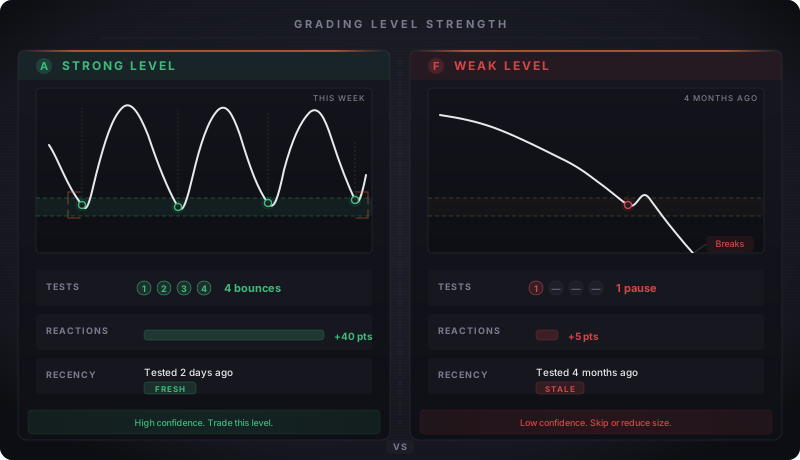
When everything is a level, nothing is a level. The skill isn't finding levels. It's grading them. Three factors determine strength:
Number of tests. Two bounces is interesting. Four is established. But too many tests can weaken a level: each test chips away at the orders sitting there. Think of a wall taking battering ram hits. It holds, but it's taking damage.
Reaction size. A 2-point bounce is mildly interesting. A 40-point bounce is significant. The size tells you how much order flow was waiting there.
Recency. A level from last week matters more than one from last year. Traders who placed orders six months ago may have closed positions, moved on, or blown up. Recent levels reflect current participants and active order flow.
The Flip: When Support Becomes Resistance
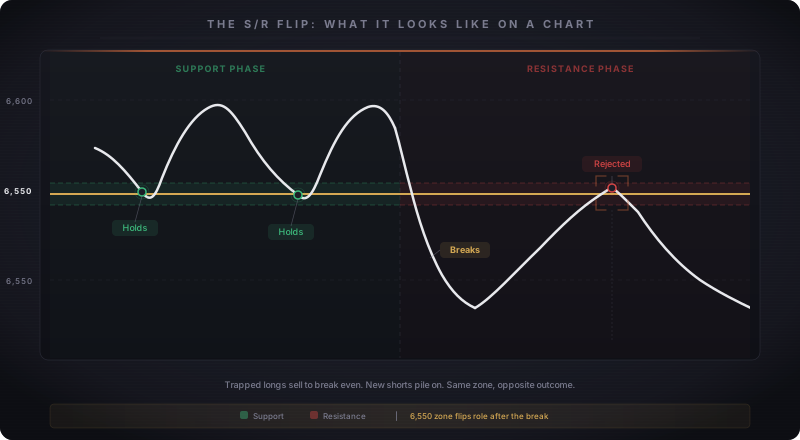
When support gives way, it often becomes resistance. When resistance breaks upward, it often becomes support. Why? Trapped traders.
ES has been bouncing off 6,550 support for two weeks. Then it breaks. Price drops to 6,500. Traders who bought at 6,550 are now underwater. When price rallies back toward 6,550, many sell to break even. New shorts target 6,550 too. The old support zone now has sellers from two groups: trapped longs exiting and new shorts entering.
Why Levels Break
Every level breaks eventually. Levels break through order absorption: each test fills some of the buy orders at that zone. The level holds, but it's thinner. Watch for three weakening signals:
Shrinking reactions. First test: 40-point rally. Second: 25. Third: 12. Each bounce weaker because fewer orders remain to fuel the move.
Declining volume on bounces. If each bounce comes with less volume than the last, buying conviction is fading.
Slower approaches. A fast drop into support triggers limit orders and catches shorts off guard. A slow, grinding descent gives traders time to pull their orders. The grind eats the level before it even arrives.
None of these signals guarantee a breakdown. But when you see two or three at the same level, the crowd defending that zone is thinning out.
Key Rules
- Never trade a support level with only 1 prior test. A single bounce is interesting. Two bounces with strong reactions establishes the level.
- Draw S/R as zones (a few ticks to a few points wide), never as exact lines. Stops set to the penny get clipped by normal noise.
- Limit your chart to 2-3 high-quality levels at a time. More than that creates analysis paralysis.
- Grade every level on 3 factors: test count, reaction size, and recency. A level missing 2 of 3 is weak.
- When a level breaks, immediately mark it for a potential flip. Broken support becomes resistance. No exceptions to checking.
- Shrinking bounces (40 points, then 25, then 12) mean the level is dying. Reduce position size or skip the next test entirely.
- If the approach to a level is slow and grinding (90+ minutes of small candles drifting toward it), the level is more likely to break than if price drops into it sharply.
Now that you know where to look for reactions and how to grade their strength, the next lesson covers trendlines and channels. Trendlines connect multiple S/R points into a directional framework and answer the question that horizontal levels can't: is the market moving up, down, or sideways?