You've spent three modules learning how markets work, how to read price action, and how to manage risk. You could explain position sizing, stop-loss placement, and why chasing trades destroys accounts. If you know all of that, why would you ever blow an account?
Because knowing and doing are different skills. That gap kills accounts.
Every blown account has the same autopsy. The trader knew their rules. They knew their risk limit. They knew they shouldn't move their stop, chase that entry, or size up on a "sure thing." They knew all of it. And they did it anyway.
Think of it like knowing how to swim. You can explain freestyle mechanics perfectly. Now someone drops you in the ocean during a storm. Your body's panic response makes everything you "knew" unreachable the moment you need it most. Real money triggers survival mode. Survival mode doesn't care about your plan.
I learned this the most expensive way possible. In September 2024, I had 20 Apex funded accounts and was on track for a combined $40,000 payout. All I had to do was close the platform and walk away. I didn't. I started pressing, oversizing, chasing entries because I "knew" where NQ was going. One bad trade became five, then I lost count. By the end of the session, every single payout was gone. $40,000, wiped out because I couldn't stop.
I could recite my rules in my sleep. I just didn't follow any of them once the emotional spiral started. That's the knowing-doing gap at $40,000.
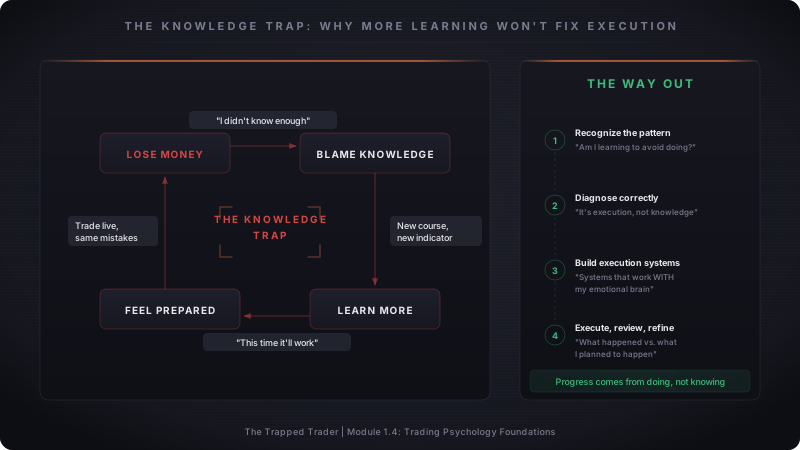
The Knowledge Trap
The instinct after a loss is to reach for more knowledge. Lost money? Must need a better indicator. Chased a FOMO entry? Better sign up for another course.
This is the knowledge trap: using education as a substitute for execution. It feels productive. It's avoidance disguised as effort.
Trading breaks the normal pattern. Failed an exam? Study harder. But the traders losing the most money often know the most about markets. They can explain risk-to-reward ratios and recite every candlestick pattern by name. Their problem was never information.
Could you teach someone your trading rules in 15 minutes? If yes, you have enough knowledge. What you need is a way to execute those rules when your brain is screaming at you to do something else.
Why Your Brain Fights Your Plan
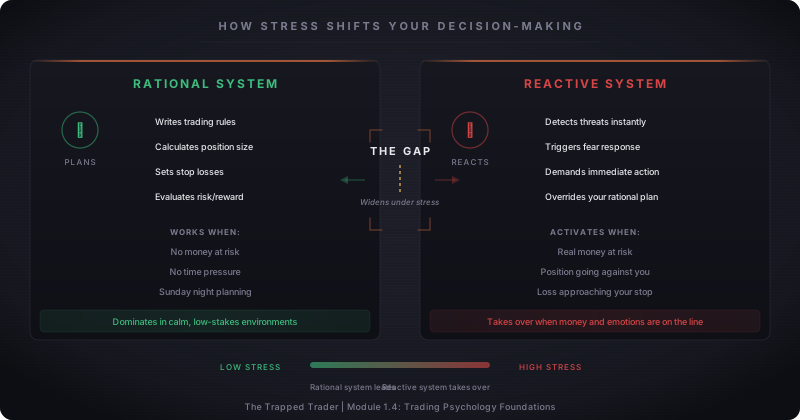
Your brain has two systems that process decisions differently.
The first is slow, rational, and deliberate. It writes trading plans, calculates position sizes, and sets logical stop-losses. Works well when there's no pressure.
The second is fast, emotional, and automatic. It evolved to keep you alive. When you see a position going against you, this system doesn't care about your 1% risk rule. It sees a threat and demands a response: freeze, fight, or run.
A losing trade triggers the same circuitry that fires during physical danger. Your brain can't distinguish between losing $500 on an ES trade and a survival threat. That's why you move your stop. That's why you size up after a loss. It doesn't feel like breaking a rule. It feels like protecting yourself.
The Simulation Gap
Paper trading can't close this gap because the gap IS the emotional component that paper trading removes. On a paper account, you feel nothing when a stop gets hit. Then you switch to live and wonder why you've become a completely different trader.
Key Rules
When you notice yourself rationalizing a rule break mid-trade, stop. That's your emotional brain wearing a logic costume.
If you can teach your rules in 15 minutes, you have enough knowledge. The problem is execution, not education.
After any rule break, write down the emotion driving it. That record closes the gap faster than any indicator.
Limit strategy changes to once per month. More frequent changes mean you're solving an execution problem with a knowledge solution.
Track your plan-vs-execution ratio weekly. Below 80% means the gap is running your account.
The next lesson maps the emotional cycle of a trade from entry to exit, so you can recognize these patterns in real time instead of only in hindsight.
01Test
You've finished reading. Time to check what landed.
Check Your Understanding
1 / 5
1.What is the knowing-doing gap in trading?
02Practice
Knowing isn't enough. Put it into practice.
Practice Exercise
Reflection·~20 min
Pull up your trade log or broker statements from your last 10-20 trades (paper or live). Create a two-column table: 'What I planned' vs. 'What I did.' For each trade, mark it GREEN if your execution matched your plan, or RED if you deviated. For each RED trade, answer: (1) What was the setup? Include the contract, time, and market context. (2) What was your pre-trade plan (entry, stop, target)? (3) What did you actually do differently? (4) What emotion was driving the deviation (fear, greed, frustration, FOMO)? (5) At what point in the trade did the deviation happen (entry, during the hold, at the exit)? After completing the table, count your RED trades. That ratio is your current knowing-doing gap score. If you have fewer than 10 trades, use the same framework on 3 high-pressure decisions from other areas: a test you crammed for but froze on, a conversation you planned but botched, a deadline you knew about but missed.