The Willpower Trap
Most traders write rules and white-knuckle through each session. Every trade becomes a negotiation that drains a limited resource. By the afternoon, rules feel like suggestions.
I've lived this. Start sharp in the morning. By noon, in control. Then the afternoon: a setup that's close enough, a stop I moved, a position I oversized because I was already green. By 2 PM I'd given back the morning's gains. The discipline was never the problem. The approach was.
Willpower is like your phone battery. Every decision costs a few percentage points. By your third or fourth trade, you're at 15%. In 'The Knowing-Doing Gap' (Lesson 1), you learned that knowing your rules doesn't guarantee following them. Effort runs out. Identity doesn't.
Identity Drives Behavior
Instead of asking "What should I do on this trade?" ask "What would a process trader do here?" The first question requires willpower. The second doesn't.
Identity shapes beliefs. Beliefs filter decisions. Decisions produce evidence that reinforces the identity.
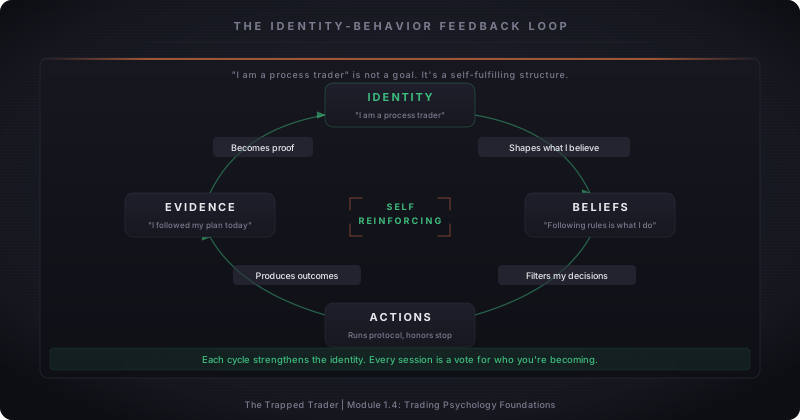
"I'm trying to quit smoking" versus "I don't smoke." The person trying to quit fights a constant battle. "I'm trying to follow my rules" puts you in a fight on every trade. "I'm a process trader" settles the argument before it starts.
Writing Your Trading Identity Statement
An identity statement is present-tense and specific. Vague statements don't change behavior.
Weak statements (too vague to drive behavior):
- "I am a disciplined trader"
- "I am a successful trader"
- "I am a patient trader"
Strong statements (tied to specific, observable behaviors):
- "I am a trader who runs the Pre-Execution Protocol before every single entry"
- "I am a trader who walks away when I hit my daily loss limit"
- "I am a trader who accepts losses on valid setups without changing the plan"
- "I am a trader who reviews every session, win or lose"
Each names a behavior you can verify. "Did I do this? Yes or no."
The statement evolves. Month one: "I am a trader who always uses a stop-loss." Six months later, that's automatic, and the statement shifts to "I am a trader who sizes positions based on the setup, not my emotional state."
Collecting Evidence
Without evidence, an identity statement is just an affirmation taped to your monitor.
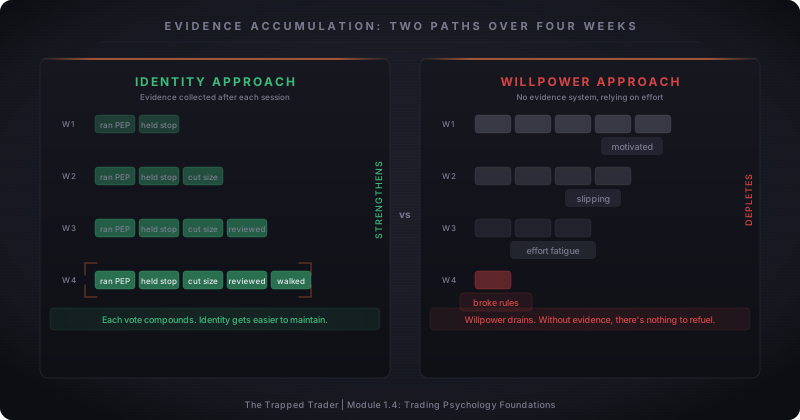
At the end of each session, spend five minutes answering three questions:
-
What did I do today that a process trader would do? Be specific. "I ran the Pre-Execution Protocol on all three entries" counts. "I was disciplined" doesn't.
-
Where did I act against my identity? Name it without judgment. "I moved my stop on the second trade because I was afraid of the loss." This isn't self-punishment. It's data.
-
What's one piece of evidence I can carry into tomorrow? Pick the strongest moment from the session. The one that proves you're becoming the trader you've described.
Log your breakthrough moments, the sessions where you did the right thing under pressure. Those entries become evidence for your identity. UpSkalr tracks these separately so you can review them when the doubt creeps back.
When Your Identity Gets Tested
The hardest moments aren't the big blowups. They're the slow erosions. A three-day losing streak. A week where every setup fails. Your brain whispers: "Maybe you're not actually a process trader."
Your trading journal from Lesson 8 is the container for identity data. Your pre-trade routine from Lesson 9 is the daily expression of it. When the pressure spikes, "who I am" holds. "What I'm supposed to do" breaks.
Key Rules
- Write 3-5 identity statements that begin with "I am a trader who..." Each must name a specific, verifiable behavior.
- Spend 5 minutes after every session collecting evidence: what you did that matched your identity, and what didn't.
- When you break a rule, log it within 2 minutes of session close. "I moved my stop" is data, not a verdict.
- During a losing streak, read your evidence journal before changing your strategy. High-process streaks are variance, not failure.
- Update your identity statement every 4-8 weeks as behaviors become automatic and new growth areas emerge.
- The Pre-Execution Protocol and Drawdown Protocol aren't external rules. They're expressions of who you are. Act accordingly.
This is the foundation everything else in this course builds on. In the next module, you'll start applying it to the practical side of trading, beginning with choosing the right platform for how you trade.