Why Your Position Size Isn't a Fixed Number
Think about someone who spends exactly 10% of their paycheck on dining out. At an expensive restaurant, they go once. At a cheap spot, they go four times. Total spending is the same.
Position sizing works the same way. Your "budget" is the dollar amount you're willing to risk (1% of your account). Wide stop means fewer contracts. Tight stop means more contracts. Dollar risk stays constant.
The instinct is to pick a contract count and stick with it. "I trade 2 ES contracts." But a 2-contract trade with a 2-point stop risks $200. The same 2 contracts with a 10-point stop risks $1,000. Same position, five times the risk.
Three Ways Traders Size Their Positions
Not all sizing methods are equal. Three common approaches, from worst to best.
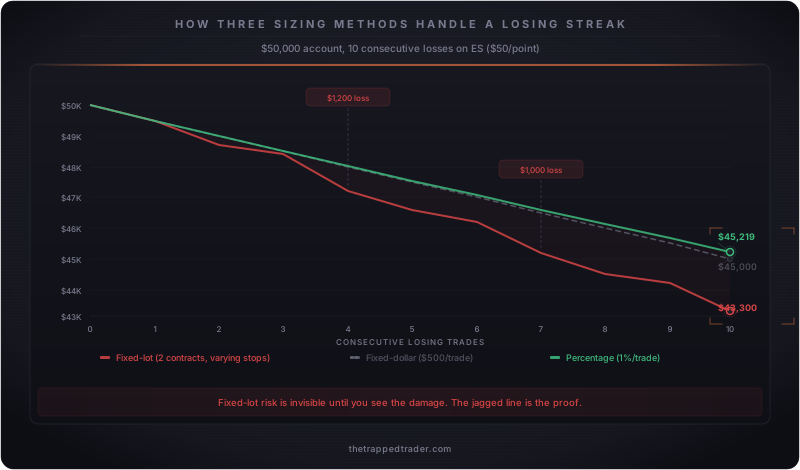
Fixed-lot sizing means trading the same number of contracts every trade. "I always trade 2 lots." Simple, but risk is unpredictable: some trades risk $200, others $1,500.
Fixed-dollar sizing means risking the same dollar amount per trade. "I risk $300 every trade." Consistent trade to trade, but $300 means 3% on a $10,000 account and 0.3% on a $100,000 account. As your balance changes, your risk percentage drifts.
Percentage-based sizing (also called fixed-fractional) means risking a fixed percentage of your current balance every trade. "I risk 1% per trade." When your account grows, your dollar risk grows. When it shrinks, dollar risk shrinks too, slowing the bleeding. This is what professional traders and prop firms use.
The Position Sizing Formula
The formula:
Contracts = (Account Size x Risk %) / (Stop Distance x Point Value)
Four inputs, one output:
- Account Size: Your current account balance. Not what you started with. What it is right now.
- Risk %: The percentage you're willing to lose on this trade. For most traders, 1%. For aggressive traders, 2%. Never more than 2% unless you have a very specific, well-tested reason.
- Stop Distance: How many points your stop loss is from your entry price. This changes every trade.
- Point Value: How much one point of movement is worth. ES = $50/point. NQ = $20/point. MES = $5/point. MNQ = $2/point.
$50,000 account x 1% risk = $500 maximum loss
5-point stop x $50/point (ES) = $250 per contract
$500 / $250 = 2 contracts
On a $50,000 account risking 1% with a 5-point stop on ES, you trade 2 contracts. If the trade hits your stop, you lose exactly $500, which is exactly 1% of your account.
Now change one variable. Same account, same risk percentage, but double the stop distance:
$50,000 x 1% = $500
10-point stop x $50/point = $500 per contract
$500 / $500 = 1 contract
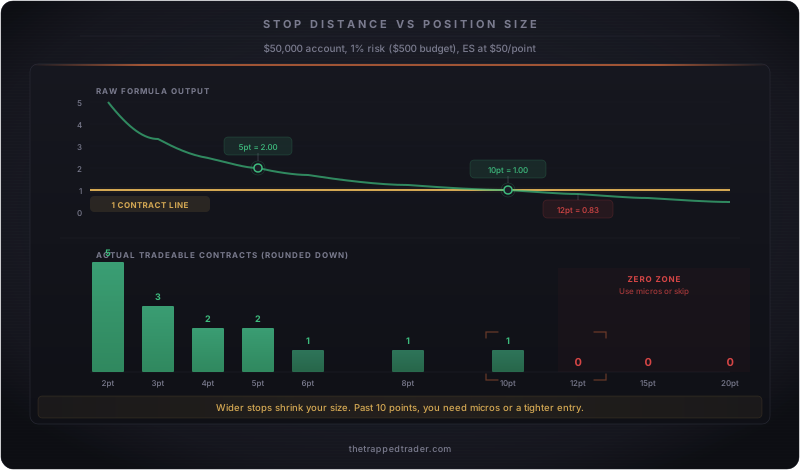
Doubling the stop distance from 5 points to 10 points cut the position size in half, from 2 contracts to 1. Your dollar risk didn't change. It's still $500, still 1%. The formula adjusts your size so your risk stays constant.
Always round down. If the formula gives you 1.7 contracts, you trade 1. Never round up. Rounding up means exceeding your risk limit.
When the Formula Says Zero
Sometimes the formula produces a number less than 1. That's the formula doing its job, telling you that you can't take this trade at this size with standard contracts.
Say you have a $50,000 account, risk 1%, and the stop distance on ES is 12 points. Dollar risk: $500. Stop cost: 12 x $50 = $600. Contracts: $500 / $600 = 0.83. That rounds down to zero.
Three options:
- Skip the trade. Not your trade today.
- Use micro contracts. MES at $5/point: $500 / (12 x $5) = 8.33, rounded down to 8 MES contracts.
- Wait for a tighter setup. A 5-point stop: $500 / (5 x $50) = 2 ES contracts.
What you don't do: risk more than 1% to make the numbers work. The formula is a constraint, not a suggestion.
Why Percentage-Based Sizing Keeps You Alive
With percentage-based sizing, each loss is smaller than the one before it because you're calculating 1% of a shrinking balance. Trade 1 risks $500. Trade 2 risks $495. Trade 3 risks $490. The losses decelerate automatically. That's the built-in braking system.
Once you understand the math, you don't have to run it by hand every trade. I built UpSkalr specifically because I needed a faster way to size positions correctly. You learn the formula here so you understand what's happening. UpSkalr handles the execution so you can focus on the trade.
Key Rules
- Calculate position size before every trade: (Account x Risk%) / (Stop Distance x Point Value)
- Always round down, never up; rounding up means exceeding your risk limit
- Never risk more than 2% per trade; 1% is the standard for developing traders
- When the formula gives you less than 1 contract, switch to micros (MES/MNQ) or skip the trade
- Wider stops mean fewer contracts; tighter stops mean more; dollar risk stays constant
- Never increase risk percentage to force a trade the formula rejects
Now that you can calculate exactly how many contracts to trade, the next lesson covers stop loss placement: where to put your stop so the distance in the formula actually makes sense for the trade setup.