The Strategy Obsession
The assumption is that finding the right strategy is what makes a trader profitable. So 90% of the time goes toward entries: better indicators, better setups, better chart patterns. Risk management gets the leftover 10%.
Strategy IS visible. You can point at a chart and say "I entered here, it went up, I made money." Risk management is invisible when it works. A losing streak that only cost 5% instead of 40% doesn't make the highlight reel.
But many strategies work. Moving average crossovers, breakouts, mean reversion, order flow, price action. Professional traders use all of them. The difference has nothing to do with which strategy they chose. The professional sized their trade so a loss wouldn't matter. The beginner sized theirs so a loss could end the month.
I can trace nearly every blowup I've ever had back to sizing, not strategy. The entries were fine. The thesis was fine. What killed me was too much size for what my account could handle when the trade went wrong.
Survival Is the Strategy
The goal of risk management isn't to maximize profits. It's to keep you at the table.
Think of it like a phone battery during an emergency. You can't control how long the emergency lasts, but you can control how fast you drain the battery. Running every app at full brightness kills it in an hour. Manage what's running and that same battery lasts all day. Your trading account is the battery.
A strategy with a 55% win rate needs hundreds of trades to let that edge play out. A losing streak of 5-8 trades in a row is statistically normal, even for profitable strategies. That's probability, not failure.
The question is what those 5 losses cost you. At 10% risk per trade, a 5-trade streak costs roughly 41% of your account. At 1% per trade, the same streak costs about 4.9%. One scenario is a career-ending hole. The other is an annoying week.
The Math Nobody Wants to See
Losses and gains aren't symmetrical. A 10% loss doesn't require a 10% gain to recover. It requires more. The bigger the loss, the wider that gap becomes.
$25,000 x 0.10 = $2,500 lost. Account balance: $22,500. Recovery needed: $2,500 / $22,500 = 11.1%
$25,000 x 0.25 = $6,250 lost. Account balance: $18,750. Recovery needed: $6,250 / $18,750 = 33.3%
$25,000 x 0.50 = $12,500 lost. Account balance: $12,500. Recovery needed: $12,500 / $12,500 = 100%
A 10% drawdown needs an 11% gain to recover. Uncomfortable but doable in a few good trading days. A 25% drawdown needs a 33% gain. That takes weeks or months of disciplined trading. A 50% drawdown needs you to double your remaining money. Very few traders recover from that. The lesson: keep drawdowns small, because the math of recovery gets exponentially harder the deeper you go.
When you lose money, the base you're compounding FROM gets smaller, but the dollar amount you need to recover stays the same. So you need a larger percentage gain on a smaller number to get back to where you started.
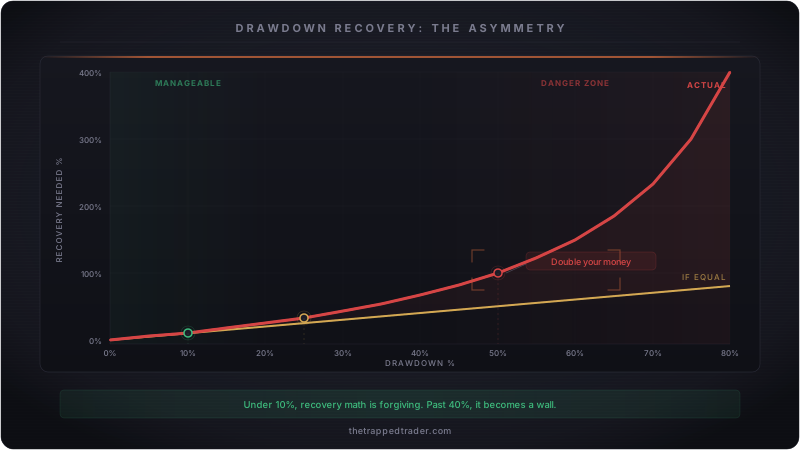
Professional traders treat drawdown limits as non-negotiable. The arithmetic doesn't allow large drawdowns to be recovered quickly. A trader who keeps their maximum drawdown under 10-15% can recover in weeks. A trader who lets it reach 50% may need a year of perfect trading just to break even.
The 1% Rule: Your Starting Point
The 1% rule is the standard position sizing guideline in active trading: never risk more than 1% of your current account balance on any single trade.
On a $25,000 account, that means your maximum loss on any trade is $250. If your stop loss is 2 points away on ES ($50 per point per contract), each contract risks $100. You can trade 2 contracts ($200 total risk) and stay within the $250 limit. If your stop is 4 points away, each contract risks $200, so you can only trade 1. The rule forces your position size to adjust based on where your stop goes, not based on how confident you feel.
Why 1% specifically? Because the math protects you during losing streaks.
At 1% risk per trade, 10 consecutive losses draw your $25,000 account down to about $22,613, a 9.6% drawdown. You need a 10.6% gain to recover. Doable in a couple of good weeks.
At 5% risk per trade, those same 10 losses reduce your account to about $14,882, a 40.5% drawdown. You now need a 68% gain to get back to even.
At 10% risk per trade, 10 losses leave you with roughly $8,718. You've lost 65%. Recovery requires nearly tripling what's left. Almost nobody comes back from that.
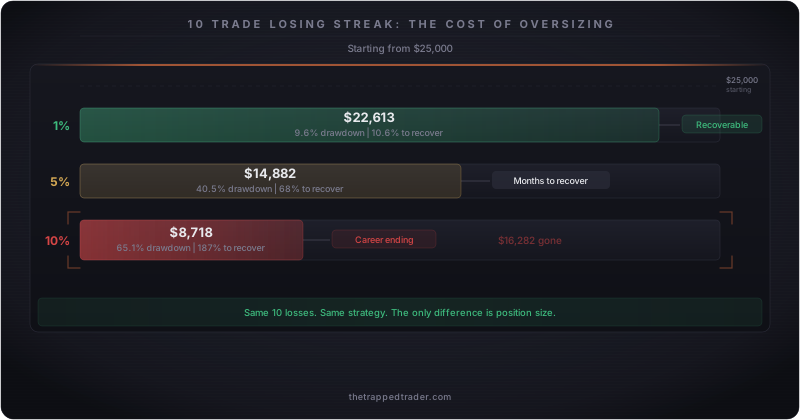
The 1% rule isn't the only valid approach. Some experienced traders use 0.5% for volatile instruments or 2% for high-conviction setups with strict rules. But the principle starts here: you control what you can lose before you ever think about what you might gain.
Key Rules
- Never risk more than 1% of your current account balance on any single trade
- A 50% drawdown requires a 100% gain to recover; keep drawdowns under 10-15%
- A 10-trade losing streak at 1% risk costs roughly 9.6% of your account; the same streak at 5% costs 40.5%
- Size every trade so a loss doesn't matter; never size so a loss could end the month
- Treat risk management as the foundation, not the afterthought after entries are decided
- If you don't know your risk per trade as a percentage, stop trading until you do
Next lesson, we do the math: the position sizing formula that turns your account balance, risk percentage, and stop distance into an exact number of contracts. No guessing. One formula, every trade.