Module 1.3·Lesson 5 of 8

Win Rate, Expectancy, and What Actually Matters

Read: 8 min | Full lesson: 28 minFree
63%

This lesson uses futures contracts (ES, MES) for all examples. The same expectancy principles apply to stocks and options with different position sizing mechanics. Level 2 covers instrument-specific techniques.

In Lesson 4, you learned that a 40% win rate with a 1:2 R:R can outperform a 60% win rate with a 1:1 R:R. But you're still juggling two separate numbers. Expectancy collapses them into one. It's the average amount you make or lose on every trade, calculated from your actual results.

A positive number means your approach has a mathematical edge. A negative number means it doesn't, regardless of how good the wins feel. This lesson gives you the formula, walks through the math, and shows you how to calculate it from your own trades.

What Expectancy Measures

R:R is something you calculate before a trade. Win rate is something you discover after weeks of trading. Expectancy is the number that ties them together into a single, actionable metric.

Think of it like batting average versus runs scored. Win rate is your batting average: how often you get a hit. But baseball games aren't won by batting average. They're won by runs. A player who bats .250 but hits home runs will outscore a player who bats .350 with nothing but singles.

Expectancy is the runs scored. It measures the actual output of your process, not just how often you connect. (If you're more of a poker player: win rate is how often you take the pot, expectancy is your expected value per hand. A tight player who folds often but wins big pots outearns the player who wins small pots constantly.)

In trading, expectancy answers one question: "If I keep trading this way, will I make money?" Not on the next trade. Not this week. Over the next 100 or 200 trades. It's the mathematical fingerprint of your approach.

Most traders never calculate expectancy. They check their win rate, look at their biggest win, glance at the account balance, and decide "things are going well" or "things aren't." That's like evaluating a business by checking the cash register without looking at expenses.

You can feel profitable while slowly losing money. You can feel like you're struggling while actually building a genuine edge. The number removes the guesswork.

The Formula

The expectancy formula has two parts: what you make when you win, and what you lose when you lose.

Expectancy = (Win Rate x Average Win) - (Loss Rate x Average Loss)

Win Rate is the decimal percentage of trades that are profitable. If you win 45 out of 100 trades, your win rate is 0.45. Loss Rate is the remainder: 1 minus win rate, so 0.55. Average Win and Average Loss are the mean dollar amounts of your winning and losing trades respectively.

Expectancy for a 45% Win Rate Trader
Win side

0.45 x $350 average win = $157.50

Loss side

0.55 x $200 average loss = $110.00

Expectancy per trade

$157.50 - $110.00 = +$47.50

This trader makes +$47.50 per trade on average. Over 200 trades, that's $9,500 in expected profit. The win rate is only 45%, but the average win ($350) is 1.75x the average loss ($200). The payoff ratio does the heavy lifting.

Now change one variable. What happens if this trader's win rate drops to 35%?

(0.35 x $350) - (0.65 x $200) = $122.50 - $130.00 = -$7.50 per trade. That 10-percentage-point drop flipped the expectancy from +$47.50 to -$7.50. Over 200 trades, the difference is $11,000: from +$9,500 profit to -$1,500 loss. Small changes in the inputs create large changes in the output.

Here's where many traders get stuck after learning about R:R. They think: "Lesson 4 told me my breakeven win rate is 33.3% at 1:2. I'm winning 45%. I'm fine." And at those exact numbers, they are. But R:R is what you PLAN before each trade. Expectancy is what you MEASURE from actual results.

This is why the R:R-only view feels so comfortable. R:R gives you a clean, forward-looking number before you enter a trade. It satisfies the need for certainty.

Expectancy requires looking backward at messy, uncomfortable data: partial fills, early exits, breakeven stops, and all the real-world friction that separates your plan from your actual performance. The pre-trade metric is easier to calculate and easier to like. But only the post-trade measurement tells you the truth.

Your actual average win might not be exactly 2x your average loss, because some trades get stopped at breakeven, some targets get partially filled, and some you exit early when conditions change. R:R is the blueprint. Expectancy is the building inspection.

Calculating from Your Own Trades

The formula is simple. Getting honest inputs is the harder part.

You need four numbers from your trade log: total winning trades, total losing trades, total dollars won, and total dollars lost. From those, you derive win rate, average win, average loss, and expectancy.

The process:

  1. Export your last 30+ closed trades (more is better)
  2. Separate winners from losers (breakeven trades count as losers for this calculation)
  3. Sum the dollar gains from all winners, divide by the number of winners = Average Win
  4. Sum the dollar losses from all losers, divide by the number of losers = Average Loss
  5. Divide winning trades by total trades = Win Rate
  6. Plug into the formula
Expectancy from a 50-Trade Log
Trade data

22 winners, 28 losers. Total gains: $8,800. Total losses: $5,600.

Averages

Average win: $8,800 / 22 = $400 Average loss: $5,600 / 28 = $200 Win rate: 22 / 50 = 0.44 (44%)

Expectancy

(0.44 x $400) - (0.56 x $200) = $176 - $112 = +$64 per trade

Positive expectancy of +$64/trade. Over the next 50 trades at this rate, the expected profit is $3,200. The 44% win rate means this trader loses more often than they win, but their winners are twice the size of their losers. The payoff ratio of 2:1 more than compensates for the sub-50% accuracy.
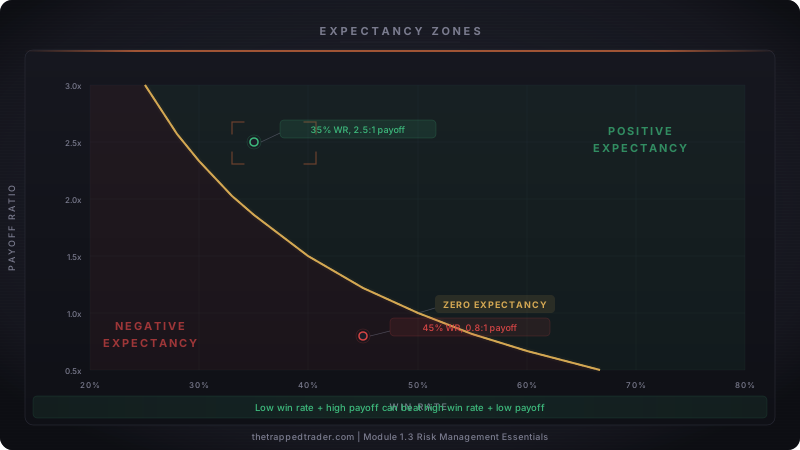
Zone diagram showing which combinations of win rate and payoff ratio produce positive expectancy versus negative expectancy, with the zero-expectancy boundary running from high payoffs at low win rates to low payoffs at high win rates

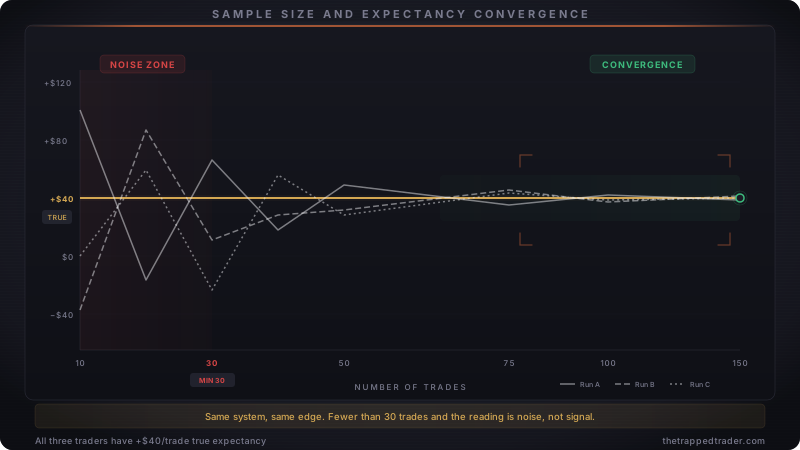
The 30-trade minimum matters. Fewer trades and randomness dominates the calculation. You might win 7 out of 10 by luck, compute a glowing expectancy, and think you've found an edge. Then the next 20 trades revert, and your "edge" vanishes. Statisticians call this insufficient sample size. Traders call it a rude awakening.

For a meaningful calculation, aim for 30 trades minimum. For a reliable one, 100+. And recalculate periodically, because markets change, your execution changes, and an expectancy that was positive six months ago might not be positive today. Tools like UpSkalr calculate expectancy automatically from your trade journal, so you can watch this number update in real time instead of building a spreadsheet from scratch after every session.

Three simulated traders with the same positive expectancy system showing wildly different readings at 10 trades that converge toward the true value by 100 to 150 trades, with a minimum threshold line at 30 trades

What Positive Expectancy Feels Like

Nobody warns you about this part: positive expectancy doesn't feel positive.

A trader with +$40 expectancy and a 40% win rate will lose 60% of their trades. On any given day with 3-4 trades, they'll probably have more losers than winners. Some days, every trade loses. Some weeks, the account draws down while the math is working exactly as it should.

The formula works over 100, 200, 500 trades. But you experience trading one trade at a time, and those individual trades don't know about your long-run expectancy. Most traders who calculate a positive expectancy for the first time feel great for about two weeks, and then hit their first extended drawdown within the system. The account drops, the losing trades stack up, and everything in them screams to change something. Abandoning a positive-expectancy system during a normal drawdown is one of the most expensive mistakes in trading. Nearly every experienced trader has done it at least once.

This is where every prior lesson in this module connects. Position sizing (Lesson 2) ensures a losing streak doesn't destroy your account. Stop placement (Lesson 3) keeps each individual loss controlled. R:R evaluation (Lesson 4) ensures you're only entering trades where the payout structure makes sense.

Expectancy ties all three together: it's the proof that the entire system works, measured from your actual results. But proof that works over 200 trades can feel like failure over 20.
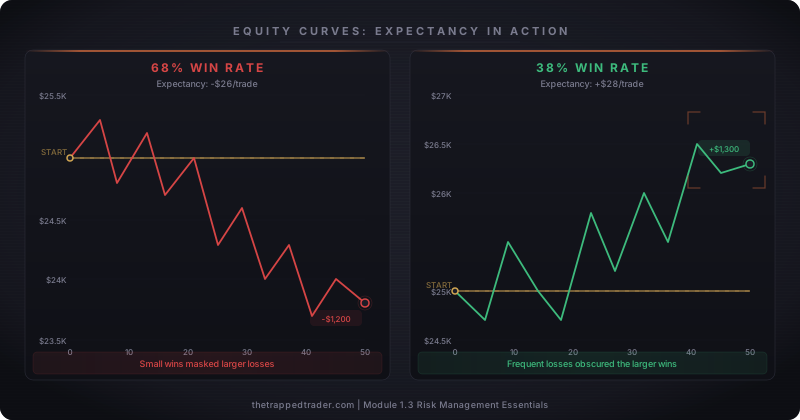
Two equity curves over 50 trades: left panel shows a high win rate trader with negative expectancy whose balance trends down despite frequent wins, right panel shows a low win rate trader with positive expectancy whose balance trends up despite frequent losses

Now that you can measure whether your trading has a mathematical edge, the next lesson covers maximum loss rules: the daily, weekly, and monthly limits that prevent a losing streak from turning into a catastrophe, even when your expectancy is positive.

01Test

You’ve finished reading. Time to check what landed.

Check Your Understanding

1 / 4

1.What does trading expectancy measure?

02Practice

Knowing isn’t enough. Put it into practice.

Practice Exercise

Calculation·~15 min

Below are 20 trade results from a hypothetical ES trading account. Calculate the expectancy per trade, then write a 3-4 sentence evaluation of whether this approach has a sustainable edge. Trade results (W = win, L = loss, dollar P&L): W +$400, L -$200, L -$200, W +$350, L -$200, L -$200, W +$500, L -$200, W +$300, L -$200, L -$200, L -$200, W +$450, L -$200, W +$400, L -$200, W +$350, L -$200, L -$200, W +$400.

03Reflect

Before you move on, anchor these ideas.