Why Loss Limits Exist
Loss limits are less about math than about what happens to your decision-making after a string of losses.
I learned this the expensive way. Every time I've traded without a hard daily limit, the pattern is the same: a couple of losers turn into "just one more," which turns into oversized positions, which turns into a hole so deep the only options are to stop or blow the account.
Think of loss limits like a fuse box. When a circuit overloads, the fuse blows. Annoying, but the alternative is the wiring catching fire. You're not the same trader after three losses. Your risk tolerance shifts. You size up. You take setups you'd normally skip. Stopping protects you from making bad decisions feel productive.
Setting Your Daily Loss Limit
Your daily loss limit should be a fixed dollar amount based on your account size, not a feeling. The standard range is 2-3% of your account. If you're risking 1% per trade (from Lesson 2), a 2% daily limit means two full losers end your day. A 3% limit gives you three.
$25,000
$25,000 x 0.02 = $500/day
$25,000 x 0.03 = $750/day
$500 limit / $250 risk per trade = 2 full losers (at 2%)
$750 limit / $250 risk per trade = 3 full losers (at 3%)
On a $25,000 account at 2% daily limit, two consecutive losing trades at 1% risk each hit your cap. At 3%, three losers end your day. Pick the number that matches your tolerance, but never exceed 3%. Beyond that, a single bad day starts creating the kind of drawdown that takes weeks to recover from.
The Two-Tier Circuit Breaker
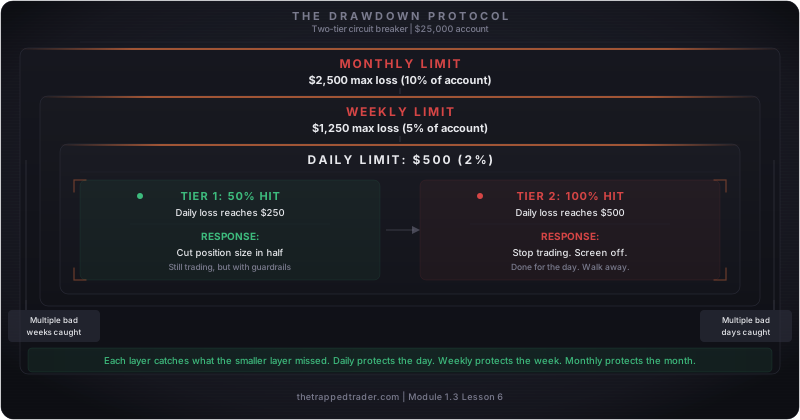
A single threshold creates an all-or-nothing problem. A better approach uses two tiers. This two-tier approach is The Drawdown Protocol.
Tier 1: 50% of your daily limit. Cut your position size in half. If your daily limit is $500, Tier 1 triggers at $250 in losses. Instead of trading 1 ES contract, you drop to 1 MES. Smaller size means the next loss hurts less.
Tier 2: 100% of your daily limit. Stop trading. Close the platform. Not minimize it. Close it. Your day is over. The market will be open tomorrow.
UpSkalr tracks your daily P&L against your loss limit in real time. Hit 50%? It flags you. Hit 100%? The session summary marks it. The data trail removes the negotiation.
Weekly and Monthly Caps
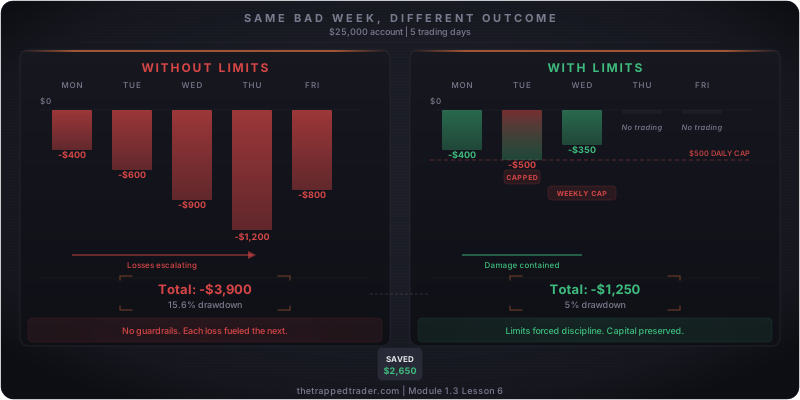
Daily limits protect individual days. Without a weekly cap, you could lose 2% five days straight: 10% gone in a week.
Weekly cap: 5-6% of your account. Roughly 2-3 bad days before the week shuts down.
Monthly cap: 10-12% of your account. If you hit it, something systemic has gone wrong. Stop trading until you've identified the problem.
$25,000
$25,000 x 0.02 = $500/day
$25,000 x 0.05 = $1,250/week
$25,000 x 0.10 = $2,500/month
The limits nest: you can have at most 2.5 max-loss days per week ($500 x 2.5 = $1,250) before the weekly cap kicks in. And at most 2 max-loss weeks per month ($1,250 x 2 = $2,500) before the monthly cap stops you. Each layer catches what the smaller layer missed. If you're hitting your monthly cap, you've had a genuinely rough stretch, and the right move is to step back and figure out why.
The Hardest Part: Actually Stopping
Setting loss limits takes five minutes. Following them takes everything you've got. The moment you hit your limit, your brain floods with reasons to keep going. "I'm so close to breakeven." Every one of those thoughts is your emotional brain overriding a decision your rational brain already made.
Make stopping physical, not mental. Close the trading platform. Walk away from the screen. If your platform supports automated daily loss limits, use them. Remove the decision from your hands entirely.
For a deeper dive on the psychology of losing streaks, see How to Break a Trading Losing Streak.
Key Rules
- Set your daily loss limit at 2-3% of your account; at 1% risk per trade, that's 2-3 full losers
- Tier 1 (50% of daily limit): cut position size in half
- Tier 2 (100% of daily limit): stop trading, close the platform, walk away
- Weekly cap: 5-6% of account; monthly cap: 10-12%
- Decide your limits when calm; enforce them when you're not
- Make stopping physical: close the platform, don't minimize it
Now that you've built your loss limit structure, the next lesson covers drawdown math: the recovery problem, and why loss limits are the first line of defense against hitting the point of no return.