The Breakeven Trap
One of the first things new traders learn: "move your stop to breakeven once you're up 1R." Sounds smart. You eliminate risk. Free trade.
Except it costs you expected value. Markets don't move in straight lines. After an entry, price often pulls back before continuing in your direction. A premature breakeven stop turns that normal pullback into a flat exit on a trade that would have worked.
When should you move to breakeven? When the market gives you a reason. In an uptrend, wait for price to establish a new higher low above your entry. Move your stop below that higher low, not to your exact entry price.
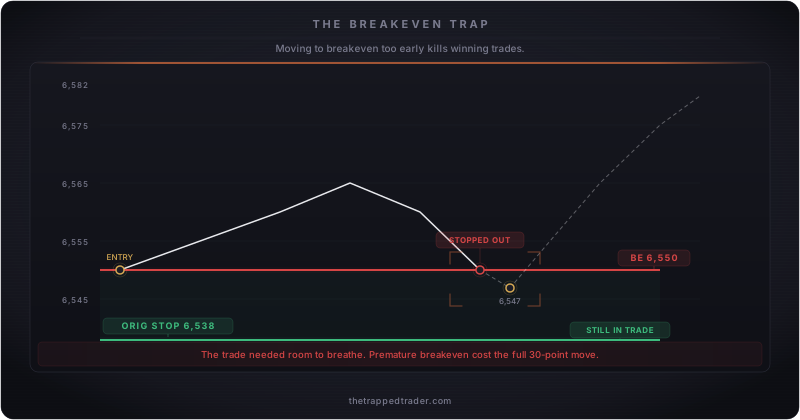
The difference between "the trade pulled back and stopped me at breakeven" and "the trade pulled back and I'm still in" often comes down to one decision: did you move your stop based on your P&L or based on what the chart showed?
Three Ways to Trail Your Stop
Once the trade is working in your direction, you need a method for protecting profits without choking the move. That's what a trailing stop does. It moves with price, locking in gains while giving the trade room to continue.
Structure-based trailing is the most adaptive approach. For a long trade, you move your stop below each new higher low as it forms. The market is literally showing you where buyers stepped in. If price breaks below the most recent higher low, the trend structure is damaged and you should be out. If you entered on a breakout (Module 1.2, Lesson 8) or a pullback to support (Module 1.2, Lesson 9), your trailing method should match your entry type: breakout entries often need wider initial room because the first pullback can be sharp, while pullback entries already have nearby structure to trail against.
ATR-based trailing is mechanical. Set your stop at 1.5x to 2x ATR below the current price or most recent swing. Works well in trending markets with consistent volatility.
Time-based management is the least discussed but often the most practical. If your trade hasn't moved meaningfully after a set number of bars (e.g., 15 bars on a 5-minute chart), tighten to the nearest structure level or exit. Trades that are going to work usually show progress relatively quickly.
Many traders combine methods: structure-based trailing as primary, time-based as secondary filter.
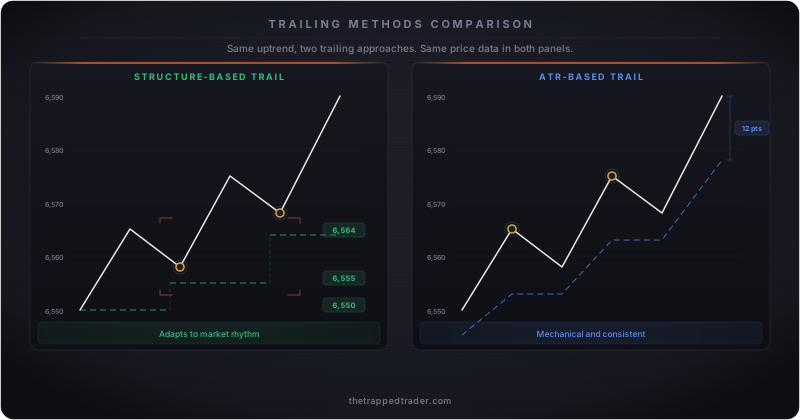
Scalpers prefer ATR-based trails for speed. Swing traders favor structure-based trailing for rhythm. The best one is the one you'll follow consistently.
Taking Partial Profits
Scaling out means closing part of your position before the trade is fully done. The standard approach: take 50% off at 1R, then trail the rest.
Why do traders take partials? Two reasons. First, it locks in profit on a portion of the trade, so even if the rest gets stopped at breakeven, you're still green. Second, it reduces the emotional weight of watching an open P&L. When you've already banked something, the remaining position feels easier to hold through pullbacks.
But partials have a cost. Every contract you close at 1R is a contract that won't benefit if the trade runs to 3R.
I take partials on almost every trade now unless the context screams continuation. Has it cost me profit? Yes. But it has kept me consistent. I rarely give back a full winner, and my equity curve is smoother because of it. That consistency compounds.
How Partials Change Your Math
Let's make this concrete. We'll compare two approaches on the same trade: full hold vs. 50% off at 1R.
You're risking $200 on this trade, split across 2 contracts ($100 risk per contract). Your target is 2R.
Both contracts hit the 2R target. Each earns $200 (2x the $100 risked per contract). Total: $400 (2R on full position).
Contract 1 closed at 1R: +$100. Contract 2 closed at 2R: +$200. Total: $300 (effective 1.5R).
Taking 50% off at 1R dropped your effective R from 2.0 to 1.5R on this trade. You gave up $100 (25% of the potential profit) in exchange for locking in $100 early.
Now change one variable. What if the trade runs to 3R instead?
Both contracts hit 3R. Total: $600 (3R on full position).
Contract 1 at 1R: +$100. Contract 2 at 3R: +$300. Total: $400 (effective 2.0R).
The gap widens as the runner runs further. At 3R, partials cost you $200 (33% of the potential). The bigger the eventual move, the more partials cost you. This is why trend followers and swing traders tend to hold full size, while scalpers and mean-reversion traders often take partials since their typical winners are smaller.
Plan Before You Enter
The worst time to make trade management decisions is while you're watching the P&L tick. Pre-commit to three decisions before every trade:
When to move to breakeven. "After price establishes a new higher low above my entry." Pick a rule. Don't improvise.
How to trail. Pick a primary method and stick with it. Switching mid-trade is rationalizing.
Whether to take partials. "50% at 1R, trail the rest." Decide before entry.
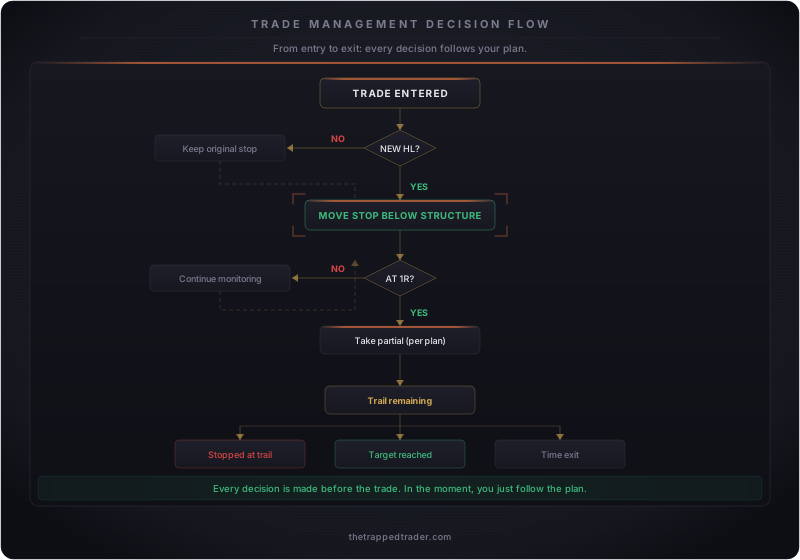
Every trade needs an exit reason logged: hit target, stopped out, trailed out, or manual close. That data tells you whether your trade management is consistent or improvised.
Your initial stop defines your R. Your trailing method defines how you protect gains. Your partial strategy defines how much you capture. One plan, decided before entry.
Key Rules
- Never move to breakeven based on P&L; wait for the market to establish new structure (a higher low for longs)
- Structure-based trailing: move your stop below each new higher low as it forms
- ATR-based trailing: 1.5x to 2x ATR below the current price or most recent swing
- Taking 50% off at 1R reduces effective R:R by about 25% on a 2R trade
- If a trade hasn't moved after 15 bars on a 5-minute chart, tighten or exit
- Decide your management rules before entry, not while watching a live P&L
With this lesson, you've built a complete risk management foundation. These nine lessons connect: position size comes from stop distance and the 1% rule, expectancy comes from win rate and R:R, scaling comes from sustained expectancy within drawdown limits. None works in isolation. All of it works together.