Module 1.3·Lesson 7 of 8

Drawdown Math: The Recovery Problem

Read: 8 min | Full lesson: 28 minFree
88%

In 'Why Risk Management Is Your Real Edge' (Lesson 1), you saw the headline version: a 50% drawdown requires a 100% gain to break even. That number is dramatic enough to stick. But most traders don't blow up in a single day. They bleed. A bad week here, an undisciplined stretch there, and suddenly they're staring at a 30% hole wondering how they got there.

This lesson gives you the complete recovery table, the formula behind it, and the time dimension nobody talks about. By the end, you'll calculate recovery requirements for any drawdown level and see why capital preservation is the highest-expected-value play in trading.

The Recovery Formula

The basic principle from Lesson 1 was simple: losses and gains aren't symmetric. Losing 50% means you need to gain 100% to get back to where you started. That wasn't just a dramatic example. It's the rule at every level, and here's the formula:

Required recovery % = loss % / (1 - loss %)

You can also express this as 1 / (1 - loss fraction) - 1 if you prefer working with fractions directly. Both give the same result.

The reason this works: when your account drops, you're calculating the recovery on a smaller base. If you lose 20% of $25,000, you've got $20,000 left. The $5,000 you need back is 25% of $20,000, not 20%.

Think of it like climbing out of a well. Every foot you fall, the walls don't just stay the same distance apart. They get closer together. A 10% fall is a short climb in a wide well, plenty of room to grab the walls and pull yourself up. A 50% fall puts you in a narrow shaft where every handhold barely moves you upward.

Past 60%, the walls are so tight that even strong daily gains translate to almost nothing in dollar terms. If you're down 60% on a $25,000 account, you have $10,000 left. A solid 1% day earns you $100, but you need $15,000 back. That's 150 days of 1% gains just to break even, and 1% daily is exceptional.

Recovery Requirements at Different Levels
10% drawdown

Account: $25,000 to $22,500. Lost $2,500. Recovery: $2,500 / $22,500 = 11.1%

25% drawdown

Account: $25,000 to $18,750. Lost $6,250. Recovery: $6,250 / $18,750 = 33.3%

50% drawdown

Account: $25,000 to $12,500. Lost $12,500. Recovery: $12,500 / $12,500 = 100%

75% drawdown

Account: $25,000 to $6,250. Lost $18,750. Recovery: $18,750 / $6,250 = 300%

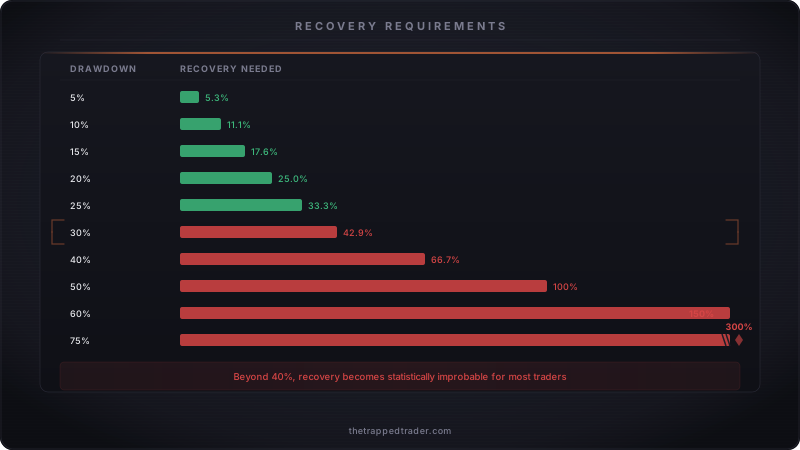
At 10%, the math barely stings. At 25%, you're working a third harder just to get back to zero. At 50%, you need to double your remaining capital. At 75%, you need to triple it. The asymmetry doesn't grow in a straight line. It accelerates.

Most beginners dismiss the moderate levels. "A 20% drawdown? I just need to make 25% back. That's not so bad." The reason this feels true is that your brain defaults to addition and subtraction: lose 20, gain 20, back to even. It anchors on the original number as the base for both directions.

But losses and gains don't operate on the same base. The 20% loss is calculated on your starting balance. The recovery is calculated on your smaller, post-loss balance. Your brain treats them as symmetric because addition and subtraction are symmetric. Multiplication and division aren't.

And even if 25% sounds manageable in isolation, most traders don't have one clean 20% drawdown and then trade flawlessly through the recovery. They claw back half, hit another rough stretch, and land at 35%. Now they need 54% to get back to where the second slide started. The numbers feel manageable one at a time, but they compound in practice.

Scale chart showing required recovery percentage for each drawdown level from 5% to 75%, revealing the accelerating asymmetry between losses and the gains needed to recover

How Long Recovery Takes

The recovery percentage tells you how far you need to climb. The time tells you how long you'll be climbing. This is where drawdown math gets truly punishing.

Assume you average 0.5% per trading day. That's a strong, consistent return. Most developing traders would be thrilled with it. At that rate, how long does it actually take to recover?

Recovery Time at 0.5% Daily Return
10% drawdown (need 11.1%)

Days = ln(1.111) / ln(1.005) = 21 trading days (about 1 month)

25% drawdown (need 33.3%)

Days = ln(1.333) / ln(1.005) = 58 trading days (about 3 months)

50% drawdown (need 100%)

Days = ln(2.0) / ln(1.005) = 139 trading days (about 7 months)

At a consistently strong 0.5% daily return, a 10% drawdown costs you a month. A 25% drawdown costs a quarter of a year. A 50% drawdown costs over half a year. And this assumes you trade perfectly during the entire recovery: no losing streaks, no mistakes, no bad days pulling you deeper.

Now change one variable. What if your daily return is 0.25% instead of 0.5%? Every recovery time roughly doubles. The 25% drawdown takes 6 months. The 50% drawdown stretches past a year. More realistic daily returns mean longer timelines. And every day you spend recovering is a day you're not compounding gains.
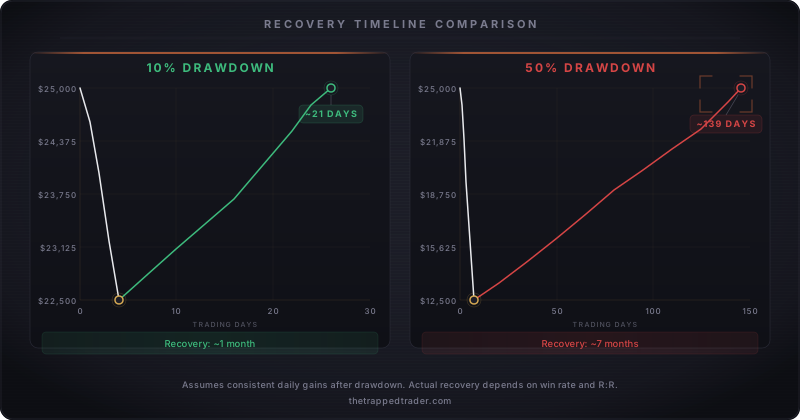
Two-panel comparison showing account recovery paths: a 10% drawdown recovering in about 21 trading days versus a 50% drawdown requiring 139 trading days at 0.5% daily returns

The Danger Zone

There's a threshold where drawdown stops being a setback and becomes a mathematical prison. For most developing traders, that threshold sits around 40%.

At 40% drawdown, you need a 66.7% gain to recover. At a strong 0.5% daily return, that's roughly 100 trading days, five full months of flawless execution.

At 50%, you need to double your money. At 60%, you need to 2.5x it. Past 40%, recovery stops being a realistic target for most developing traders.

Curve chart showing the accelerating relationship between drawdown percentage and required recovery gain, with zones marked as manageable under 20% and danger zone past 40%

I've saved more accounts than I can count after a big losing day or a tilt episode. The pattern is always the same: damage that took minutes or an hour to inflict takes one to two weeks or more to repair. You can't just "make it back" at the same size. You have to size down, slow down, and claw back more than you lost because the recovery math is working against you the entire time. That's the part nobody warns you about. The blowup feels like the problem. The weeks of reduced size grinding back to even is the actual cost.

For prop firm traders, trailing drawdowns make this math existential. You're not just fighting the recovery asymmetry. You're fighting a hard floor that follows you up but never follows you down. Every dollar you earn raises the stakes, and every dollar you lose brings you closer to a cliff with no second chance.

Capital Preservation Is the Edge

Every risk management tool you've learned in this module serves one purpose: keeping your account above the line where recovery is realistic. The 1% rule from Lesson 2 limits how much each trade can hurt. Structural stops from Lesson 3 place those limits at levels that make sense. Favorable R:R from Lesson 4 ensures you're compensated for the risk.

Positive expectancy from Lesson 5 confirms your approach actually has an edge worth compounding. The loss limits from Lesson 6 cap how far a bad day or bad week can push you. And The Drawdown Protocol exists specifically to trigger before you reach the danger zone, cutting size at 50% of your daily risk limit and shutting you down at 100%.

They all point to the same conclusion: a dollar of prevented loss is worth more than a dollar of profit.

This isn't a psychological trick or a motivational reframe. It's arithmetic. Consider two traders who both average 0.5% daily over six months.

Trader A follows strict risk rules and never dips below a 10% drawdown. Their account compounds forward the entire time. On a $25,000 account, six months of 0.5% daily compounding (roughly 125 trading days) grows the account to approximately $46,600.

Trader B trades aggressively in month two, hits a 30% drawdown, then trades perfectly for the remaining five months. They spend the first 72 trading days just recovering to their starting balance. The remaining 53 days of compounding grows their account to roughly $32,600.

Same skill level. Same daily return when trading well. But Trader A ends up $14,000 ahead because they never had to spend months climbing out of a hole. That's the cost of a single undisciplined stretch: not just the drawdown itself, but all the compounding time it steals from your future.

The traders who survive long enough to become consistently profitable aren't the ones with the biggest winning days. They're the ones who lose the least on their worst days. They treat capital preservation not as a restriction, but as their primary edge.

Now that you understand why protecting capital matters more than growing it, the next lesson covers the other side of the equation: when and how to scale your position size up. Because once you've proven consistency and your account is growing, there's a right way to compound your edge, and sizing up without criteria is how you land right back in the recovery math you just learned.

01Test

You’ve finished reading. Time to check what landed.

Check Your Understanding

1 / 5

1.A trader's $30,000 account drops to $21,000. What percentage gain on the remaining balance is needed to recover to $30,000?

02Practice

Knowing isn’t enough. Put it into practice.

Practice Exercise

Calculation·~15 min

Build a personal drawdown recovery reference table. Use your actual account size (or $25,000 if you don't have a live account). For each of the five drawdown levels listed below, calculate the dollar amount remaining, the dollar amount lost, the percentage gain needed to recover, and the estimated trading days to recover at 0.5% daily return. Then answer the assessment question at the end.

03Reflect

Before you move on, anchor these ideas.