Module 1.3·Lesson 8 of 8

Scaling and Compounding: When to Size Up

Read: 8 min | Full lesson: 28 minFree
100%

You've spent this entire module learning how to protect your account. Position sizing, stop placement, R:R ratios, expectancy, max loss rules, drawdown math. All of it points to one goal: staying in the game long enough for your edge to compound.

This lesson is about the moment every trader eventually faces: you're making money, and you want to make more. Sizing up is inevitable if your edge is real. The answer to "when" has nothing to do with how you feel.

The Confidence Trap

After a good week or a good month, something shifts. You start thinking bigger. You've been trading 1 MES contract and hitting your numbers. Why not 2? Why not switch to ES? You've earned it, right?

This is one of the most dangerous moments in a trader's development, because the reason you want to size up is almost always wrong.

Think of it like a video game. You cleared the tutorial, beat a few early levels, and now you're ready to jump straight to the hardest difficulty. The early levels weren't useless, but they didn't prepare you for the boss fight. You're confusing "I haven't died yet" with "I'm ready for anything."

In trading, the boss fight is a 10 or 15-trade losing streak that's statistically guaranteed to happen eventually. Your current size needs to survive that streak, not just feel comfortable in the tutorial.

Most beginners think a winning streak means their strategy is working and it's time to scale. The wrong mental model: confidence = readiness. Short-term results are dominated by variance, not skill.

This feels wrong because your brain is wired to find patterns, even in randomness. A winning streak triggers the same pattern-recognition instinct that helped your ancestors spot predators: something is happening, and your brain wants to assign a cause. Confirmation bias does the rest. You remember the trades that confirmed your skill and forget the ones where you got lucky on a sloppy entry.

A 55% win-rate strategy can easily produce 8 winners in a row. It can also produce 8 losers in a row. Both are statistically normal. If you sized up after the winning streak, you're entering the inevitable losing streak at your largest size. That's how accounts blow up after months of profitability.

Traders talk a lot about tilt, the emotional spiral after losses. But the opposite is just as dangerous: WILT, or "winners tilt." It's what happens when a hot streak convinces you that you've figured it out. You start sizing up, skipping your checklist, taking setups you'd normally pass on.

The confidence feels earned, but it's just recency bias wearing a disguise. WILT is how traders give back weeks of profit in two or three sessions. It's harder to recognize than tilt because it doesn't feel like a problem. It feels like you're finally trading the way you always knew you could.

How Compounding Actually Works in Trading

Compounding is real. It's the reason small accounts can grow into meaningful ones. But compounding in trading works differently than compounding in a savings account, and the difference matters.

In a savings account, your balance only goes up. Every month, interest adds to your principal, and next month's interest is calculated on the larger base. It's a smooth, upward curve.

In trading, your balance goes up AND down. Drawdowns reset your compounding base. Every time you lose 10%, you're compounding from a smaller number. This is why drawdown recovery math, which you studied in Lesson 7, matters so much: a 10% loss requires an 11.1% gain just to get back to even.

Compounding at Steady Size vs. Premature Scaling
Steady approach: 1 MES contract, $25,000 account

Average net gain of $25/day after spread and commissions (roughly 20 ticks net on MES at $1.25/tick). Over 20 trading days: $25 x 20 = $500/month.

After 3 months of consistency

Account grows to approximately $26,500. You've proven the process works over 60+ trading days. Now you scale to 2 MES contracts.

Premature approach: switch to 2 contracts after week 3

Same $25/day average, but now at 2 contracts. Sounds like $50/day. But your first 5-day losing streak at 2 contracts costs $250 instead of $125. On a $25,500 account, that's a 1% drawdown in a week from a normal losing streak.

The steady trader reaches $26,500 in 3 months with controlled drawdowns. The premature scaler might reach $26,500 faster during good stretches, but a normal 5-day losing streak at double size creates a $250 hole instead of $125. If the losing streak extends to 10 days (which happens), that's $500 gone, wiping out all gains from the size increase. The premature scaler's equity curve looks like a roller coaster. The steady trader's looks like stairs.
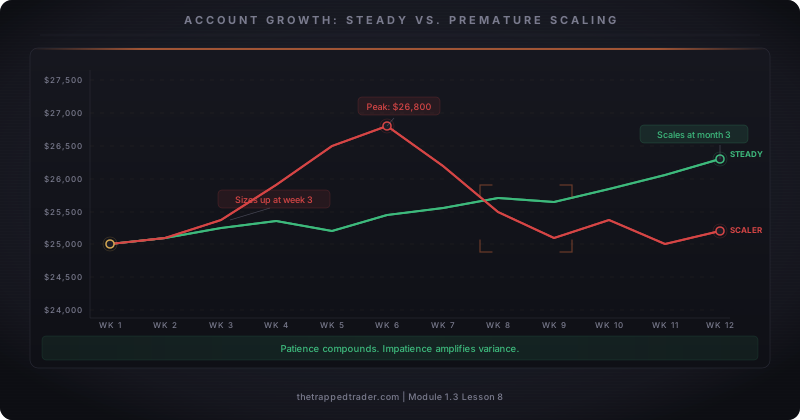
Account growth comparison showing steady single-contract growth as a stable staircase pattern versus premature scaling creating volatile spikes and deeper drawdowns

Compounding only works when you protect the base. Every dollar you lose in a drawdown is a dollar that stops compounding. This is why the rest of this lesson focuses on when to scale, not just how much to scale.

The Criteria That Actually Matter

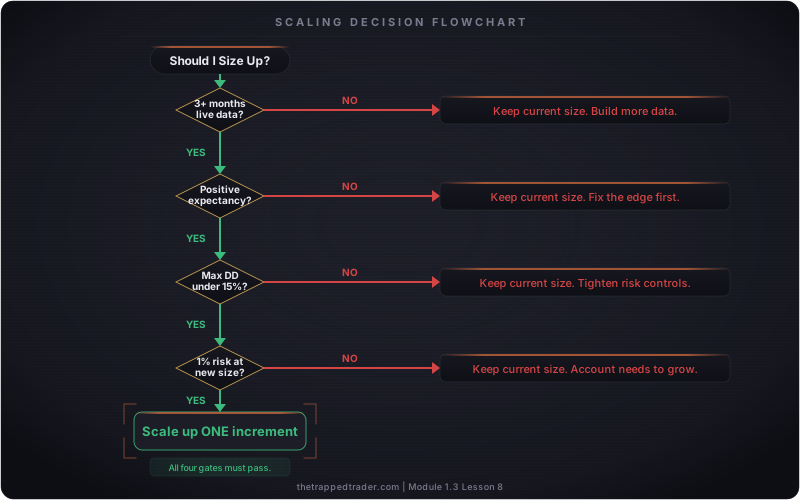
If confidence isn't a valid criterion, what is? Four things, and all four must be true at the same time.

1. Time: The 3-month consistency rule. You need a minimum of 3 months (roughly 60 trading days) of live trading data at your current size. Not paper trading. Not backtesting. Live trades with real money.

Why 3 months? The math and the industry both point here. At 2-5 trades per day, three months gives you 120-300 trades. Below about 100 trades, a 55% win rate is statistically indistinguishable from coin-flipping noise (p-value above 0.20, meaning a 1-in-5 chance your results are pure luck). At 120+ trades, your metrics start becoming statistically meaningful.

Many prop firms require several consecutive profitable months before they'll scale your account. As of early 2026, firms like Topstep and Take Profit Trader require 4 consecutive profitable months, making 3 months slightly more aggressive than the industry standard (verify current terms on each firm's website, as rules change frequently). One good month can be luck. Two can be a favorable market regime.

Three months forces you to trade through different conditions: trending weeks, choppy weeks, news events, low-volume drift.

2. Positive expectancy. Your expectancy per trade, which you calculated in Lesson 5, must be positive across the full 3-month sample. Not just the last two weeks. Not just the best month. The entire period. If your expectancy is positive but driven by one or two outlier wins, that's a red flag, not a green light.

3. Maximum drawdown within limits. During those 3 months, your worst peak-to-trough drawdown should stay under 15% of your account. If you've already hit 15% at your current size, sizing up will push you past 20% during the next comparable drawdown. In 'Maximum Loss Rules' (Lesson 6), you learned that The Drawdown Protocol kicks in at specific thresholds. Your scaling plan must respect those same thresholds at the new size.

4. Risk per trade stays at 1%. Scaling up doesn't mean accepting more risk per trade. It means your account has grown enough that 1% of a larger account allows for more contracts. If your account hasn't grown, you haven't earned the right to trade bigger. The math does the deciding, not you.

Decision flowchart for evaluating whether to increase position size, with four criteria gates that must all pass before sizing up

Drawdown-Based Scaling

Scaling isn't just about sizing up. It's about knowing when to size down, and having a plan to size back up after recovery. This is drawdown-based scaling, and it works in both directions.

The logic is straightforward. You set equity thresholds tied to your position size. When your account drops below a threshold, you reduce size. When it recovers above a threshold, you increase back. No emotion. No "I think the losing streak is over." Just numbers.

Drawdown-Based Scaling Ladder
Starting point: $30,000 account, 2 MES contracts

At 2 MES contracts with a 50-tick stop, risk per trade = 2 x 50 x $1.25 = $125 (0.42% of account). Well within the 1% limit.

Scale-down threshold: account drops below $27,000 (10% drawdown)

Reduce to 1 MES contract. New risk per trade = 1 x 50 x $1.25 = $62.50 (0.23% of $27,000). Smaller size means the next losing streak hurts less, giving you room to stabilize.

Recovery threshold: account recovers above $28,500

This is NOT the same as the scale-down threshold. You need a buffer. You scaled down at $27,000 but don't scale back up until $28,500. This prevents whipsawing: scaling down, immediately scaling back up, then scaling down again.

The buffer between your scale-down trigger ($27,000) and your scale-up trigger ($28,500) is $1,500 or about 5% of your original account. This dead zone prevents reactive size changes. You sit at the smaller size until you've genuinely recovered, not just bounced.
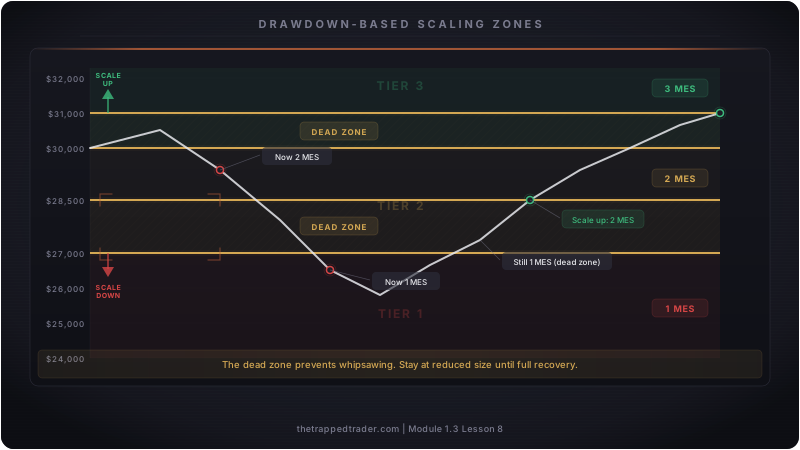
Equity zones showing position size tiers with scale-down triggers, dead zones, and recovery thresholds for a drawdown-based scaling system

Putting Your Scaling Plan on Paper

The best time to write a scaling plan is right now, before you need it. Decisions made during a winning streak are just as emotional as decisions made during a losing streak. Both feel rational in the moment. Neither actually is. The plan you write today is protection against the version of you who will want to break the rules tomorrow.

Your plan needs four components, and each one must contain specific numbers, not vague intentions.

Scaling-up criteria. The four checkboxes from earlier: 3 months of data, positive expectancy, drawdown under 15%, risk per trade at 1%. Write the specific numbers for your account. Not "positive expectancy" but "expectancy above $15 per trade across 60+ trading days." Not "controlled drawdown" but "max drawdown under $3,750 on a $25,000 account."

Vague plans get overridden by emotions. Specific plans get followed.

Scaling-down thresholds. Specific equity levels where you reduce size. For every position size on your ladder, there's an equity level where you step down. Write them as exact dollar amounts, not percentages you'll calculate later.

"Scale down at $27,000" is a rule you can follow at 6 AM after three losing trades. "Scale down when drawdown exceeds roughly 10%" is a suggestion you'll negotiate with yourself.

A position size ladder. A simple table: at $X equity, trade Y contracts. At $X-Z equity, trade Y-1 contracts. This removes every calculation from the moment of decision. You look at your account balance, you look at your ladder, and you know your size. No mental math, no judgment calls.

A review schedule. Monthly or quarterly, you review your data. Not daily. Not after a bad week. Reviewing too often leads to tweaking, and tweaking is just another word for emotional decision-making. Set a calendar reminder and do not open the plan between reviews.

This is the final lesson in Module 1.3. You've built a complete risk management foundation: position sizing, stop placement, risk-to-reward, expectancy, maximum loss rules, drawdown recovery math, and now scaling. Every one of these topics connects.

Your position size comes from your stop distance and your 1% rule. Your stop comes from market structure. Your expectancy comes from your win rate and R:R. Your scaling comes from sustained expectancy within drawdown limits. None of it works in isolation. All of it works together.

In Module 1.4, you'll take this foundation and apply it to building a complete trading plan, from rules to routines to the daily process that turns knowledge into consistency.

01Test

You’ve finished reading. Time to check what landed.

Check Your Understanding

1 / 4

1.Which of the following is a valid criterion for increasing position size?

02Practice

Knowing isn’t enough. Put it into practice.

Practice Exercise

Plan Writing·~15 min

Write a personal scaling plan for your current trading account. Use the criteria framework from this lesson. Your plan must cover all four components: scaling-up criteria, scaling-down thresholds, the specific position sizes at each equity level, and a timeline for review. If you don't have a live account yet, use a $25,000 MES account as your starting point.

03Reflect

Before you move on, anchor these ideas.