Module 1.3·Lesson 4 of 8

Risk-to-Reward Ratios

Read: 8 min | Full lesson: 28 minFree
50%

This lesson uses futures contracts (ES, MES) for all examples. The same risk-to-reward principles apply to stocks and options with different position sizing mechanics. Level 2 covers instrument-specific techniques.

Your win rate doesn't determine whether you make money. Your risk-to-reward ratio does. A trader who wins 40% of the time with a 1:2 R:R will outperform a trader who wins 60% with a 1:1 R:R over any meaningful sample of trades. This lesson covers what R:R measures, how to calculate it from your stop and target distances, and the formula that tells you the minimum win rate you need at any R:R level.

What Risk-to-Reward Measures

In 'Stop Loss Placement: Where and Why' (Lesson 3), you set your stop at the price where your trade idea is wrong. That stop distance is one half of the R:R equation. The other half is your profit target: how far price needs to move in your favor before you exit.

Risk-to-reward ratio compares those two distances. If your stop is 4 points below your entry and your target is 8 points above it, your R:R is 1:2. You're risking 1 unit to potentially gain 2.

Think of R:R like the payout odds on a bet. If a friend offers you a coin flip where tails costs you $50 but heads pays you $100, you'd take that bet all day long. You'd win only 50% of the time, but you'd still come out ahead because the payout is tilted in your favor. The coin doesn't need to be rigged. The payout structure does the work.

R:R in trading operates the same way: when your potential gains are larger than your potential losses, you don't need to win most of your trades to make money. But most traders don't think in payout terms. They think "I need to be right more often," when the real question is "how much do I get paid when I'm right?"

The notation matters. A 1:2 R:R means for every $1 you risk, you could make $2. A 2:1 R:R means the opposite: you're risking $2 to make $1. When someone says "my R:R is 3," they typically mean 1:3. In this course, we always write it explicitly: 1:2, 1:3, 1:0.5. Risk comes first.

Calculating R:R from a chart comes down to three price levels. Your entry price minus your stop gives you risk distance. Your target minus your entry gives you reward distance.

Say the entry is at 5,240 with a structural stop at 5,236 and a target at 5,248. Risk = 4 points. Reward = 8 points. R:R = 1:2. In 'Position Sizing: How Much to Risk Per Trade' (Lesson 2), you learned that ES moves $50 per point. Those 4 points of risk equal $200 per contract, and the 8 points of reward equal $400 per contract. The dollar amounts confirm the ratio: $200 risk for $400 potential gain.

Why Win Rate Alone Is Misleading

Most beginners obsess over win rate. They want to win 70%, 80%, 90% of their trades. Winning more should mean making more, right? Not necessarily, because win rate says nothing about the SIZE of wins and losses.

The misconception goes like this: "If I win more trades than I lose, I'm profitable." That's only true when your average win is at least as big as your average loss. For most beginners, it isn't.

The psychology behind this is specific and predictable. Behavioral finance calls it the disposition effect: traders sell winners too early and hold losers too long. A trade moves 3 points in your favor, and the urge to lock in the gain is overwhelming. You close it.

Then a trade goes 3 points against you, and instead of taking the loss, you hold because "it might come back." Sometimes it does. But the pattern creates an asymmetry: your average win is 3 points while your average loss slowly creeps toward 6 or 8.

You're winning 60% of your trades and still bleeding money, because the wins are half the size of the losses.

Losing feels roughly twice as painful as winning feels good, so traders unconsciously arrange their trades to win often, even when that arrangement produces smaller gains than losses. The R:R framework forces you to evaluate the trade's math before your emotions get involved.

Two Traders, Same Market
Trader A: 60% win rate, 1:1 R:R

Risks $200 per trade. Over 100 trades: 60 wins x $200 = $12,000 in gains 40 losses x $200 = $8,000 in losses

Trader A net profit

$12,000 - $8,000 = $4,000

Trader B: 40% win rate, 1:2 R:R

Risks $200 per trade, targets $400. Over 100 trades: 40 wins x $400 = $16,000 in gains 60 losses x $200 = $12,000 in losses

Trader B net profit

$16,000 - $12,000 = $4,000

Both traders made $4,000 over 100 trades, but Trader B won only 40% of the time. Now bump Trader B's win rate to just 45%: 45 wins x $400 = $18,000 minus 55 losses x $200 = $11,000. Net profit: $7,000, nearly double Trader A's result. A small improvement in accuracy creates a large improvement in profit when R:R is favorable.
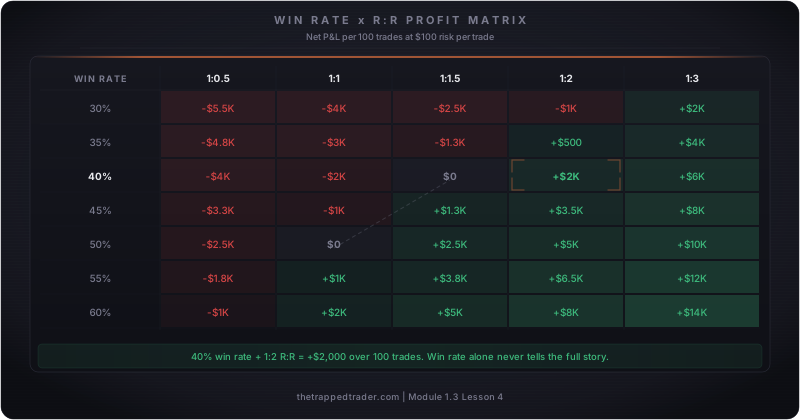
R:R is the variable you can control and plan for before every trade. Win rate fluctuates week to week. Some weeks you'll hit 55%, others 30%. But if you only take trades where the R:R is at least 1:1.5 or 1:2, you don't need to be right most of the time.

Matrix showing profit or loss per 100 trades at $100 risk for different combinations of win rate and R:R, with green cells profitable and red cells unprofitable

The Breakeven Formula

Every R:R level has a breakeven win rate: the minimum percentage of winning trades needed to avoid losing money. The formula is simple.

Breakeven Win Rate = 1 / (1 + R:R multiple)

The "R:R multiple" is the reward side of the ratio. For a 1:2 R:R, the multiple is 2. For 1:3, it's 3. For 1:0.5 (risking twice your potential gain), it's 0.5.

Breakeven Win Rates at Different R:R Levels
At 1:1 R:R (multiple = 1)

1 / (1 + 1) = 1 / 2 = 50.0%

At 1:2 R:R (multiple = 2)

1 / (1 + 2) = 1 / 3 = 33.3%

At 1:3 R:R (multiple = 3)

1 / (1 + 3) = 1 / 4 = 25.0%

Now flip it: 1:0.5 R:R (multiple = 0.5)

1 / (1 + 0.5) = 1 / 1.5 = 66.7%

At 1:1 R:R, you need to win half your trades just to break even. At 1:2, only 33.3%. At 1:3, just 25%. But flip the ratio to 1:0.5, and you need to win 66.7%. The drop isn't linear: improving from 1:1 to 1:2 cuts your required win rate by nearly 17 percentage points, while improving from 1:2 to 1:3 cuts it by only 8.
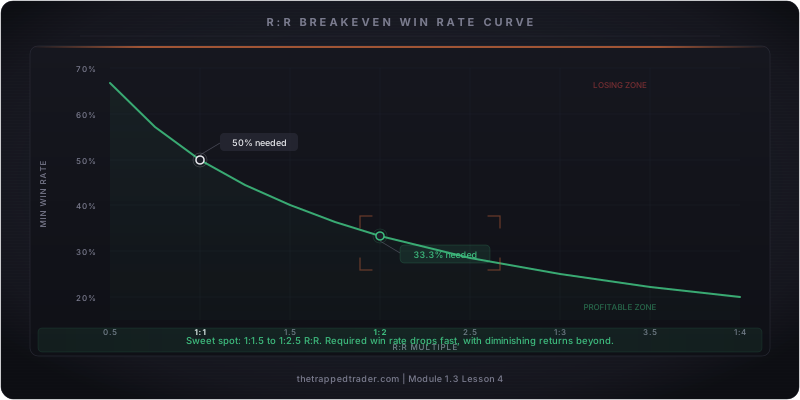
Look at the pattern in those numbers. The biggest gain comes from improving a bad R:R to a decent one. Going from 1:0.5 to 1:1 cuts your required win rate from 66.7% to 50%. Going from 1:1 to 1:2 cuts it from 50% to 33.3%. But going from 1:2 to 1:3 only cuts it from 33.3% to 25%. There are diminishing returns to chasing higher R:R.

Curve showing the relationship between R:R multiple and minimum breakeven win rate, with the curve steepening sharply below 1:1 and flattening above 1:2

Evaluating R:R Before You Enter

R:R is not something you calculate after a trade closes. It's something you measure before you enter. Every setup has a natural R:R based on three numbers: your entry price, your structural stop (from Lesson 3), and your profit target.

The process:

  1. Identify your entry price
  2. Set your stop at the structural invalidation point (Lesson 3)
  3. Identify a realistic profit target: the next support or resistance level, a prior swing high or low, or a measured move from a pattern
  4. Calculate: Reward distance / Risk distance = R:R multiple
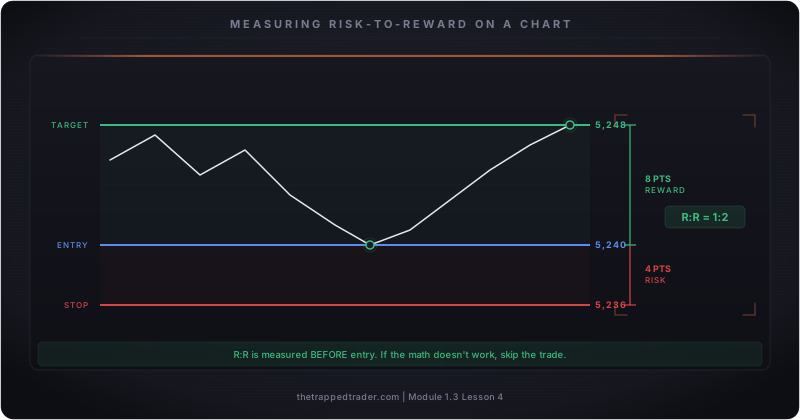
Annotated price chart showing an ES long trade with entry at 5,240, stop at 5,236 (4 points risk), and target at 5,248 (8 points reward), with the R:R measurement of 1:2 displayed

Step 3 is where most traders get the math wrong. They set arbitrary targets ("I want 10 points") instead of letting the chart define where price is likely to pause. A realistic target is the next visible structure level: a prior swing high, a key resistance zone, or a round number that consistently attracts attention. If that structural target only gives you a 1:0.8 R:R, the setup isn't worth taking, no matter how clean the entry pattern looks. And don't move the target further out to force a better ratio. A target in empty space, with no structural reason for price to stop there, is a wish, not a plan.

Once the formula clicks, the last thing you want is to punch it into a calculator before every entry. UpSkalr runs this math automatically: feed it your risk and profit targets, and the algorithm calculates your R:R, breakeven win rate, and position size in one step. You learn the formulas here so you know what the numbers mean. UpSkalr handles the arithmetic so you can focus on reading the chart.

Now that you can calculate R:R and the minimum win rate to break even at any level, the next lesson covers expectancy: the single number that combines your win rate and R:R into a measure of whether your trading actually has a mathematical edge.

01Test

You’ve finished reading. Time to check what landed.

Check Your Understanding

1 / 4

1.A trade has a stop loss 4 points below entry and a profit target 8 points above entry. What is the risk-to-reward ratio?

02Practice

Knowing isn’t enough. Put it into practice.

Practice Exercise

Calculation·~15 min

Calculate the risk-to-reward ratio and breakeven win rate for three trade scenarios. For each scenario, show every step: risk in points, reward in points, R:R ratio, and breakeven win rate using 1 / (1 + R:R multiple). Then decide whether each trade meets a minimum R:R of 1:1.5. Finally, write 2-3 sentences explaining which trade you'd take based purely on R:R and breakeven win rate. You don't need to factor in win rate or expectancy yet.

03Reflect

Before you move on, anchor these ideas.