Your Stop Is an Invalidation Point
A stop loss goes at the price where your trade idea is wrong. Not "the most I'm willing to lose." Not "a number that keeps my dollar risk comfortable." The price where the market proves you wrong.
Think about a smoke alarm. You set the sensitivity so it goes off when there's actual smoke. Too sensitive and it triggers every time you boil water. Too insensitive and it misses a real fire. Stop placement works the same way. If you enter long because you think price is bouncing off support, your stop belongs below that support. Not 3 points below entry because "$150 feels comfortable."
Structure-Based Stops
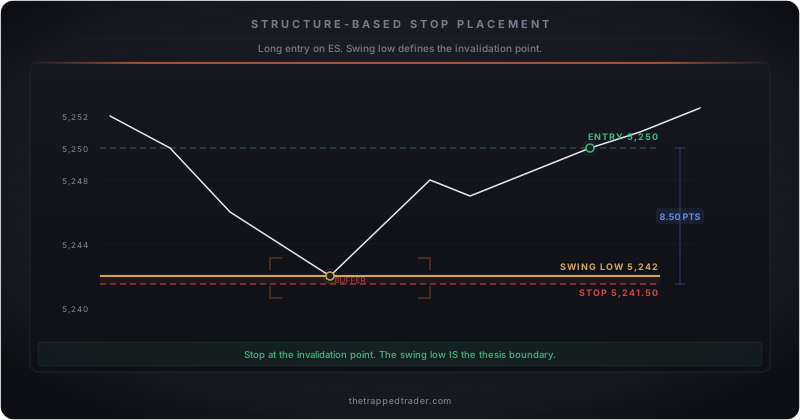
Structure-based stops use price levels the market already established. The standard approach: place stops beyond swing lows for long trades and beyond swing highs for short trades.
A swing low is where price dropped, buyers stepped in, and price reversed higher. If price later drops below that level, buyers couldn't hold. For a long trade, that's your invalidation point.
The process:
- Find the most recent swing low below your entry price
- Place your stop 1-2 ticks below that swing low (the buffer)
- Calculate the distance between your entry and your stop
- Feed that distance into the position sizing formula from Lesson 2
The buffer matters. Price often retests a swing low with a wick that pokes below the exact level before bouncing. I've been stopped on exact swing lows more times than I can count. Adding a 1-2 tick buffer (0.25-0.50 points on ES) cut my premature stop-outs dramatically.
Long entry at 6,600. Most recent swing low at 6,592.
Stop at 6,591.50 (2 ticks below the swing low)
6,600 - 6,591.50 = 8.50 points
$500 / (8.50 x $50) = $500 / $425 = 1.17, rounded down to 1 contract
The structure gives you an 8.50-point stop. On a $50,000 account at 1% risk, that's 1 ES contract. If the swing low breaks, your thesis is dead, and you're out for $425, under your $500 budget.
For short trades, the logic flips. Your stop goes above the most recent swing high, with a 1-2 tick buffer above it. If price breaks above that swing high, sellers couldn't hold, and your bearish thesis is invalidated. Same method, opposite direction.
ATR-Based Stops
Not every trade has a clean swing point nearby. Sometimes the chart is choppy, or the nearest structure is so far that the stop distance makes your position size zero. That's where ATR-based stops come in.
ATR (Average True Range) measures how far price typically moves per bar. A 14-period ATR of 12 on an ES 5-minute chart means each bar covers about 12 points on average.
The go-to multiplier is 1.5x ATR, placing your stop beyond the average single-bar range so normal oscillation won't reach it. Scalpers sometimes use 1.0x, swing traders go up to 2.0x.
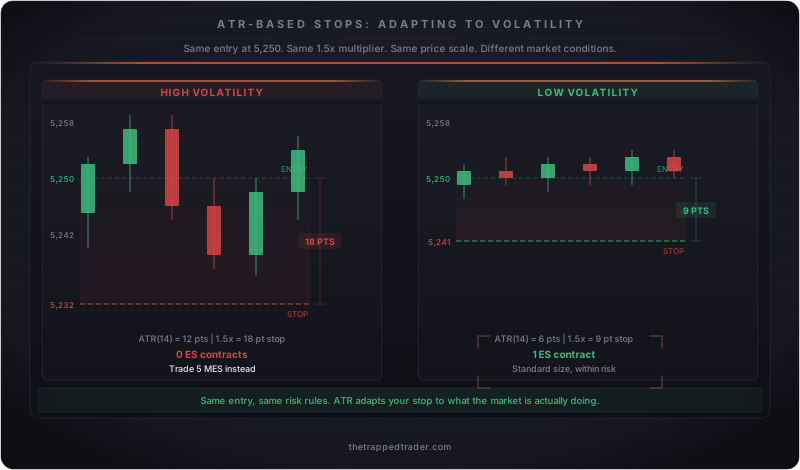
ES 5-minute chart shows ATR(14) = 12 points
12 x 1.5 = 18 points
6,600 - 18 = 6,582
$500 / (18 x $50) = $500 / $900 = 0.55, rounded down to 0 ES contracts
At 18 points, the ATR-based stop is too wide for a standard ES contract on this account. Switch to MES ($5/point): $500 / (18 x $5) = $500 / $90 = 5.55, rounded down to 5 MES contracts. The sizing formula from Lesson 2 does exactly what it should: it tells you to size down when the stop is wide.
Now change one variable. Same entry, but the market is calmer. ATR drops from 12 to 6 points. ATR stop: 6 x 1.5 = 9 points. Stop at 6,591.
Position size on ES: $500 / (9 x $50) = $500 / $450 = 1.11, rounded down to 1 ES contract. Same method, different volatility, different result. The ATR adapts your stop to what the market is doing right now, not what it was doing last week.
Why Tight Stops Cost More
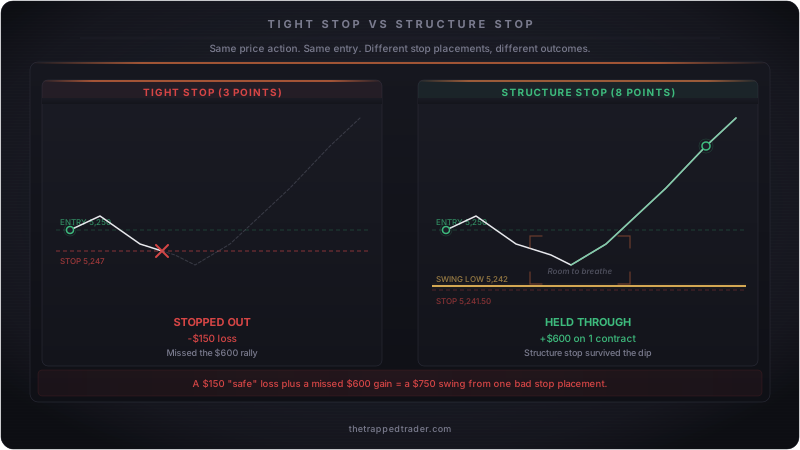
The instinct is tight stops. A 3-point stop on ES risks $150 per contract versus $400 at 8 points. Smaller loss. Safer. Right?
The real cost comes from how often you get stopped out. ES moves 3-5 points within minutes during regular hours. A 3-point stop sits in the middle of normal noise: the alarm placed directly above the stove.
A structure-based stop at 8 points only triggers when the market actually breaks the level. That's meaningful information. The wider stop gets hit less often, and when it does, it's telling you something real.
Key Rules
- Place your stop where your trade idea is wrong, not where your dollar risk feels comfortable
- Structure-based stops go 1-2 ticks beyond the swing low (longs) or swing high (shorts)
- ATR-based stops use a 1.5x multiplier as a starting point; adjust based on stop-out frequency
- Never use a fixed-point stop that ignores structure and volatility
- If the formula gives you 0 contracts at the correct stop, switch to micros or skip the trade
- A tight stop that gets hit 7 out of 10 times costs more than a wide stop that gets hit 3 out of 10
Every stop placement method feeds the same formula from Lesson 2. The distance determines the size. The next question is whether the potential reward justifies that risk. That's Lesson 4: risk-to-reward ratios.