The Five Stages
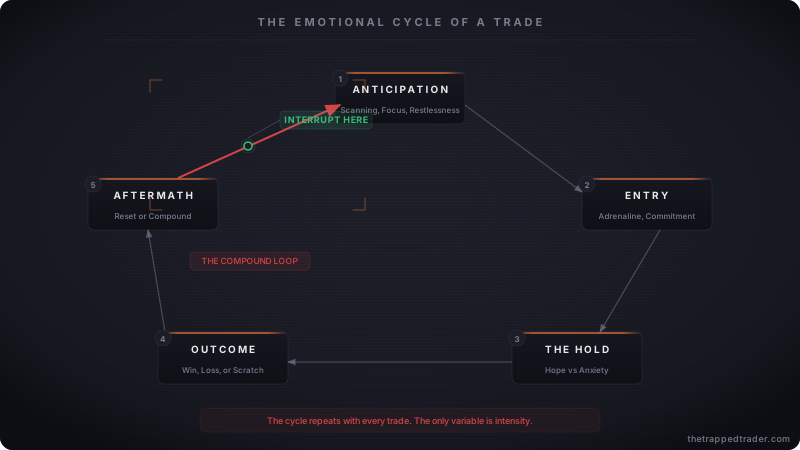
Every trade moves through five emotional stages. The only variable is intensity.
Stage 1: Anticipation. Scanning charts. Impatience creeps in. The longer you wait, the more your brain lowers the bar.
Stage 2: Entry. You pull the trigger. No more "maybe." This is where hesitation lives.
Stage 3: The Hold. Every tick in your favor feels like validation. Every tick against you feels personal. This is where traders move their stop-loss, add to losers, or close winners too early.
Stage 4: The Outcome. Win, lose, or breakeven. The emotional response is immediate, but it's not the one that matters most.
Stage 5: The Aftermath. The stage that gets skipped. After a loss, the Aftermath is where revenge trading begins. After a big win, it's where overconfidence inflates your next position size.
Your Brain on a Trade
The emotional cycle isn't weakness. It's biology. Your brain has two systems competing for control.
The amygdala is your brain's threat detector. Fast, reactive, built for survival. The prefrontal cortex is the analytical brain. Slow, deliberate. It built your trading plan. Under stress, the amygdala wins. Every time.
Think of it like a riptide. Fighting it exhausts you and pulls you under. The way out is to swim parallel to shore. The emotional cycle is the riptide. You beat it by recognizing you're in it.
I watched this once. Long ES, stop under a level I trusted. Price drifted down and my hand moved the stop before I'd made a conscious decision. "Just a few points." A $300 loss became $800. Price reversed right where my original stop had been.
How the Cycle Distorts Your Decisions
Each stage produces a specific distortion. Know the pattern, spot it before it becomes an action.
Anticipation: "Close enough" starts to look like "good enough."
Entry: Fear of loss makes you hesitate. Fear of missing out makes you jump. Same amygdala, opposite directions.
Hold: Close the trade to end discomfort, or move your stop further away. Both feel rational. They aren't.
Outcome: You judge the trade by the result instead of the process.
Aftermath: Whatever you felt bleeds into your next Anticipation. A loss creates urgency. A win creates overconfidence.
Interrupting the Cycle
You can't stop the emotional cycle. But you can create a gap between the feeling and the action.
Name the stage. Say out loud: "I'm in the Hold, and I want to close because I'm anxious, not because my thesis changed." Naming the emotion activates the prefrontal cortex.
The 10-second rule. Before any mid-trade action, wait 10 seconds of doing nothing. Then ask: "Is this part of my plan, or a reaction to what I'm feeling?"
Physical check. Tight jaw, clenched fists, shallow breathing, leaning toward the screen: amygdala signatures. Step back physically.
Naming the stage you're in is the first intervention. UpSkalr's pre-trade check asks you to rate your confidence, stress, and focus before every session, naming your emotional state before the first trade.
When the Cycle Compounds
Without interruption, the emotional cycle doesn't just repeat. It escalates. You take a loss, skip the Aftermath, start scanning immediately, and enter a marginal trade. The third cycle starts at an even higher emotional baseline.
This is how a $200 loss becomes a $1,500 day. The Drawdown Protocol (50% of daily loss limit = cut size in half; 100% = stop trading) is a structural circuit breaker for this exact pattern.
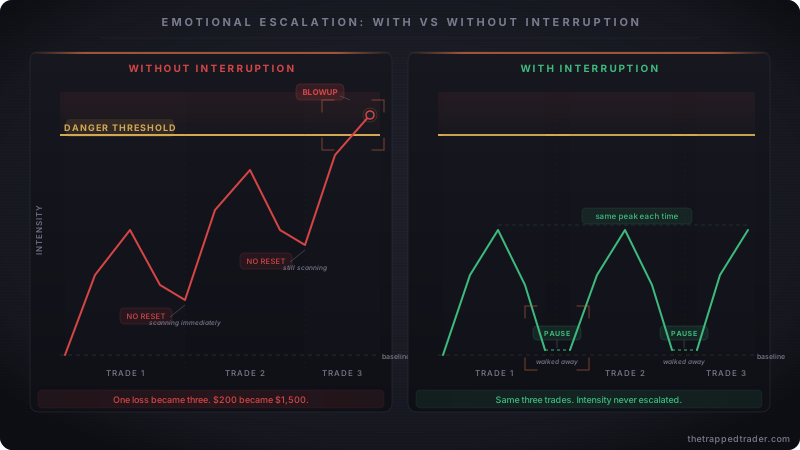
The losses don't cause the spiral. Skipping the Aftermath does.
Key Rules
- When you feel the urge to act mid-trade, name the stage out loud: "I'm in the Hold." That single sentence activates your analytical brain.
- Wait 10 seconds before any mid-trade action. Not 10 seconds of staring at the chart. 10 seconds of doing nothing.
- If your heart rate is elevated after a loss, you're still in the Aftermath. Do not scan for the next trade until it drops.
- Check your body: tight jaw, clenched fists, shallow breathing means your amygdala is driving. Lean back. Unclench.
- Wait at least 3 minutes between closing a losing trade and evaluating any new setup.
- After 2 consecutive losses, take a 10-minute screen break before any new trade.
In the next lesson, you'll look at the first specific emotion that derails trades: fear, not the obvious kind, but the quiet fear that stops you from taking a valid trade in the first place.