What Revenge Trading Actually Is
Revenge trading is the pattern of taking unplanned trades specifically to recover a loss. It's not just "trading while angry." Plenty of traders feel frustrated after a loss and still follow their process. Revenge trading is different because the motive has shifted. You're no longer trading your setup. You're trading your P&L.
Think of it like chasing a pickpocket. Someone grabs $20 from your pocket and you sprint after them, knocking over displays, breaking merchandise. By the time you stop, you've caused $200 in damage recovering $20. The chase cost ten times more than the theft.
Revenge trading feels rational because your brain is solving a problem: "I'm down $300, the market is still moving, I can make that back with one good trade." It's your brain's loss-aversion system hijacking your analysis. The amygdala hijack from earlier in this module is driving, wearing a disguise that looks like strategy.
I've revenge traded more times than I can count. Every single time, it felt like the rational move. Every single time, I ended deeper in the hole.
The Anatomy of a Tilt Spiral
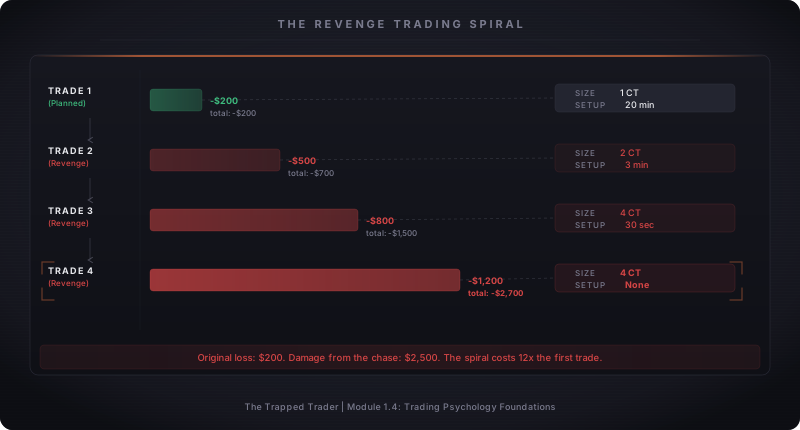
What makes revenge trading account-ending is that it rarely stops at one. Three things escalate simultaneously.
Position size goes up. 1 contract becomes 2, then 4.
Analysis time goes down. Your first trade involved 20 minutes of chart review. The revenge trade? Maybe 3 minutes. By the third, you're clicking entries the second a candle moves your direction.
Emotional intensity goes up. The first loss was frustrating. The second is infuriating. By the third, you're in survival mode. Your knowing-doing gap has widened into a canyon.
The Signals You're Already In It
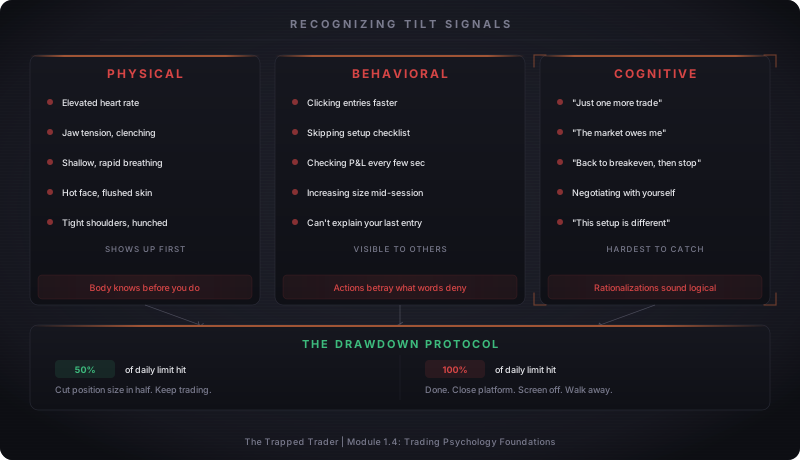
The hardest part is recognizing it while it's happening. Look for signals in three categories.
Physical signals show up first. Elevated heart rate, tense jaw, shallow breathing, hot face. Your body registers threat before your conscious mind catches up.
Behavioral signals are visible to anyone watching. Clicking faster. Not waiting for your setup. Checking P&L every few seconds.
Cognitive signals are the trickiest. "I just need one more trade." "The market owes me." "I'll stop after I get back to breakeven." If you're negotiating with yourself about one more trade, you've already lost. Screen off.
I wrote about this pattern in breaking the losing streak, including a full reset sequence for after you stop. Recognition is step one. You can't brake if you don't know you're accelerating.
Pulling the Emergency Brake
When you're in tilt, willpower isn't enough. You need a rule that doesn't require willpower.
The Drawdown Protocol from Module 1.3. Two tiers, no ambiguity:
- 50% of your daily loss limit hit: cut your position size in half for the rest of the session.
- 100% of your daily loss limit hit: done. Close the platform. Turn off the screens. Walk away.
The protocol works because it removes the decision from the moment you're least equipped to make it. No negotiation. The number hits, the rule fires.
UpSkalr tracks every rule violation and calculates the dollar cost. After a month, you can see exactly how much revenge trading cost you, not in theory, but in your own data.
Remember the math from Module 1.3 (Lesson 7): a 10% drawdown needs 11% to recover. A 30% drawdown needs 43%. Every additional revenge trade makes recovery exponentially harder.
Key Rules
- When you notice yourself rationalizing a trade after a loss, stop. That's revenge trading starting.
- At 50% of your daily loss limit, cut position size in half. No negotiation.
- At 100% of your daily loss limit, close the platform. Screen off. Walk away.
- If your heart rate is elevated and your jaw is clenched, you're in tilt. Don't click anything.
- Never enter a trade within 3 minutes of a loss. Set a timer.
- "I just need to get back to even" is the sentence that ends accounts. That's not a target. That's a trap.
- Keep your Tilt Response Plan printed and visible at your station.
Now that you understand the tilt spiral, the next lesson shifts focus: what does "winning" actually mean if you measure it by something other than today's P&L?