What FOMO Really Is
FOMO stands for fear of missing out. You're not afraid of the trade. You're afraid of the story you're telling yourself about what happens after the trade leaves without you.
I still deal with this. A level I've been watching gets hit, price bounces hard, and three candles later it's 15 points above my entry zone. Early on, I'd chase the move, slap in a market order with no defined stop, and watch price stall the moment I filled. There are only two clean options: take the first touch with a stop below structure, or wait for a pullback retest. Everything in between is chasing.
FOMO looks like greed, but it's a fear response. Your brain runs a fast simulation: "If I don't get in now, I'll feel terrible watching from the sideline." That simulated future regret overwhelms your rational process. You're not grabbing at profit. You're running from the imagined pain of missing out.
The Anatomy of a Chase Entry
A chase entry is a trade you take not because it met your criteria, but because you couldn't stand watching it leave without you. Chase entries aren't just emotionally driven. They're mechanically worse.
Your plan said enter ES long at 6,600 on a pullback to support. Price ran to 6,612. You enter there. Your stop still goes below support at 6,596: 16 points of risk instead of 4. Your target at 6,620 gives you 8 points of reward for 16 points of risk (0.5:1 R:R). From the planned entry, it was 5:1. Same market, terrible trade.
Entry: 6,600 | Stop: 6,596 (4 pts risk) | Target: 6,620 (20 pts reward) | R:R = 5:1
Entry: 6,612 | Stop: 6,596 (16 pts risk) | Target: 6,620 (8 pts reward) | R:R = 0.5:1
Same stop, same target, different entry. The 12-point late entry added 12 points of risk AND removed 12 points of reward. The R:R dropped from 5:1 to 0.5:1, a tenfold deterioration, from one decision.
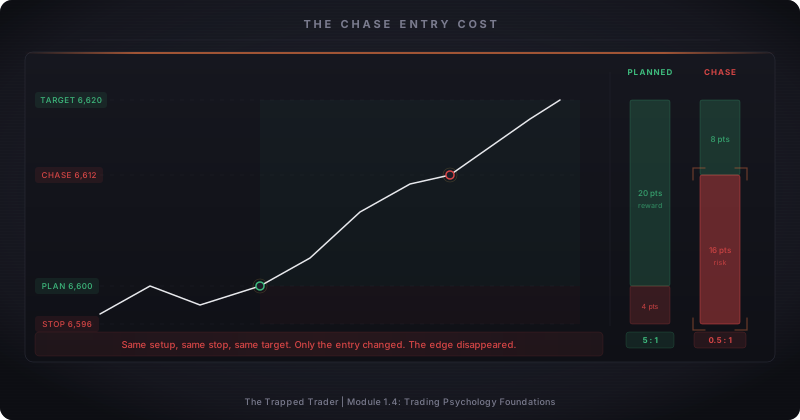
The math is always the same. Late entry, wider stop, worse ratio. Your edge evaporates.
The Scarcity Lie
FOMO works because your brain treats trading opportunities like they're scarce. That framing feels true in the moment. It's completely wrong.
A 5-minute ES chart prints about 78 candles per session. Nearly 400 per week. You don't need this trade. You need a valid setup.
Recognizing and Interrupting FOMO
FOMO has predictable triggers. Once you learn yours, you can catch them before they override your process.
- Watching a move happen in real-time. This trigger hits hardest. Seeing candles stretch without you creates immediate urgency.
- Social media or chat room callouts. Someone posts a winning trade screenshot. You think: "Why wasn't I in that?"
- A string of missed setups. You've passed on three valid trades today (maybe for good reasons, maybe from the fear we covered in Lesson 3). The fourth one starts to move, and the cumulative frustration boils over.
- After a losing trade. You want to "make it back," and the next move looks like the vehicle. FOMO provides the urgency, the loss provides the justification. That combination turns a single bad entry into a spiral.
UpSkalr tracks 9 cognitive biases including FOMO. Flagging it before you trade creates a paper trail that makes the pattern impossible to ignore.
Any structured delay, even 30 seconds, gives your prefrontal cortex time to catch up.
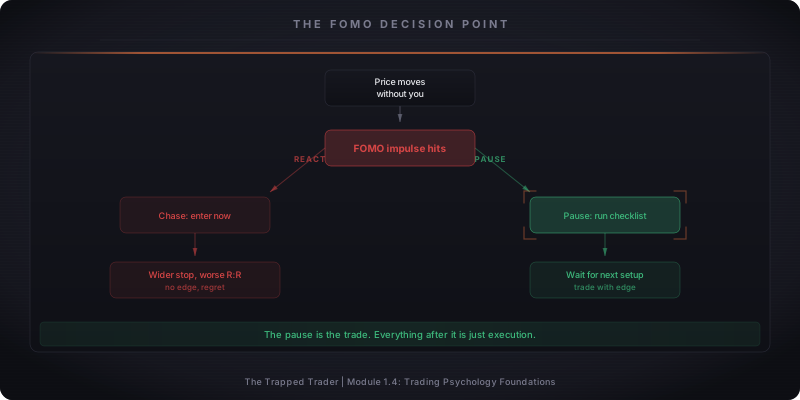
Your Pre-Execution Protocol (check size, check stop, check bias) doubles as a strong FOMO interrupt. Force yourself through all three checks before touching the buy button. If you can't answer all three, the trade isn't ready.
Key Rules
- When you feel the chase impulse, run the Pre-Execution Protocol before touching the buy button. Size, stop, bias. If you can't answer all three, don't enter.
- Never enter a trade that wasn't in your pre-session plan without a 30-second pause first.
- Calculate the risk-to-reward ratio at your actual entry price, not your planned entry. If R:R drops below 1:1, the trade is dead.
- A 5-minute ES chart prints 78 candles per session. Missing one setup costs nothing.
- "I'll just take a small position" is still a chase. Half-sized garbage is still garbage.
- After any FOMO entry, log the trigger in your journal: what you saw, what you felt, what you skipped.
Now that you understand how FOMO creates bad entries, the next lesson covers what happens when the damage compounds. Revenge trading is the spiral that starts when one chase leads to another.