Why a Trade Log Isn't a Trading Journal
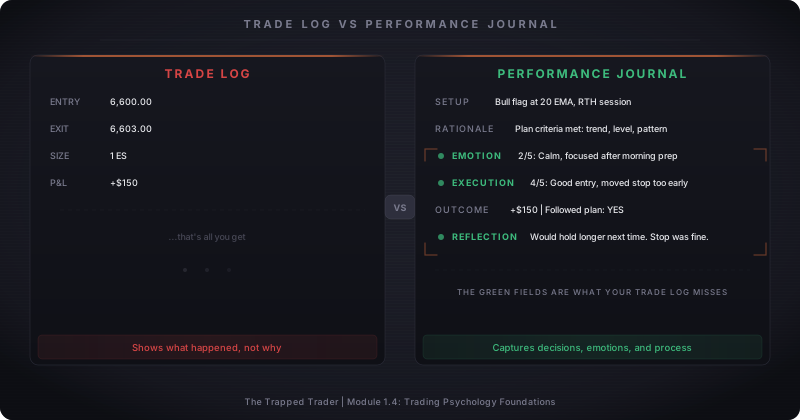
A trade log records outcomes: bought ES at 6,600.00, sold at 6,603.00, made $150. Useful for taxes. Useless for growth. Think of it like a flight recorder. Your trade log is the crash site. Your trading journal is the black box.
When I started tracking beyond entries and exits, I discovered that loss aversion was the root of most of my problems. Moving stops, averaging into losers, chasing entries: the journal revealed they all traced back to one thing. I couldn't accept a loss cleanly. That single pattern, invisible in my P&L, was driving my worst sessions. I built UpSkalr to track trade thesis alongside the emotional data that traditional platforms ignore.
Building Your Journal Entry
A useful journal entry captures eight things across three phases: before, during, and after the trade. Some are a number, some a sentence. Skipping any leaves a gap that makes pattern detection harder later.
Pre-Trade (capture BEFORE you enter)
1. Setup context. What did the chart look like? What session? Any news events approaching?
2. Pre-trade mental state. Rate three dimensions on a 1-10 scale: confidence (1 = no conviction, 10 = fully committed), stress (1 = relaxed, 10 = overwhelmed), and focus (1 = scattered, 10 = locked in). Three numbers, three dimensions.
3. Active biases. Scan the three bias categories below. If any bias is active, flag it. "FOMO from watching ES run 10 points without me" is actionable data. "None" is also valid.
During Trade
4. Trade thesis. Why do you believe this trade will work? Not which boxes were checked. What's your market read? "Going long ES at VAH because overnight longs are still in and the opening drive is with trend" captures the reasoning, not just the compliance.
5. Execution quality score (1-10). From Lesson 7: waited for setup, correct size, stop per plan, stop left alone, exited without emotional override.
6. Plan adherence. Which rules did you follow? Which did you break? Be specific.
Post-Trade (capture AFTER you exit)
7. Outcome. Entry, exit, P&L, hold time. Did the trade follow your plan, yes or no?
8. Post-trade reflection. What would you do the same? What would you change? This field gets skipped constantly, and it matters most during weekly review.
Tracking Your Mental State
Three dimensions give you something to chart over time. Confidence tells you about your conviction. Stress tells you about your emotional load. Focus tells you about your attention quality. A label matters too. "Stress 8, frustrated because I missed the earlier move" is actionable data. "8" by itself is noise.
Track all three dimensions at three points:
Before entry. If you write "confidence 3, stress 8, focus 4, want to recover morning losses" and still enter, the journal creates an undeniable paper trail.
During the hold. Did your stress spike? Did your focus drop? Did you move your stop?
After exit. If you followed the plan perfectly and still feel bad because you lost money, you're evaluating on outcomes instead of process.
Cognitive Biases: The Pre-Session Scan
Nine biases show up in trading journals over and over. They group into three categories of three.
Emotional biases (triggered by feelings): Revenge Trading, FOMO, Loss Aversion. These fire when your emotions override your plan.
Perception biases (distort how you read the market): Confirmation Bias, Recency Bias, Anchoring. These warp what you see on the chart.
Judgment biases (warp your decision-making): Overconfidence, Gambler's Fallacy, Sunk Cost Fallacy. These corrupt the decision itself.
Before each session, scan these three groups. If any bias is active, flag it in Field 3 of your journal. The entry creates a paper trail that makes patterns impossible to deny.
Mining Your Journal for Patterns
A single entry is a data point. The journal becomes a performance tool when you have 10-20 entries and start reading across them for recurring themes.
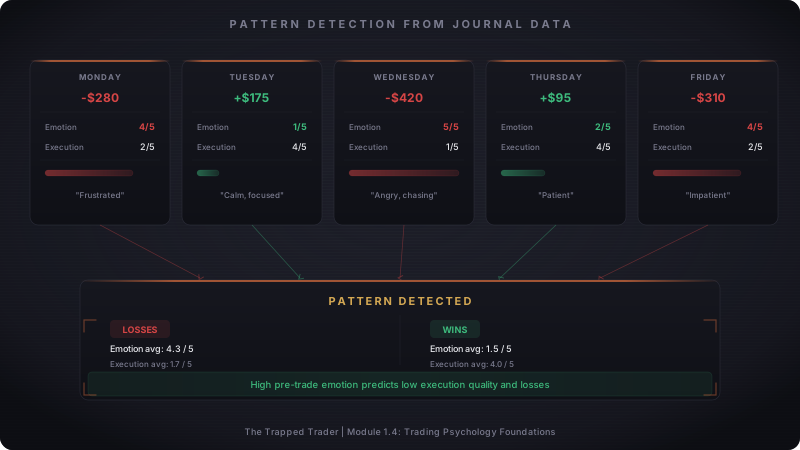
Common patterns: time-of-day effects, emotional carryover, better performance on one setup type, execution quality dropping when you increase size. None are visible in a trade log.
The Weekly Review
Set aside 20-30 minutes once a week. Read your entries as a coach, not as a trader. Three questions:
1. What recurring emotions appeared before my losing trades? Was there a common feeling or score? This often reveals your personal tilt pattern before it reaches the revenge stage from Lesson 6.
2. What was my average execution quality, and what brought it down? Look at entries scoring below 5. Was it stop placement, sizing, or entry timing?
3. What would I tell a friend who showed me these entries? If a friend showed you a journal where they entered 4 trades in 20 minutes after a loss, all at increased size, you'd say "revenge trading." Give yourself the same honesty.
4. Were my losing trades thesis failures or execution failures? A thesis failure means the market read was wrong. An execution failure means the read was right but you didn't follow through. The distinction changes what you fix.
I built UpSkalr around this exact workflow. You log the trade thesis, not 200 fills. The pre-trade check captures your mental state and flags active biases. Your weekly and monthly reviews pull from real data, not memory. That's the difference between a trade log and a performance journal.
The Monthly Review
Once a month, zoom out. Set aside 1 hour on the first of each month. Pull your month's data. Calculate expectancy, win rate, and average R. Compare to last month. Look for setup-type performance drift: is one setup carrying the others? Is a setup you keep taking actually losing money over 30+ trades? Monthly data smooths out the weekly noise and shows you whether your system is working, not just whether last week went well.
Key Rules
- Record all 8 journal fields after every trade across three phases: pre-trade (context, mental state, biases), during (thesis, execution score, plan adherence), post-trade (outcome, reflection).
- Rate confidence, stress, and focus on a 1-10 scale at 3 points: before entry, during the hold, after exit.
- Scan the 9 cognitive biases (emotional, perception, judgment) before each session. Flag any that are active.
- Conduct a 20-30 minute structured weekly review every week. Answer 4 questions: recurring emotions before losses, average execution score trend, what you'd tell a friend, and whether losing trades were thesis failures or execution failures.
- Run a monthly review (1 hour, first of each month). Calculate expectancy, win rate, average R. Compare to last month.
- If you notice high stress or low confidence correlating with low execution across 3+ entries, build a rule to address it.
- A single journal entry is a data point. You need 10-20 entries before patterns emerge. Don't draw conclusions from 3 trades.
Now that you can build a journal and mine it for patterns, the next lesson covers building a pre-trade routine, because the journal is where you track whether that routine is working.