
Why 93% of Prop Firm Traders Never Get Paid
In 2024, FPFX Technologies analyzed over 300,000 prop trading accounts across 10 firms. The numbers were brutal: only 14% of traders passed the initial challenge. Of those who got funded, less than half ever received a payout. Run the math and 7% of all traders across that sample achieved a single payout.
Seven percent.
If strategy were the issue, why would traders with profitable sim accounts fail the same evaluation three times? The answer has more to do with the sim-to-live gap than with any flaw in their trading plan.
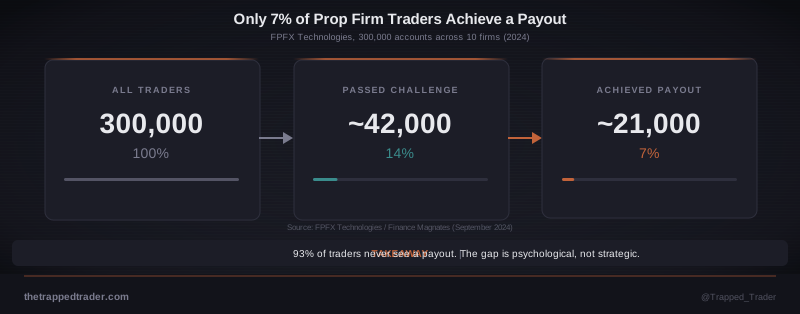
You've failed an evaluation? You're not in some small minority of incompetent traders. You're in the 93% majority.
And the traders in that 93% aren't all terrible. Most of them can pull up a sim account and execute just fine. The gap between sim performance and evaluation performance is psychological. Your strategy doesn't change between accounts. Your brain does.
The evaluation environment creates pressure that doesn't exist anywhere else in trading. You've got a real dollar amount on the line (the evaluation fee). You've got an artificial deadline creating urgency. You've got a trailing drawdown that punishes any normal losing streak.
And you've got a profit target that makes you feel like you need to trade, even when there's nothing worth trading.
That combination amplifies every psychological weakness you have. It pressure-tests your worst instincts for 30 straight days.
The 5 Psychological Traps of Prop Firm Evaluations
Every evaluation activates the same five traps. Whether you call it trading combine psychology or prop firm challenge mindset, the pattern is the same. You've probably felt all of them. Naming them is the first step toward disarming them.
1. Loss Aversion Amplification
Kahneman and Tversky's prospect theory research shows that humans experience losses roughly twice as intensely as equivalent gains. A $500 loss feels about as bad as a $1,000 gain feels good. That's baseline human wiring, validated across 19 countries.
In an evaluation, this gets worse. Every tick against you carries extra weight: movement toward a trailing drawdown that erases weeks of work, movement toward wasting another $150-250 evaluation fee. It's the kind of pressure that sends traders into a revenge trading cycle before they even realize what's happening.
So you tighten your stops too early. You cut winners short because you can't handle the pullback. You stop taking valid setups because the potential loss feels catastrophic, even when the math says it's well within your plan.
The reframe: A losing trade executed within your rules proves your process works regardless of outcome.
2. The Sunk Cost Trap
You're 18 days into a 30-day evaluation. You're up $1,200 on a $3,000 target. Then you take a bad loss and suddenly you're at $800.
The voice in your head says: "I've already put in 18 days. I can't let that go to waste." So instead of executing your normal plan the next day, you size up. You need to recover lost ground. You take setups you'd normally skip because you need the P&L.
This is sunk cost bias in real time. Those 18 days are gone whether you pass or fail. The smart play is to trade day 19 exactly like day 1. But your brain won't cooperate, because it's accounting for time already spent.
The reframe: Every day of the evaluation is day 1. The only thing that matters is today's execution.
3. Choking Under Pressure
You know that feeling when a setup you've taken a hundred times suddenly feels impossible? That's choking, and it's not a figure of speech. It's a neuropsychological response where increased stakes disrupt automatic performance. The skills you've trained to be second nature (reading price action, managing risk, executing entries) degrade when you're monitoring them too closely. Research backs this up: the higher the stakes, the more your brain interferes with what your hands already know how to do.
On a personal account, you execute your plan without overthinking each step. In an evaluation, you're hyper-aware of every tick, every position, every dollar of drawdown. That hyperawareness is exactly what degrades performance.
I've been there. During one evaluation, I had a textbook NQ long setup at a support level with multiple confluences: previous day's close, a Fibonacci level, and a volume shelf all lining up. On a personal account, I take that trade every single time. In the evaluation, I froze.
"What if it's a fakeout?" I waited for one more candle. Then another. By the time I had my "confirmation," the market had rallied 100 points. That's $2,000 on a single contract I left on the table, and a clean evaluation day turned into a zero because I couldn't pull the trigger on a setup I'd taken dozens of times before.
The reframe: If you're thinking about the evaluation during the trade, you're already choking. Execute your plan, then check the evaluation metrics at end of day. Not before. Not during.
4. The Comparison Trap
Open any trading subreddit or Discord after 4 PM ET and you'll see it: "Just passed my Topstep evaluation in 8 days!" Screenshots of funded accounts. Celebration posts.
You never see the failures. Nobody posts "Failed my 6th evaluation today, spent $1,400 total, still can't get funded." That's survivorship bias playing out in real time.
That $800 figure represents a normal experience, not a shameful one. But when every post you see is a success story, your own failures feel uniquely yours.
The reframe: The people posting their wins aren't showing you their first five attempts. The 93% don't post.
5. Target Fixation
Topstep's 50K evaluation has a $3,000 profit target. Once you know that number, your brain locks onto it. Every end-of-day P&L gets measured against $3,000. You start calculating: "I need $200 a day for 15 days." Trading becomes math homework instead of reading the market.
Target fixation pulls your focus from process to outcome. Instead of asking "Is this a valid setup?" you ask "Does this get me closer to $3,000?" Those are fundamentally different questions, and they lead to fundamentally different trades.
The reframe: Your job is to execute your process for 30 days. The profit target takes care of itself when the process is right.
The Shame Cycle Nobody Talks About
Nobody in the prop firm industry will say this out loud: the failure-shame-repeat cycle is baked into the business model. Traders fail, feel ashamed, wait a few weeks, convince themselves the next attempt will be different, and buy another evaluation. That average spend of $800 across 3 attempts? Recurring revenue.
I'm not calling prop firms scams. Many offer legitimate funded accounts and real payouts. But understanding the business model helps you see why the cycle persists. The firms don't need to manipulate you. The evaluation structure itself creates enough psychological pressure to ensure most traders fail repeatedly.
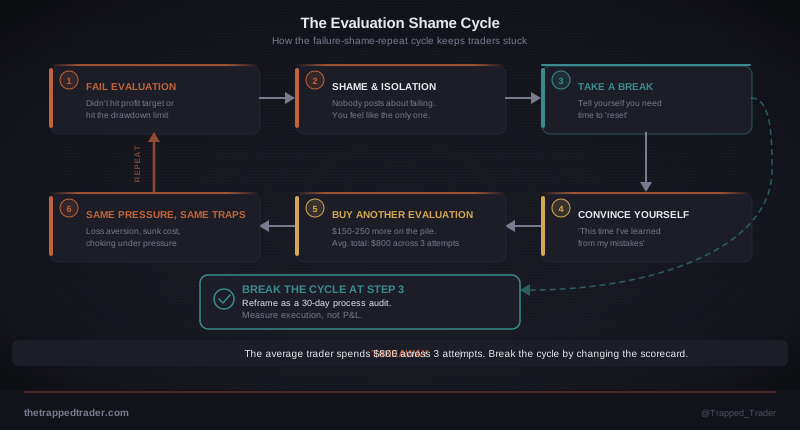
The cycle works like this: fail the evaluation, feel ashamed, tell yourself you need a break, spend a few weeks convincing yourself this time will be different, buy another attempt, feel the same pressure, make the same psychological errors, fail again. The cycle keeps going until the money runs out or the shame gets too heavy.
I've taken over 800 prop firm evaluations across Apex, Topstep, MyFunded Futures, Tradeify, and others. Eight hundred. I know the shame cycle because I've lived in it for years.
In September 2024, I had 20 Apex funded accounts and was on track for a combined $40,000 payout, money I personally needed at the time. Instead of following my rules, I started pressing. Oversizing. Chasing entries on NQ because I "knew" where it was going. I blew through drawdown limits on every account, and by the end of the day, that 40k locked-in payout was gone.
After that, I rebuilt by trading 1 micro NQ contract for weeks. One contract. Do you know how humiliating that felt? I'd been trading 3 to 5 contracts for months. My trading buddies were talking about their wins on minis, and there I was, back to the size I used when I first started.
But that humiliation was the beginning of something different: treating the evaluation as process practice instead of a test I needed to ace.
The shame compounds because nobody talks about it. Trading communities celebrate wins. Failures get silence. You're sitting there thinking something is fundamentally broken about you as a trader, while 93% of everyone who tries is in the exact same position.
The most damaging part: believing that everyone else can do this except you.
That isolation is what keeps the cycle spinning. Not the evaluation fee. Not the strategy. The shame.
The Evaluation as a Process Audit
I stopped treating the evaluation as a test. I started treating it as a 30-day process audit.
A test has a binary outcome, pass or fail. That framing activates every trap I described above. Loss aversion spikes because failure means wasting the fee. Sunk cost kicks in because you've "invested" days. Target fixation takes over because you're measuring against the profit target.
A process audit asks a different question: "Am I executing my trading plan consistently?" The outcome becomes data, not a pass/fail verdict. Every day gives you information about your execution quality, your emotional management, your risk discipline.
The Daily Scorecard
Before each trading day, run the Pre-Execution Protocol: check your size, check your stop, check your bias. If any of those three aren't clear, don't trade. That single rule would eliminate half the evaluation failures I've seen, because the worst evaluation trades happen when a trader doesn't have a clear plan but feels pressure to "get in."
Then, at end of day, score yourself on three metrics that have nothing to do with P&L:
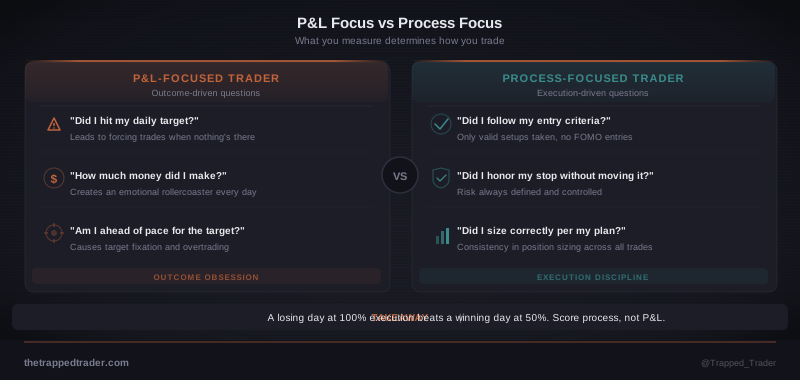
- Did I follow my entry criteria? (Yes/No per trade)
- Did I honor my stop without moving it? (Yes/No per trade)
- Did I size correctly per my plan? (Yes/No per trade)
A day where you went 3-for-3 on execution but lost $200 is a better evaluation day than a day where you made $400 by breaking two rules. The evaluation doesn't know the difference. But your development as a trader depends on knowing it.
I built UpSkalr specifically because I needed a way to track process metrics separately from P&L during evaluations. If you're journaling your evaluations, check it out. Tracking execution quality over time shows you whether you're actually improving, regardless of what the P&L line says on any given day.
What the Evaluation Is Actually Testing
Forget the profit target for a minute. What are prop firms actually selecting for?
Three things: risk management discipline, emotional stability under sustained pressure, and consistency over 30+ days. They don't care how you trade, what setups you use, or what timeframe you're on. They don't care whether you prefer ES or NQ.
The profit target exists to filter. The drawdown limit exists to measure. The consistency rules exist to separate traders who can execute for a month from traders who rely on one big day.
That last point matters. As of March 2026, Topstep's Trading Combine consistency rule says no single trading day can account for more than 50% of your total profits. On a $50K evaluation ($49/month Standard Path) with a $3,000 profit target, a $2,000 end-of-day trailing max loss limit, and a $1,000 daily loss limit, you literally can't pass by hitting a home run. You have to grind.
Prop firm rules and pricing change frequently. Verify current parameters on the firm's website before signing up.
Managing the Drawdown
The trailing drawdown is where most evaluation failures happen. Not because traders can't manage risk, but because the psychological weight of watching your drawdown floor rise with profits is uniquely stressful. Once you're underwater and trapped in a losing position, the pressure to hold and hope intensifies. You make money, the floor rises to protect the firm. Then a normal pullback threatens to catch you, and suddenly you're trading scared.
This is where the Drawdown Protocol applies directly:
- 50% of your daily risk budget used: Cut your position size in half for the rest of the day. You're not done, but you're trading smaller.
- 100% of your daily risk budget used: Done. Screen off. Walk away. No exceptions.
The traders who pass evaluations aren't the most profitable. They're the most disciplined. They can take a $400 loss on Tuesday and trade Wednesday exactly the same way.
They can see $1,800 in the account on day 20 and not start pressing for the final $1,200.
A losing day with clean execution still counts as progress. A winning day built on broken rules is borrowed time. That's what measuring process instead of P&L looks like in practice.
This is an educational example, not a trade recommendation. Your results will vary based on your own risk management and execution.
Your next evaluation doesn't need a better strategy. It needs a different scorecard. Measure execution, not dollars. Run the Pre-Execution Protocol before every trade. Apply the Drawdown Protocol when pressure spikes. Treat the 30 days as data collection, not a test.
The traders who pass aren't smarter or more talented. They've just stopped letting the evaluation change how they trade.
If you want more trading psychology frameworks like these, the Trader's Debrief newsletter goes out weekly. Check out the free lessons if you want structured courses on execution psychology. I'm always sharing real-time takes on X at @Trapped_Trader.