What Continuation Patterns Actually Tell You
The prior trend pushed price hard in one direction, then the winning side paused. The result is a temporary standoff: each swing gets smaller and the range compresses.
A triangle at a tested resistance level from Lesson 2 has a story: buyers keep showing up at higher prices while sellers defend a level that held before. The same triangle floating in the middle of an open range is just price wandering.
Triangle Patterns: Three Setups, One Mechanism
All three types share the same structure: two converging trendlines. What differs is which side is squeezing.
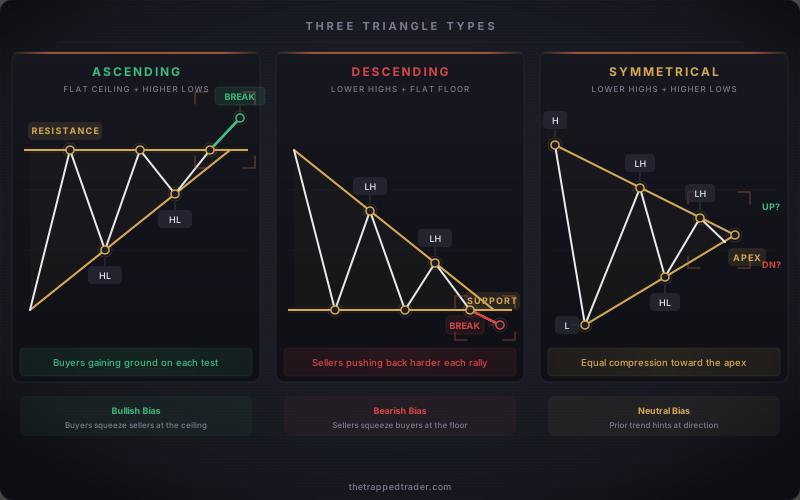
Ascending triangle: Flat resistance ceiling, buyers making higher lows. Leans bullish.
Descending triangle: Flat support floor, sellers making lower highs. Leans bearish.
Symmetrical triangle: Both lines slope toward each other at equal angles. Neither side has a clear edge. Resolution can go either way.
Textbooks support an upside bias for ascending triangles, but they don't filter by location. An ascending triangle forming at major resistance tested eight times on a higher timeframe tells a different story. Drawing triangle boundaries uses the trendline skill from Lesson 3: two touches per side minimum, three makes a line significant.
Flags and Pennants: The Pause After the Surge
Flags and pennants are faster than triangles. The pattern has two parts: a sharp move (the flagpole), then tight consolidation. That consolidation is either a flag (parallel channel, usually angled slightly against the trend) or a pennant (small symmetrical triangle).
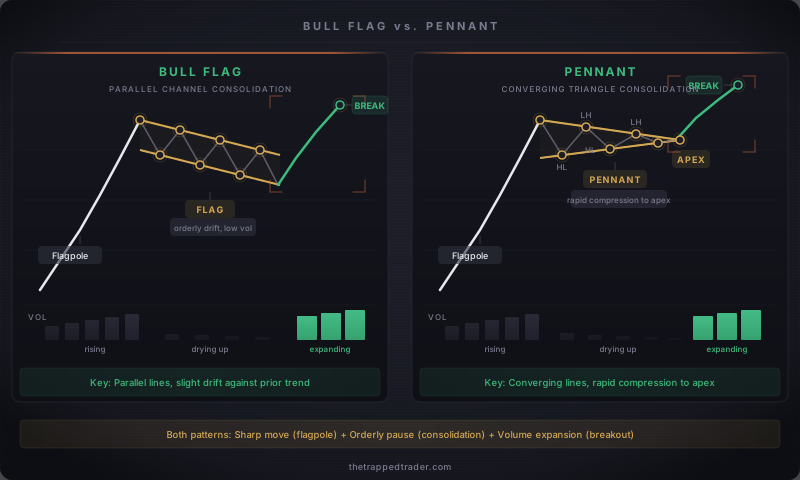
The key is volume. High on the flagpole, drying up during consolidation. If volume stays heavy during the pullback, it's not a flag, it's distribution. The shape is secondary. Volume behavior is primary.
Location: Signal or Noise
Your S/R analysis and trend structure must happen before evaluating any continuation pattern:
- Prior trend is clearly structured. If you can't label the swing highs and lows from Lesson 4, you don't have a trend. No trend means no continuation.
- Pattern forms at a meaningful level. If you can't name the level, the pattern lacks context.
- Breakout has room to run. If it slams into the next major level 3 points away, the risk-to-reward fails.
Evaluate location first, trend structure second, pattern shape last.
False Breakouts: Why Patterns Fail
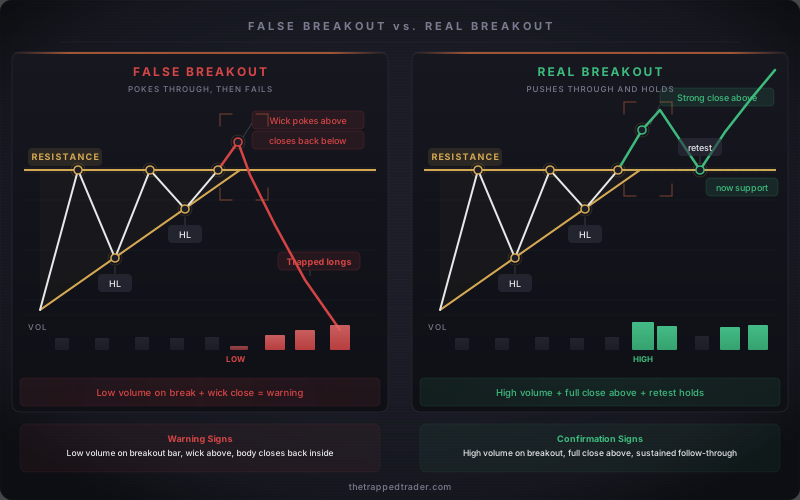
Most false breakouts share recognizable features:
Low volume on the initial push. Fewer participants committing. The breakout lacks fuel.
Immediate slowdown after the boundary. Real breakouts keep moving. False breakouts stall right above the boundary.
Failure to close on the right side. A wick through a boundary that closes back inside the pattern carries no weight. A breakout close, where the body is on the other side, does.
Waiting for the bar to close and watching volume don't make you miss the trade. They make you miss the trap. Read more in Trapped Traders: How to Spot and Stop the Cycle. Pattern boundaries are liquidity magnets. Sometimes price pushes through specifically to trigger clustered stops, providing liquidity for the opposite direction.
Key Rules
- Never enter inside a triangle or flag. The trade is the breakout, not the anticipation.
- A breakout on low volume is a warning, not a signal. Compare the break candle's volume to the prior 10-candle average.
- Confirm the prior trend before evaluating any continuation pattern. No trend means no continuation.
- A flag pullback deeper than 61.8% of the flagpole is not a flag anymore. It's a reversal developing.
- Name the nearest key level before trading any pattern breakout. If the breakout slams into resistance 3 points away, the risk-to-reward fails.
- If you can't draw the pattern boundaries with at least 2 touches per side, the pattern is not formed yet.
- Evaluate location first, trend structure second, pattern shape last. Reverse this order and you trade noise.
The Pre-Execution Protocol ties it together: before acting on any pattern breakout, check your position size, check where your stop goes, and check whether your directional bias is backed by the trend structure from Lesson 4. The pattern tells you compression is happening. Context tells you whether that compression matters.
Now that you can read continuation patterns and evaluate whether they carry meaning, the next lesson covers the opposite: reversal patterns. You'll use the same context-first logic, but you'll be watching for the moment when the winning side loses control.