Module 1.2·Lesson 4 of 10

Trend Structure: Highs and Lows

Read: 7 min | Full lesson: 28 minFree
40%

Support and resistance tells you where price reacts. Trendlines show you the path. But neither answers the most basic question in trading: is this market going up, going down, or going nowhere? This lesson teaches you the structural definition of a trend. Not gut feeling. Not candle color. A specific pattern of swing points that you can identify, label, and use to set your directional bias on any chart, any market, any timeframe.

Swing Points: The Footprints of Price

Before you can read a trend, you need to see the pieces that build it. Every price chart creates a series of peaks and valleys as price moves. Those peaks and valleys have names.

A swing high is a local peak where price pushed up and then reversed back down. A swing low is a local valley where price pushed down and then reversed back up. Together, they're the structural skeleton of every chart you'll ever read.

Think about tracking an animal through sand on a beach. You don't need to watch the animal walk to know where it went. The footprints tell you. If each footprint lands higher on the slope than the last, the animal walked uphill. If each lands lower, it walked downhill. If the footprints cluster in the same area, it paced back and forth without going anywhere. Swing points are the market's footprints. Read the pattern, and you know the direction without guessing.

In 'Candlestick Patterns That Actually Matter' (Lesson 1), you learned to read individual candles as buyer and seller pressure. Now you're zooming out. Single candles are letters. Swing points are sentences. You need both, but the sentences tell you more about where the story is going.

In 'Trendlines and Channels' (Lesson 3), you connected swing points with lines to visualize direction. This lesson takes the next step: instead of drawing lines between the points, you're reading the structural pattern the points form on their own.

Uptrend: Higher Highs and Higher Lows

An uptrend has one structural definition: each swing high is higher than the previous swing high, AND each swing low is higher than the previous swing low. That's it. Higher highs and higher lows.

Both conditions matter. Higher highs alone don't confirm an uptrend. If price is making higher peaks but lower valleys, that's expanding volatility, not a directional trend. The market is getting wilder, not committing to a direction. You need both higher highs AND higher lows for the structure to confirm that buyers are in control.

Why does this pattern mean buyers are winning? Because after each pullback, buyers step in at a higher price than last time. They're more eager. They don't wait for the same discount they got on the previous dip. That rising floor of higher lows tells you buying pressure is increasing, and each wave of selling gets absorbed at a higher price point.

Most beginners skip this and go by candle color. They see five green candles and call it an uptrend. This shortcut feels trustworthy because it works some of the time: when you see a row of green candles and price IS trending up, the correlation reinforces the habit. The problem is that green candle streaks also appear during countertrend pullbacks inside a downtrend, and you can't tell the difference by looking at the candles alone.

The candles are moving up temporarily, but the swing structure hasn't changed. Until you see a higher high AND a higher low at the swing level, a streak of green candles proves nothing about the trend. Candle color shows short-term pressure (Lesson 1). Swing points show structure.

Labeling Swing Points Step by Step
Identify the first swing high

ES hits 5,230 and reverses down. Label it H (first high, nothing to compare yet).

Identify the first swing low

ES drops to 5,215 and reverses up. Label it L (first low, nothing to compare yet).

Compare the next swing high

ES rallies to 5,245. Compare to the previous high (5,230): 5,245 > 5,230. Label it HH (higher high).

Compare the next swing low

ES pulls back to 5,225. Compare to the previous low (5,215): 5,225 > 5,215. Label it HL (higher low).

HH + HL confirmed. This is an uptrend. Each comparison is always against the most recent swing point of the same type: highs compare to the prior high, lows compare to the prior low. If either comparison fails (a lower high or a lower low), the uptrend label no longer applies.
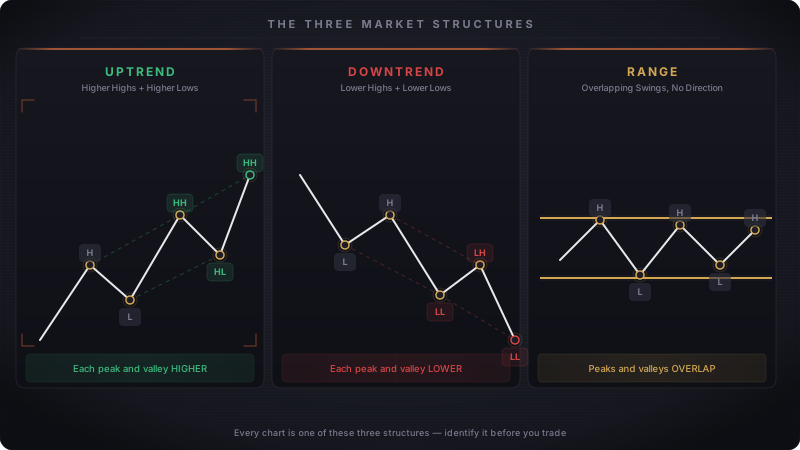
Comparison of three market structures showing uptrend with higher highs and higher lows, downtrend with lower highs and lower lows, and range with overlapping swings and no directional pattern

Downtrend: Lower Highs and Lower Lows

The downtrend is the structural mirror: each swing high is lower than the previous swing high, AND each swing low is lower than the previous swing low. Lower highs and lower lows.

The lower highs are the key tell. After each bounce, sellers push price back down before it can reach the prior peak. That falling ceiling of lower highs says sellers are more aggressive each time, and buyers can't hold their ground.

One practical difference between uptrends and downtrends: downtrends tend to move faster. Fear is a stronger motivator than greed. When a stock or futures contract starts falling, traders rush to protect capital. Panic selling creates sharp, fast moves.

Uptrends grind higher candle by candle over days and weeks. Downtrends can cover the same distance in half the time. You'll notice this the first time you mark up a chart with swing points: the uptrend side of a move takes twice as many candles as the downtrend side.

This speed difference has practical implications. If you're looking for downtrend structure breaks (a higher high that violates the lower-high pattern), they can happen quickly. Missing a few candles during a fast downtrend means potentially missing the reversal signal.

The Range: When There's No Trend

Most beginners assume the market is always either trending up or trending down. It's not. Markets spend a significant portion of time going sideways, and if you don't recognize it, you'll keep trying to trade trends that don't exist.

A range (also called consolidation or a sideways market) happens when swing points overlap with no clear direction. Highs aren't consistently higher or lower. Lows aren't consistently higher or lower. Price bounces between rough boundaries without committing to either side.

The tell is overlap. In a trend, each swing builds on the previous one in a clear direction. In a range, swings overlap with their predecessors. A high at 5,260, low at 5,230, high at 5,255, low at 5,235. The highs aren't getting higher. The lows aren't getting lower. Price is churning in the same zone.

Trying to trade trends in a range is one of the fastest ways to drain an account. You enter long, price chops down and stops you out. You flip short, price chops up and stops you out again. The market isn't moving against you personally. It's not moving anywhere. Learning to recognize range structure and sit on your hands saves more money than any entry signal.

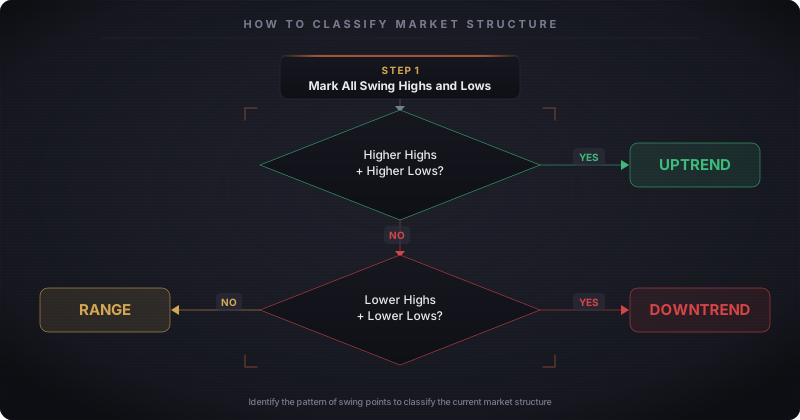
Decision flowchart for classifying market structure: check swing highs and swing lows for higher or lower patterns to determine uptrend, downtrend, or range

When the Structure Breaks

Trends don't last forever. At some point, the pattern of swing points changes. Recognizing that shift early is one of the most valuable skills you can develop.

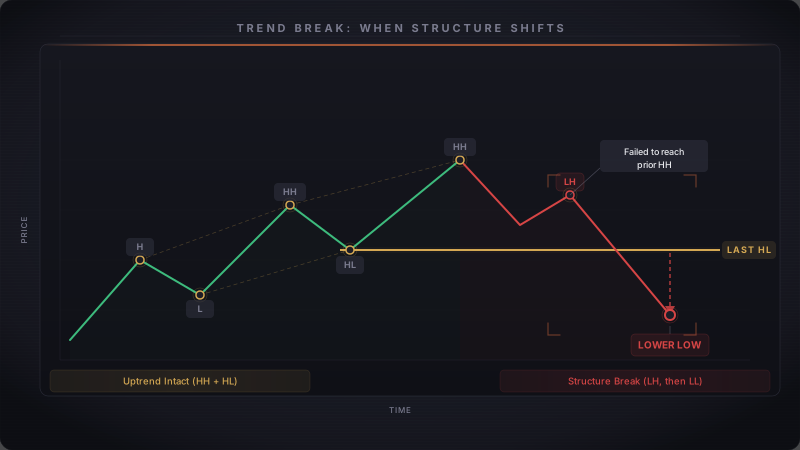
In an uptrend, the break signal is a lower low: price drops below the most recent swing low, violating the higher-low pattern. In a downtrend, the break signal is a higher high: price pushes above the most recent swing high, violating the lower-high pattern.

One violation doesn't mean the trend reversed. It means the trend has been damaged. Think of it as a crack in a wall, not a demolition. A single lower low in a strong uptrend could be a false break that gets bought right back. Or it could be the beginning of a reversal. You don't know yet. What you know is that the structural pattern is no longer clean, and that changes how much you should trust it.

In 'Support and Resistance' (Lesson 2), you learned that broken support often flips to resistance because trapped traders sell to exit at breakeven. The same principle applies to trend structure levels. If an uptrend has higher lows at 5,200, 5,220, and 5,240, and price breaks below 5,240, that broken higher low can flip to resistance. Trapped buyers who entered near 5,240 may sell if price rallies back, adding selling pressure at a level that used to attract buyers.

Annotated chart showing an uptrend with labeled HH and HL points that transitions to a structure break when price makes a lower high and then a lower low below the most recent swing low

This is what the 'check bias' step in the Pre-Execution Protocol means. Before every trade, identify the market structure. Is the trend intact? Has it been damaged by a structure break? Is the market ranging? Your answer shapes everything: which direction to trade, where to place your stop, and whether to trade at all.

Now that you can identify uptrends, downtrends, ranges, and structure breaks from swing points, the next lesson covers chart patterns: triangles and flags. These patterns form within the trend structure you just learned to read, and they signal when the market is preparing for its next directional move.

01Test

You’ve finished reading. Time to check what landed.

Check Your Understanding

1 / 4

1.Which sequence of swing points defines an uptrend?

02Practice

Knowing isn’t enough. Put it into practice.

Practice Exercise

Plan Writing·~15 min

Write a market structure assessment procedure that you'll follow before every trading session. Your procedure should have 5-7 numbered steps covering: which timeframe to check first, how to identify swing highs and lows, how to classify the structure (uptrend, downtrend, or range), how to check for recent trend breaks, and how this assessment sets your directional bias. Then apply your procedure to today's chart (or the most recent session) of ES, NQ, or any market you follow, writing out each step with specific prices and your conclusion.

03Reflect

Before you move on, anchor these ideas.