Module 1.2·Lesson 6 of 10

Chart Patterns: Reversals

Read: 9 min | Full lesson: 35 minFree
60%

Reversal patterns tell you one side of the market has exhausted itself. A head and shoulders, a double top, a rounding bottom: each describes a specific way that momentum died. But the pattern alone isn't a trade signal. Where it forms and what happened before it determines whether you're watching a real trend change or just noise on a chart.

Why Reversals Happen

In 'Chart Patterns: Triangles and Flags' (Lesson 5), you learned that continuation patterns form when a trend pauses to compress before potentially resuming. Reversal patterns are fundamentally different. They form when the trend doesn't just pause. It fails.

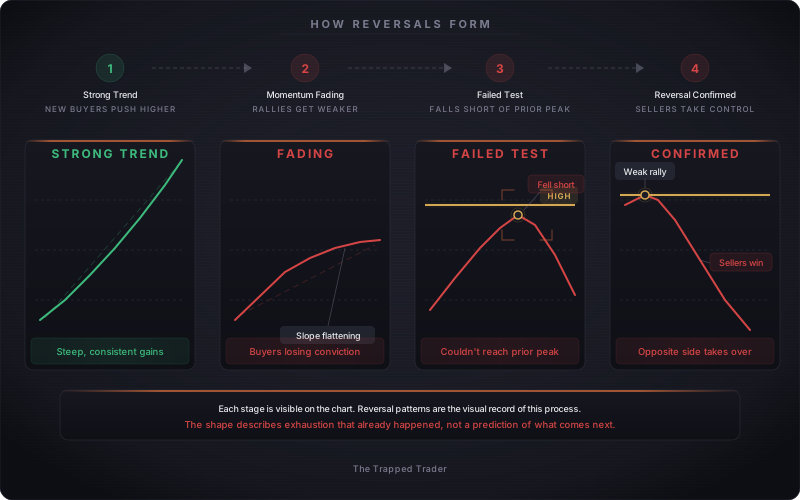
Here's the mechanism. Every trend needs a constant supply of new participants willing to push price further. In an uptrend, that means new buyers at higher and higher prices. Eventually, the supply of willing buyers thins out. The last group pushes price to a new high, but nobody shows up behind them. Price falls back. The next group of buyers tries again but can't match the previous high. That failure is the moment the chart records as a reversal pattern.

Think of it like a crowd trying to push a stalled car up a hill. At first, it's easy: plenty of people, gentle slope. But the hill gets steeper. People start dropping off. The remaining pushers slow down, each shove weaker than the last. Eventually they can't hold the car's weight, and it rolls backward. A reversal pattern on a chart captures that exact moment: the push that fell short.

This connects directly to trend structure from Lesson 4. In an uptrend, you see higher highs and higher lows. A reversal pattern starts forming when the most recent attempt at a higher high falls short. That's the first structural crack. The pattern is the chart's way of making that crack visible.

Flow diagram showing the four stages of a reversal: strong trend with new participants, momentum fading as fewer join, a failed test that falls short of the prior extreme, and confirmation as the opposite side takes control

Head and Shoulders: The Classic Reversal

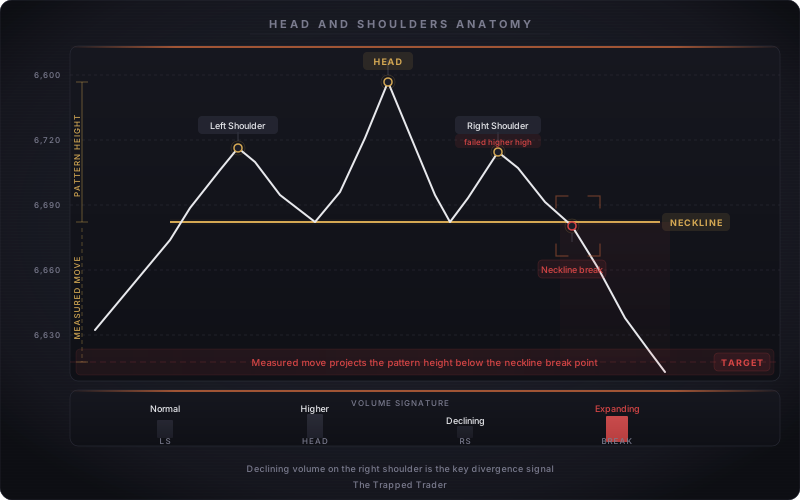
The head and shoulders is the most recognized reversal pattern, and for good reason: it tells a clear story of exhaustion in three acts.

Left shoulder: price rallies to a new high, then pulls back. Normal trend behavior. Nothing unusual yet.

Head: price rallies past the left shoulder's peak, making a higher high. Still normal. The trend looks healthy. But this is the peak where momentum appears strongest while actually being the last gasp: the final group of buyers pushing price to its extreme.

Right shoulder: price rallies again, but this time it falls short of the head. It might not even reach the left shoulder's level. This is the critical failure. Buyers tried to continue the trend and couldn't. The higher-high sequence from Lesson 4's framework just broke.

Neckline: draw a line connecting the lows between the left shoulder and head, and between the head and right shoulder. That's the neckline. It represents the support level that held during the pattern's formation. When price breaks below the neckline, the pattern is confirmed.

Annotated head and shoulders pattern showing left shoulder, head, right shoulder, neckline, and the measured move target projected below the neckline break

The neckline break matters because it's the point where former support becomes resistance. In 'Support and Resistance' (Lesson 2), you learned about support/resistance flips. That's exactly what happens here: buyers who defended the neckline on the two pullbacks have been overwhelmed. The level that held twice just failed.

Once the neckline breaks, you can estimate a price target using the measured move. The logic: the pattern's height (from head to neckline) projects below the breakout point.

Measured Move Target for Head and Shoulders
Identify the pattern's height

Head at 5,400. Neckline at 5,330. Distance = 70 points

Project below the neckline break

5,330 - 70 = 5,260 target

Dollar value on ES (1 contract)

70 points x $50/point = $3,500 potential move

The measured move target is 5,260, which represents a $3,500 move per ES contract. This is an estimate, not a guarantee. Use it for evaluating risk/reward before entering, not as a precision exit.

The answer: the distance grows to 100 points. Target: 5,300 - 100 = 5,200. Dollar value: 100 x $50 = $5,000 per contract. The deeper the neckline sits below the head, the larger the implied move, and the bigger the risk/reward picture for your trade.

The inverse head and shoulders is the same pattern flipped upside down. The easiest way to see it: mentally rotate any head and shoulders diagram 180 degrees. What was a peak becomes a valley. What was a high that couldn't be reached becomes a low that couldn't be broken.

In practical terms, an inverse H&S forms at bottoms: a low (left shoulder), a lower low (head), and a higher low (right shoulder). That higher low is the key. Just as the right shoulder in a bearish H&S shows buyers failing to push higher, the right shoulder in an inverse H&S shows sellers failing to push lower. The neckline break upward confirms the reversal from downtrend to uptrend, and the measured move math works the same way, projected above the neckline instead of below.

Double Tops and Double Bottoms

A double top is simpler than an H&S. Price reaches a high, pulls back, rallies to the same high again, and fails. Two tests of the same level, two rejections.

Why does the second test fail? Think about it from the perspective of the participants. The first time price hit that level, some buyers were willing to pay up. They bought, and price eventually moved away. The second time price reaches that level, those buyers already have their position. They aren't buying again at the same price.

Fewer new participants are willing to step in at the high. Meanwhile, sellers who sold near that level the first time got confirmed: the level held once, so they defend it more aggressively the second time.

In 'Support and Resistance' (Lesson 2), you learned that levels gain strength from repeated tests. A double top IS a level being tested twice from below. The pattern and the support/resistance concept are the same thing seen through two lenses.

The pattern confirms when price breaks below the neckline, which is the low point between the two peaks. Until that break happens, you're looking at a potential double top, not a confirmed one.
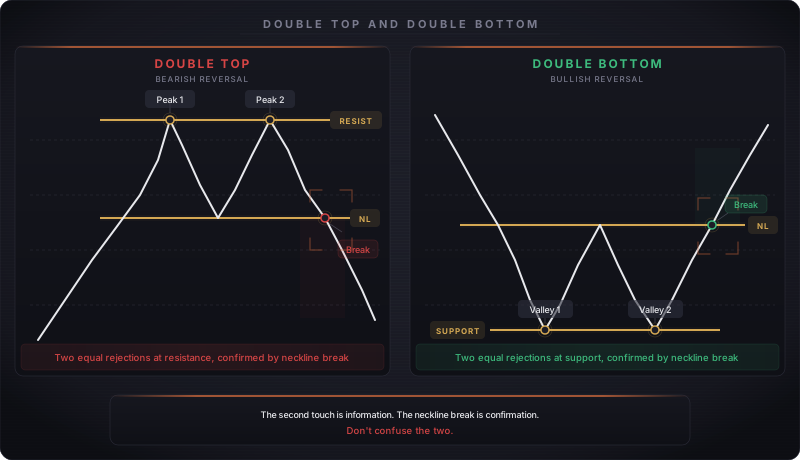
Side-by-side comparison of a double top pattern (two equal peaks with a neckline break downward) and a double bottom pattern (two equal valleys with a neckline break upward)

The double bottom is the inverse. Two tests of support that both hold, with a neckline break upward confirming the reversal. The same logic applies: sellers tried twice to push price lower and couldn't. The measured move calculation works identically: distance from the valleys to the neckline, projected above the breakout.

The three things to evaluate: where is it forming relative to key levels, how long was the preceding trend, and are the peaks making lower highs or staying roughly equal. Those three checks separate a continuation setup from an exhaustion signal.

Rounding Patterns: The Slow Turn

Not every reversal is sharp. Rounding tops and rounding bottoms show a gradual shift in sentiment rather than a decisive failure at a single level.

In a rounding top, price makes progressively smaller new highs. Each rally weakens slightly, each pullback gets a bit deeper. Over many candles, the chart literally curves over. Nobody can point to a single candle where "the trend broke." It just faded. Think of a ball thrown into the air: it doesn't stop instantly at the peak. It decelerates, pauses at the apex, and curves back down. A rounding top looks the same way on a chart.

A rounding bottom is the mirror image. Lower lows get progressively shallower. Selling pressure dries up gradually until buying interest takes over.

Comparison of a rounding top (price curves gradually downward from a series of weakening highs) and a rounding bottom (price curves gradually upward from a series of shallowing lows)

The key difference between rounding patterns and H&S or double tops is time. Head and shoulders and double tops can form over a few sessions. Rounding patterns often take weeks on a daily chart or hours on an intraday chart.

That slow formation makes them harder to spot in real time, but the gradual nature also means the reversal tends to carry more weight when it completes: the sentiment shift is deeper and more distributed across participants.

Rounding patterns don't have a clean neckline like H&S or double tops. Traders typically watch for a break of the prior trend's most recent swing point as confirmation. The measured move is harder to define precisely, so these patterns work better as a directional bias indicator than a specific entry trigger.

Context Makes or Breaks the Pattern

Every new trader learns to spot reversal patterns within a few hours of study. Identifying the shape is the easy part. Evaluating whether the pattern means anything is where most traders fail. Remember the stalled car on the hill: you could see the pushers slowing down, but you still needed to know how steep the hill was, whether more people were coming to help, and whether the brakes would hold before you could predict a rollback. The same logic applies to chart patterns.

Most traders assume that seeing a head and shoulders means the market will reverse. It doesn't. The shape is just a description of what price did. Whether it leads to a real reversal depends entirely on context. In 'Candlestick Patterns That Actually Matter' (Lesson 1), you learned that candlestick patterns describe past buyer/seller pressure, not future direction. The same principle applies here: reversal patterns describe exhaustion that already happened. They don't guarantee what happens next. Context determines whether that exhaustion leads to a genuine reversal or just a brief pause before continuation.

Three conditions separate valid reversal patterns from chart noise:

1. A preceding trend worth reversing. If there's no sustained trend before the pattern, there's nothing to reverse. An H&S shape forming inside a two-week sideways range isn't a reversal pattern. It's price bouncing within a box.

2. The pattern forms at a meaningful level. The level could be a previous support or resistance zone from Lesson 2, a round number, or a higher-timeframe reference point. A reversal pattern at a level where other participants are watching carries weight. The same pattern floating in the middle of nowhere doesn't.

3. Confirmation through a neckline break. The pattern isn't complete until the neckline gives way. This is the step most impatient traders skip. They see the right shoulder forming and enter early. Then the pattern fails, the trend resumes, and they're trapped on the wrong side.

Before trading any reversal pattern, run the Pre-Execution Protocol: check your size (reversal trades are counter-trend, so consider reducing position size), check your stop (above the right shoulder for shorts, below the right shoulder for inverse H&S longs), and check your bias (is the broader trend actually showing exhaustion, or are you trying to be the hero who calls the top?).

Now that you can read both continuation and reversal patterns, the next lesson introduces moving averages: a way to smooth out the noise and see the trend's direction more clearly. Moving averages won't replace what you've learned about raw price action, but they'll give you an additional filter for confirming what the chart is already telling you.

01Test

You’ve finished reading. Time to check what landed.

Check Your Understanding

1 / 4

1.What three conditions must be present for a reversal pattern to be considered valid?

02Practice

Knowing isn’t enough. Put it into practice.

Practice Exercise

Plan Writing·~20 min

This exercise has two parts. Part A: Create a personal reversal pattern evaluation checklist that you'll reference before trading any reversal setup. Your checklist must cover three sections: 1. Pattern Identification: What do you see on the chart? List the criteria for recognizing head and shoulders, double top/bottom, and rounding patterns. Include at least 2 specific visual markers per pattern type. 2. Context Validation: Why does this pattern matter here? Include all three context requirements from this lesson, plus at least one criterion referencing support/resistance from Lesson 2 and one referencing trend structure from Lesson 4. 3. Entry Criteria: When do you act? Include neckline break confirmation, a measured move target calculation step, and a Pre-Execution Protocol check (size, stop, bias). For each criterion, write one sentence explaining WHY it's on your list. Part B: Apply your checklist. ES forms a head and shoulders after a 180-point rally over two weeks. The head reaches 5,520, the right shoulder peaks at 5,490, and the neckline sits at 5,460. The head tested a prior weekly resistance level. Calculate the measured move target (show your work: head-to-neckline distance, projection, and dollar value per contract). Then run this setup through your Part A checklist: does it pass all three sections? Write a 2-3 sentence verdict.

03Reflect

Before you move on, anchor these ideas.