Module 1.2·Lesson 7 of 10

Moving Averages: The Smoothed View

Read: 9 min | Full lesson: 30 minFree
70%

Every charting platform puts moving averages in the default setup. They've been around for decades while countless other indicators came and went. There's a reason for that: when used correctly, they give you real information about trend context. The problem is "used correctly." Most traders treat moving averages as crystal balls. They see a golden cross and buy. They see price touch a moving average and assume a bounce is guaranteed. Neither of those things is what a moving average actually does.

Moving averages summarize where price has been. That's the whole job. They're backward-looking by design. Understanding that one distinction changes everything about how you use them.

What a Moving Average Actually Does

A moving average takes the closing prices from the last N candles, adds them up, and divides by N. Every time a new candle closes, it drops the oldest price and adds the newest one. The window shifts forward in time. That's the "moving" part.

A 20-period SMA on a daily chart holds the last 20 daily closes. Yesterday's close gets added; the close from 21 days ago gets dropped. Plot that calculated value on a chart, connect the dots, and you get a smooth line that follows price without the noise.

Here's the calculation so you can see the lag for yourself:

Calculating a 5-Period SMA
Gather the last 5 closing prices

$100, $102, $98, $104, $106

Add them together

$100 + $102 + $98 + $104 + $106 = $510

Divide by 5

$510 / 5 = $102

The 5-period SMA is $102, but the most recent close is $106. That $4 gap is the lag. The dip to $98 three candles ago is still pulling the average down, even though price has recovered and pushed higher. The SMA hasn't forgotten the old data yet.

That calculation shows the core issue with equal weighting: yesterday's extreme close has the same influence as today's close. For a trader trying to read current momentum, that's a meaningful limitation.

SMA vs EMA: Speed vs Smoothness

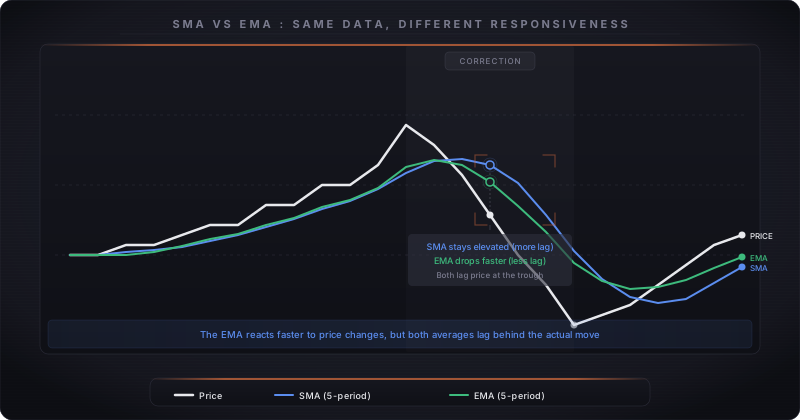
An Exponential Moving Average fixes the equal-weighting problem by giving more influence to recent closes. It applies a smoothing multiplier that weights the newest price more heavily than older ones. The further back a close is, the less it contributes.

Think about how you'd estimate the current temperature in a city. You wouldn't give equal weight to readings from last month and readings from yesterday. You'd lean heavily on recent data. EMA does the same: the most recent close carries the most weight, so the line moves faster when price does.

The practical result: when ES drops sharply, EMA drops faster toward actual price. When it recovers, EMA climbs back faster. SMA hangs further behind in both directions.

SMA vs EMA: EMA tracks price more closely during sharp price moves

The trade-off is noise. Because EMA reacts faster, it also reacts to every small wiggle. In a choppy, ranging market, EMA whipsaws more. SMA's lag becomes a feature in those conditions: it filters out the noise and keeps the line smooth.

This creates a natural split:

  • Day traders and momentum traders often prefer EMA: it reflects what's happening right now, not what happened two weeks ago.
  • Swing traders and position traders often prefer SMA: the smoother line is better for identifying structural trend direction and reducing false signals.

Neither is objectively better. The choice depends on what you need to see.

The Three Periods That Actually Matter

Most platforms let you set any MA period. Traders experiment: 7-period, 13-period, 21-period (Fibonacci), 34-period. You'll find forums dedicated to optimizing MA periods for specific markets.

What matters more than optimization is this: the periods that produce the most reliable chart reactions are the ones most traders are actually watching.

When thousands of prop traders, hedge funds, and retail accounts all watch the 20-period MA, reactions near that level become partly self-reinforcing. Buyers who use the 20 MA as their entry filter step in at the same zone. That buying creates real demand. A custom 17-period EMA might produce cleaner signals on a specific historical dataset. But if nobody else is watching it, the self-reinforcing mechanism doesn't activate.

Most beginners think Fibonacci-based periods work because of the math. They don't. The market doesn't care about number sequences. It responds to where other traders are positioned, and most traders are watching 20, 50, and 200.

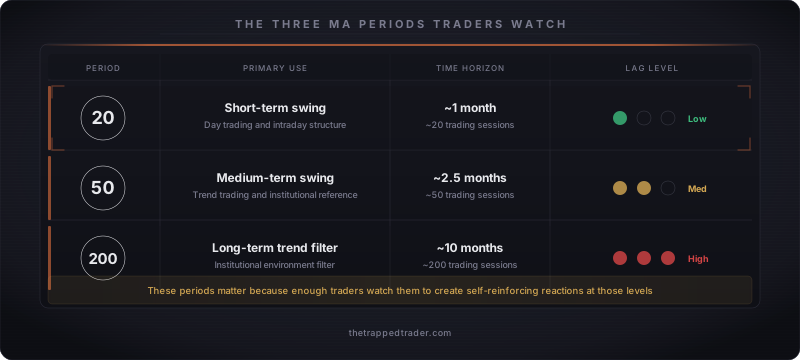
The 20, 50, and 200-period MAs: characteristics and primary use cases

20-period MA: Roughly one calendar month of daily trading sessions. Day traders and short-term swing traders watch this level closely. Price staying above the 20-period MA on a daily chart signals near-term bullish momentum. Breaking below it with conviction is often the first warning of a momentum shift.

50-period MA: Roughly two and a half months. Institutional traders and algorithmic systems frequently cite this as a meaningful reference. When an index or stock tests its 50-day MA after a significant run, the reaction there often signals whether the trend has real institutional backing or not.

200-period MA: Nearly 10 months of daily data. The long-term trend filter. Price above the 200-day MA is the baseline for a bullish structural environment. Below it is bearish.

Many institutional mandates are tied to this level in ways that create real buying and selling pressure. When ES approaches its 200-day MA, Bloomberg runs segments on it. That attention is the signal.

Moving Averages as Dynamic Support and Resistance

In 'Support and Resistance' (Lesson 2), you learned that support and resistance levels are price zones where supply and demand interact. Moving averages serve the same function, with one difference: they move.

A static S/R level sits at the same price forever. A moving average at $4,800 today might be at $4,850 next week, because the calculation constantly updates with new price data. That continuous updating is what makes it "dynamic."

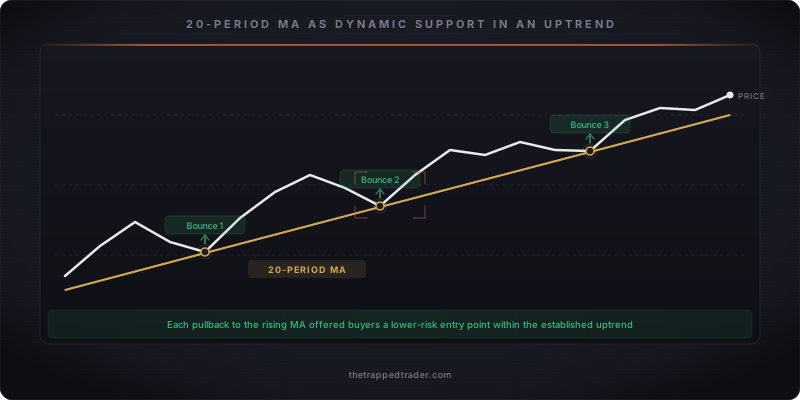
In a healthy uptrend, price doesn't go straight up. It makes a higher high, pulls back, makes another higher high, pulls back again. If the uptrend is real, those pullbacks often stop near the rising MA. Traders who missed the earlier move see price returning to a level they know others are watching, and they step in. That buying creates a bounce.

Moving average as dynamic support: price pulls back to the MA and bounces in an uptrend

This is where MAs become practically useful: not as signals themselves, but as context for where to look for entries. The MA pullback doesn't tell you to buy. It tells you where buyers have shown up before and might show up again. The candlestick patterns from Lesson 1 tell you whether they're actually showing up right now.

The dynamic S/R role works in reverse too. In a downtrend, the falling MA often acts as resistance. Price rallies back to the MA, sellers step in, and price gets pushed back down. The framework is the same: MA as the zone, candlestick pattern as the confirmation.

The Crossover Trap

You've probably heard the terms "golden cross" and "death cross." A golden cross forms when the 50-period MA crosses above the 200-period MA. A death cross forms when the 50 crosses below the 200.

These events get significant coverage. Financial media runs segments. Social media trading communities treat them as major signals. And most of the time, by the time the cross forms, the significant move is already largely complete.

The reason is simple math. A 50-period SMA averages the last 50 closes. A 200-period SMA averages the last 200. For the 50 to cross the 200, price has to sustain one direction long enough to pull a faster average through a slower one. That takes weeks.

By the time the 50-day MA crosses below the 200-day MA on ES, the index has likely already fallen 10-15% or more from its high. You're not getting early warning. You're getting a confirmation signal derived from two lagging averages of historical data, arriving after most of the move has already happened.

The crossover looks convincing because two lines crossing is a clear visual event. Before the cross, the faster average was below the slower one. After, it's above. That looks like a regime change on your chart, a definitive moment where the dynamic flipped. Your eye sees a before and after and interprets it as a signal.

Most beginners think: "The golden cross tells me the uptrend is starting." What it actually tells you: "Two averages of past prices have confirmed a trend that has been building for weeks or months." The distinction matters. If you enter long on a golden cross thinking you're catching the beginning of a move, you're often buying into the middle or end of it.

That doesn't make crossovers useless. As long-term structural context, "we're in a bear market confirmed by the 200-day MA being above the 50-day MA" is valid framing. But as a trigger for fresh entries, they're far too slow.

The correct mental model: moving averages are background context for the work you're already doing with price structure and candlestick patterns. They answer three questions: Is the trend environment cooperative with my trade direction? Is there a dynamic level nearby where buyers or sellers have historically stepped in? Are the MA periods aligned (all three stacked in one direction) or conflicting and tangled?

The next lesson covers breakouts and fakeouts, which is where this MA context starts to play a concrete supporting role. A breakout that closes convincingly above or below a key MA carries more weight than one that ignores it. Once you understand why breakouts succeed or fail, you'll see how MAs help filter the real ones from the traps.

01Test

You’ve finished reading. Time to check what landed.

Check Your Understanding

1 / 5

1.What is the key structural difference between a Simple Moving Average (SMA) and an Exponential Moving Average (EMA)?

02Practice

Knowing isn’t enough. Put it into practice.

Practice Exercise

Reflection·~15 min

Open a daily chart of any market you actively watch (ES, NQ, SPY, or any individual stock). Add the 20, 50, and 200-period Simple Moving Averages. Scroll back at least 6 months and complete these two tasks. Task 1: Find 3 to 5 specific instances where price pulled back to one of the MAs and either bounced or broke through. For each instance, write down the approximate date, which MA was tested (20, 50, or 200), whether price bounced or broke, and one sentence describing what the surrounding trend structure looked like at that moment. Task 2: Look at the current chart and describe the MA alignment in one sentence. Are the three MAs stacked in bullish order (20 above 50 above 200, price above all three)? Bearish order? Tangled together? Write what that configuration tells you about the current trend environment.

03Reflect

Before you move on, anchor these ideas.