What a Pullback Is (and Why It Happens)
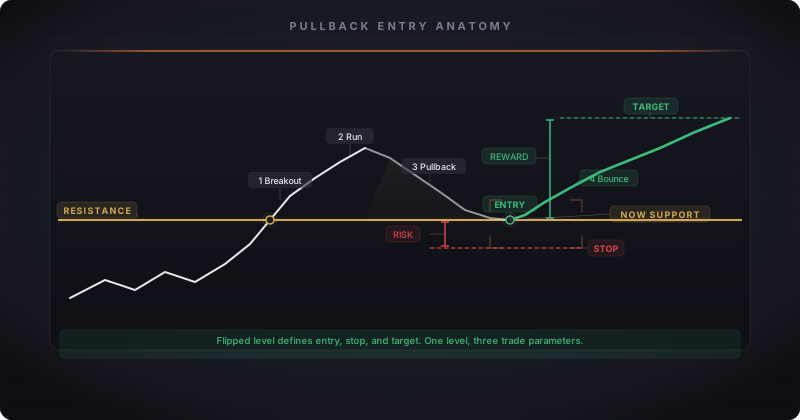
Price rarely breaks through support or resistance and keeps going in a straight line. It pauses, reverses a bit, and drifts back toward the level it just broke. That move back is a pullback. When price approaches the broken level and bounces, that's a retest.
Think of a running back breaking through the defensive line. He bursts through the gap, gets a few yards into the open field, then defenders converge and push him back toward the line of scrimmage. If his offensive line committed to the block, he bounces off their wall and breaks into the second level. If they didn't commit, he gets stuffed and the play is dead.
Price works the same way after a breakout: if enough traders committed on the break (strong volume, decisive candles), they'll defend the level when price pulls back. If nobody committed, the level gives way and the whole move unravels.
Three things drive pullbacks:
Profit-taking. Traders who caught the breakout lock in gains. Their sell orders (in an upside breakout) create temporary downward pressure that pulls price back toward the broken level.
Late demand. Traders who missed the breakout see price returning to "their" level. They step in as buyers at the old resistance, now support, creating the bounce.
Market breathing. No move is one-directional. Every impulse is followed by a correction. It's how price absorbs new information.
In 'Support and Resistance: Where Price Reacts' (Lesson 2), you learned that levels can flip: resistance becomes support, and support becomes resistance. The pullback is where that flip gets tested. If broken resistance acts as support on the retest (price bounces off it from above), the flip is confirmed, and you have your entry.
Why Pullback Entries Beat Chasing
When a breakout fires, the instinct is to jump in. Price is moving, volume is surging, and it feels like you'll miss the trade. But chasing has a structural problem: you're entering at the worst possible spot for risk management.
A pullback entry fixes three things.
You get a defined level. Instead of buying "somewhere above resistance," you're buying at the old resistance, now support. You know exactly where the level is because you've been watching it.
You get a tighter stop. Your stop goes just below the flipped level. If price pushes through it, the flip failed and your thesis is wrong. On a chase entry, where does the stop go? Usually it's either too wide (destroying your risk/reward) or too tight (catching a normal retracement).
You get double confirmation. The breakout happened AND the retest held. That's two structural signals instead of one. A chase entry only has the breakout.
What Makes a Good Pullback
Most beginners think every pullback to a broken level is a buy signal. "Price hit old resistance, now I go long." Here's why that feels right: you've spent this module learning that levels matter, that S/R flips are real, and that retests confirm direction. You absorbed those lessons well.
The trap is overcorrecting into "every level works every time." A pullback to a flipped level is a candidate, not a signal. Entering a weak one is just catching a failed breakout with extra steps.
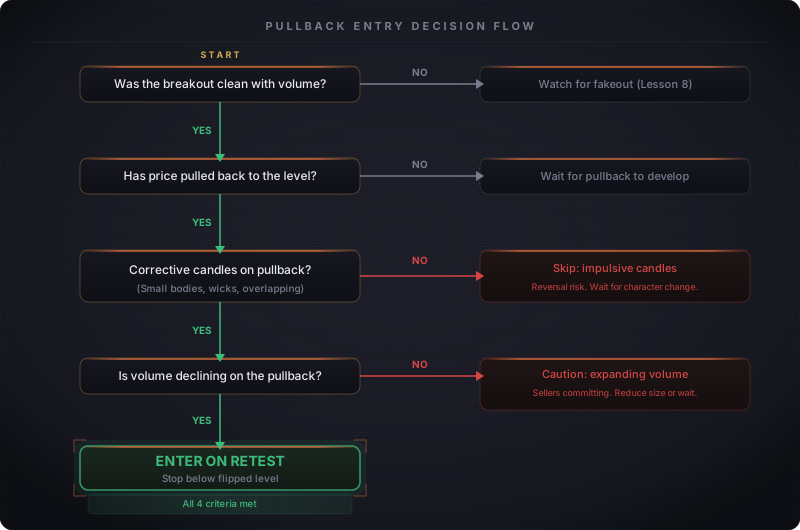
Score each pullback on four factors before committing. Rate each one from 1 (weak) to 3 (strong), then add them up.
1. Breakout quality (1-3). The breakout that preceded the pullback matters more than the pullback itself. Was it a clean break on volume, like you learned in Lesson 8? Or was it a weak poke above the level that barely closed through? A strong breakout means buyers committed. That commitment creates a pool of traders who'll defend the level on a pullback. A weak breakout means nobody committed, and nobody will defend anything. Score 3 for a clean break with above-average volume. Score 2 for a moderate break with average volume. Score 1 for a weak poke with below-average volume.
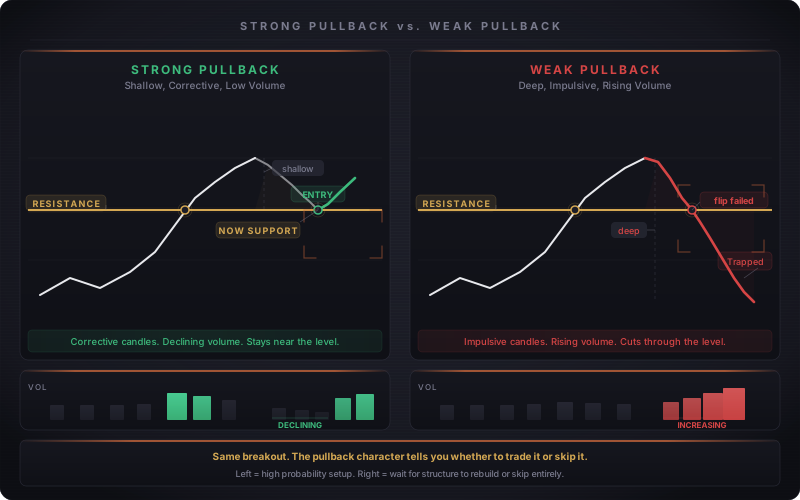
2. Pullback depth (1-3). How far does price retrace? A shallow pullback (barely touches the broken level before bouncing) tells you buyers are eager. A deep pullback (cuts through the flipped level and lingers below it) tells you the flip isn't holding. There's no universal ratio, but a pullback that overshoots the level by more than the size of the breakout candle is a warning sign. Score 3 for a shallow pullback that stalls at or just above the level. Score 2 for a pullback that touches the level and briefly dips through. Score 1 for a deep pullback that sits on the wrong side.
3. Candle character (1-3). This is the one most traders skip. Look at the candles on the pullback itself. Corrective candles (small bodies, prominent wicks, overlapping with each other) mean the move back is a natural breather. Impulsive candles (large bodies, minimal wicks, covering ground fast) mean sellers are in control. Score 3 for corrective, overlapping candles. Score 2 for mixed character. Score 1 for impulsive, directional candles.
4. Volume behavior (1-3). Volume should decline during a healthy pullback. Declining volume means fewer participants are selling: it's profit-taking, not a new move down. If volume increases on the pullback, sellers are entering aggressively. That changes the story from "natural retracement" to "potential reversal." Score 3 for clearly declining volume. Score 2 for flat volume. Score 1 for increasing volume.
Total: 10-12 = high-probability setup, take the trade. 7-9 = proceed with caution, tighten your stop or reduce size. 4-6 = skip it. The numbers aren't magic, but they force you to evaluate instead of react.
When Pullbacks Fail
Not every pullback bounces. Sometimes price returns to the broken level and keeps going, erasing the breakout entirely. Spotting a failing pullback early is the difference between a small stop-loss and watching your position fall apart.
Three red flags:
Impulsive candles on the pullback. If the move back to the level looks like a breakout in the opposite direction (large bodies, strong momentum, no wicks), it's not a pullback. It's a reversal forming. The candle character tells you everything: corrective movement back = healthy, impulsive movement back = trouble.
Increasing volume on the pullback. Volume confirms direction. In Lesson 8, you learned that volume validates a breakout. The same logic applies in reverse. If the volume on the pullback matches or exceeds the breakout volume, sellers are committing with equal force. That's not profit-taking. That's new supply entering the market.
Price lingering below the flipped level. A healthy retest touches the level and bounces within a few candles. A failing retest pushes through and sits there. The longer price stays on the wrong side of the flipped level, the more trapped traders accumulate above it, which creates additional selling pressure when they cut their losses.
You've now built every tool you need to read price action on a single timeframe: levels, trend structure, patterns, breakouts, and pullbacks. The final lesson in this module adds one layer on top. In 'Putting It Together: Multi-Timeframe Analysis' (Lesson 10), you'll learn to check whether a pullback setup on your trading timeframe aligns with the trend on a higher timeframe, so you're not buying a retest against the bigger picture.